

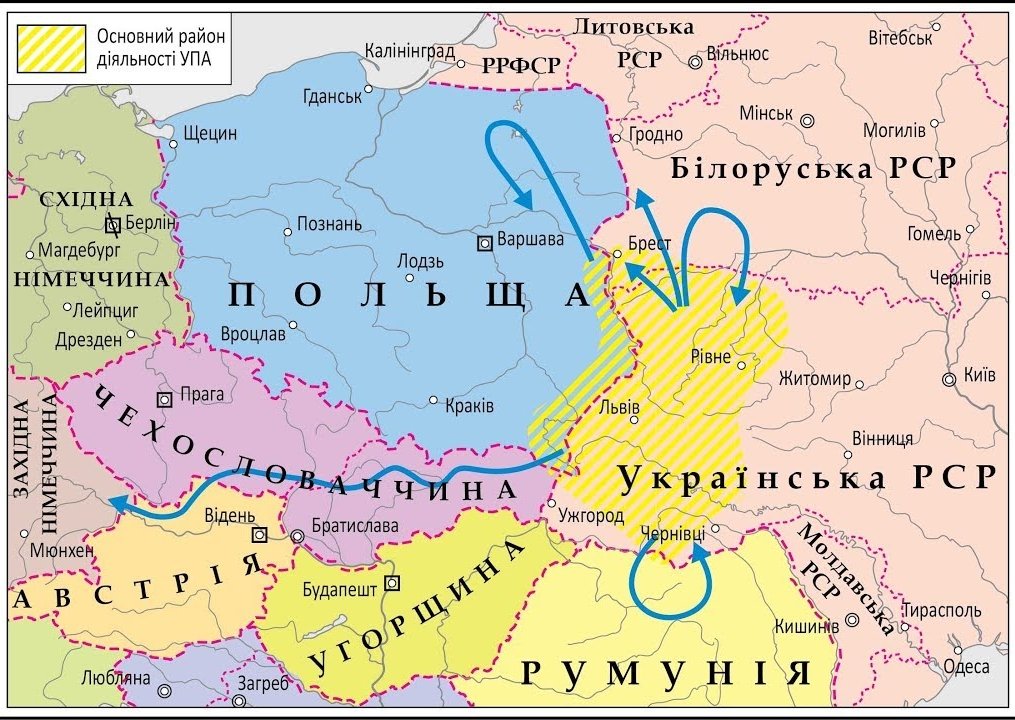
Question: In which countries and for what purpose did the UPA raid?
Answer:
The UPA, with its thoroughly progressive ideas, did not fight exclusively in its ethnographic territories but sought to ensure that these sacred ideas and struggles were known throughout the USSR and the world. The UPA, which set itself the goal of including all nations enslaved by the USSR in the armed struggle, carried out a series of raids into neighbouring countries. I know about the raids of our units in Belarus, Romania, Hungary, Slovakia, Poland and Lithuania (Vilnius region).
The task of the raiding units of the UPA was to impose friendship between the Ukrainian and neighbouring nations, to inform them about the liberation struggle of the Ukrainian people, their slogans and ideas, and to portray life in the USSR (mainly to those peoples who themselves did not survive the horrors of the Bolshevik regime). The next task of the UPA was to activate the anti-Bolshevik forces of these nations in a single anti-Bolshevik bloc.
During the raids, our units removed special literature in different languages that was distributed among the population. Our literature was also sent to prominent personalities of this nation who lived there legally.
2. What is the situation in Belarus according to the data of the UPA raiding units?
In the winter and spring of 1949, UPA detachments raided Belarus. The general communique about this raid says:
»In January. In Pinsk (BSSR), Ukrainian rebels planted a mine under the club building where a party meeting was taking place. All party members flew into the air. The Belarusian population is extremely hostile to Stalin’s hangers-on. It cannot come to terms with the Bolshevik occupation. When Ukrainian rebels come to these areas, the peasants obtain weapons and, together with the rebels or independently, carry out revolutionary actions. They burn village councils and kill Stalin’s minions. In connection with the revolutionary sentiments of the population in the spring of 1946, the local authorities in the Pinsk region issued a decree stating that anyone who talks about a possible war will be punished with 5 years in prison.”
The Belarusian collective farmer, who suffered so much during the German occupation from Stalin’s plunder partisans, met the Ukrainian rebels and declared: “You are ours because you don’t rob.”
3. If the UPA had any connection with the underground of the Baltic nation (Lithuania), then what information is there about the struggle for freedom of the Baltic peoples?
In October 1946, we (in Transcarpathia) had a message that our troops (UPA) in the winter and spring of 1946, which raided Belarus, also visited Lithuania, mainly the areas of the old Lithuanian capital Vilna. Then it was said that the Lithuanians welcomed the UPA units on their land in a friendly manner. This indicates that the relevant Lithuanian underground organizations have prepared their people for a friendly reception of UPA detachments raiding Lithuania.
Our revolutionary literature in Russian was distributed among the Lithuanians, which they eagerly read, and the fame of our troops and battles spread throughout the country. At the same time, communiqués stated that the Baltic nations were actively protesting against the deportation of Lithuanians to Siberia. They created militants who even operated in cities (Tallinn) and killed traitors to their people – local communists and members of the Communist Party sent by Moscow.
4. What does the UPA know about the struggle in the Caucasus?
In the fall of 1945, Red Army soldiers who were treated in the Caucasus returned and said that the Bolshevik authorities did not allow anyone to move beyond the hospital yard, explaining that in this territory the gangs that attack the Red Army soldiers kill and rob them. At the same time, our communiqués reported that an uprising was taking place in the Caucasus. Then the Chechens and Kabardians rose up en masse.
In the same year and the following year, 1946, mass evictions of these nations to Siberia were carried out. People were caught by deception, lured with all sorts of registrations, etc.
At the same time (in December 1945) the UPA radio station reported: “The uprising also covered part of Kuban, Georgia, and Azerbaijan. Revolutionary uprisings also take place on the Don in the region of Kalach and Novopechersk.“
Especially in the Caucasus, the struggle took on acute forms. Bolshevik Moscow sent large forces there and began to massively evict Chechens, Kabardians and other Caucasian nations. The struggle continued throughout 1946. During the mass deportation of these peoples to Siberia, as well as the Tatars (Crimea), the Bolsheviks accused them of collaborating with Hitler and the Banderite connections.
In Kuban, the Cossacks also responded warmly and actively. Cossack villages became strong strongholds in the fight against Bolshevism. This struggle obviously has its deep roots in the psyche of the Cossacks. This is evidenced by a song that originated among the Kuban Cossacks, and was sung already in the summer of 1946 in the western regions of Ukraine:
“Thunder clouds have spread into the sky
A shot rang out like thunder into the morning distance,
Hey, the fighting song sounds like a call
The free Kuban was shaken.
Don’t scream, my dear, we will scatter the clouds,
Let’s break up the commune – our enemy.
Hey, with unbreakable force, with a mighty blow,
We will sweep away the damned enemy.”
The history of this song is very interesting. One commander of a UPA squad, which consisted of Kuban Cossacks, retreated to Kuban in the fall of 1944. Already in the spring of 1945, this commander appeared in the Volyn forests with a whole unit of selected Cossacks. After staying here for some time, talking about the struggle of the Kuban Cossacks against the Bolsheviks, he again went with his squad to his native Kuban.
Question:
What information is known about such countries as Romania and Hungary, and were UPA raids carried out there?
Answer:
Romania and Hungary border the territories in which units of the UPA-South operated and these units carried out raids there. Both of these countries fell under the influence of the Bolshevik nobles. Stalin’s agents spread their false propaganda here, hiding behind the backs of the communist parties of these nations. But sensible elements of both mentioned countries did not accept the tempting words of their own and Stalin’s agitators but called on the people to fight the new invader.
There is an anti-Bolshevik organization in Romania, which has its own armed units. They acted most strongly in the area of the city of Iasi. In the cities, they carried out terrorist attacks against Bolshevik officers and party members. During UPA raids on Romanian territories south of Bukovina or in the Transcarpathian border strip, the Romanian population treated us with great sympathy. The Ukrainian rebels found sincere help and all kinds of support there. The Romanians hid the wounded, provided the necessary information, served as guides, etc.
Anti-Bolshevik forces are active in Hungary. The Hungarian population, enslaved by the Bolsheviks, sympathizes with our struggle. Here is a fact, and it is far from the only one, that illustrates the attitude of the Hungarian population towards the UPA. In the village of Kobiliauska Polana rebels staged a rally for the Hungarian population. The Hungarians present interrupted the rebel demonstrations with a storm of applause; they fully supported the struggle
UPA, and the youth, carried away by its ideas, themselves destroyed all the portraits of Stalin and his associates and the Bolshevik slogans that hung in the meeting hall.
In the spring of 1945, when I was on a raid in Transcarpathia, I also met Hungarians there who treated us friendly and helped us.
Question:
What is the situation in Poland and what is the relationship between the Ukrainian and Polish underground?
Answer:
Poland belongs to those newly developed states in which the Bolsheviks interfere most in their internal affairs. In Poland, Bolsheviks are visible everywhere. They can be seen in the administration, mainly in senior positions, in the MO (Police Obyvatelska), in the UBP, in the ranks of the KBB (Vennentshny Bezpechenstvo Corps), VOG1 (border guards) and BP. In the latest formations, they are not only in officer positions but also have their own people among the rank and file. Each Bolshevik officer organizes seksots, entangling them with “unreliable” officers – Poles. I remember how the Polish underground press wrote that out of fifty-odd Polish generals, there are only 9 Poles.
All headquarters are surrounded primarily by “older brothers.” Polish coal from Szlesk and manufactured goods go mainly to the USSR. Some Polish factories were dismantled and transported to Russia. Most of the Polish public at first regarded the Bolsheviks as allies, as liberators, and not as imperialists. Some Poles began to cooperate with the Bolsheviks in the fight against the Ukrainian national liberation movement and took an active part in the eviction of Ukrainians – west of the Curzon line, which the UPA strongly condemned as something that ran counter to the consent of both nations and corresponds only to the imperialist goals of the Stalinist clique and its agents. Stalin’s Polish agents successfully inflamed the passions of the Polish masses and incited them against the Ukrainians.
Those who followed these calls did not realize that they were thereby aiding the Bolshevik machinery.
In such a difficult situation, the UPA, led by the UGVR and faithful to its principles, with no less persistence and consistency, convinced of the correctness of its work and its usefulness for both nations, continued to explain to the Polish people that the Bolshevik imperialists were preparing enslavement for the Polish people, that the Polish people must renounce the imperialism and chauvinism artificially instilled in them and take the path of cooperation with other enslaved nations, and that the Polish people must discard all half-hearted, parliamentary methods of struggle, as inappropriate in the fight against Bolshevism and choose the revolutionary path of struggle.
Using this method, UPA detachments and cadres of the revolutionary OUN held many meetings, conversations, meetings with the Polish population and distributed their brochures, leaflets, and appeals in both languages. Special letters were sent to leading Polish citizens. Our statements were undoubtedly confirmed by life itself in the new reality.
The persistent and consistent work of the UPA in the Polish sector throughout 1945-46 gradually influenced the improvement of relations between both nations. We received letters from certain groups of the Polish population in which they spoke out for cooperation, sent their wishes to the UPA, denounced those who interfered with this cooperation, and condemned the crimes of the rogues of Polish society. In the Polish villages, our rebels were received very cordially and provided all kinds of assistance.
The UPA carried out a large explanatory campaign among the so-called. The Polish Army (V GG), which, under the command of NKVD officers, carried out the eviction and fought with the UPA.
The political action of the UPA, which began among the Polish people and troops, eventually led to the political-military cooperation of the UPA with Polish underground nationalist organizations and their armed detachments. Our UPA units, together with the Polish ones, fought against the eviction campaign, destroyed the Yenkavedist bandits and their Polish agents, freed prisoners, stood in defense of the civilian Polish and Ukrainian population, carried out joint political propaganda actions, etc. For example, on U.S. 27, 1946, the combined forces of Polish and Ukrainian detachments destroyed a strong center of Polish-Bolshevik robbers—the city of Grubeshov.—The action ended in complete success.
This question can be answered very broadly because I had the opportunity to speak with various echelons of Polish society and with underground figures, but this will not fit into the scope of this interview.
Polish Stalinist agents shouted a lot about mutual understanding and cooperation in the press. They understand perfectly well that mutual understanding between the Ukrainian and Polish nations and their close cooperation with other enslaved nations will put an end to their speculations and deal a decisive blow to their imperialist policy.
Question:
What impressions and facts did the raiding UPA fighters from Slovakia and the Czech Republic gain?
Answer:
Although the Czech army of 14,000 soldiers stood in the Duklja-Transcarpathia border strip and guarded the borders, our rebel groups easily sneaked between the outposts and found themselves deeper inland. In this case, we were assisted by the civilian population, who always informed us about the deployment of Czech units and guided us through dangerous territories.
In general, the Slovak population provided us with great help at every step, so we didn’t even notice that we found ourselves among a foreign population.
The majority of the Slovak population is anti-communist. They are mostly ardent admirers of Catholicism and follow their clergy, who cannot agree with those who deny religion. There are more communized elements in those areas of Slovakia where evangelicals live in compact numbers.
In one area I accidentally met a university professor and several engineers. I spoke with them the whole night and gave them our literature in different languages, which they very willingly accepted. They also showed themselves to be enemies of Bolshevism, complaining about the Czech communists, who, with the help of the Bolsheviks, seized power and dominated the Slovak people. They remember President Tiso and the times of independence with deep respect. Among us, there was also a second lieutenant of the technical units of the Slovak army, who stated “Slovak fighters will not fight against you because they have the same views as you.”
Near the town of L. Slovak soldiers met us in the forest. They did not shoot at us, but talked to us, treated us to cigarettes and said that they would not fight against us and that we should not shoot at them either.
The NB (police) came to one mill above Vagoya and said that if Bandera’s people came, they should be fed, shown the way, and in two days – report to them.
All of Slovakia, mainly the mountainous and forested areas, was overflowing with Czech troops, police and specially mobilized communist partisans. They blocked villages and carried out raids. For example, through the Low Tatras, starting from the Poprad River along Groc there was a firing squad. A similar execution station was located on the Polish border, along the Vagu, along the Magyar border. The section was led by Brig. General Nosko.
There were also outposts on the Morava. All of them sought to prevent our groups from entering the West.
In the areas of Bratislava, I met people from the Slovak underground organization. They helped us as if they were their own, giving us signalmen even abroad.
The Slovak population helped us with all our needs. Women brought us food into the forests, men took us from one area to another. When we were in the village, the peasants asked us to come to them and were offended if someone did not do this.
The peasants prepared food in advance and waited for the right moment to transfer it to us.
They all said:
“You are taking up arms against our common enemy, and we are grateful to you for this and will help you in any way we can.”
The Czech population received us worse. True, I did not go through the entire Czech Republic but was only in Moravia, but I saw that the Czech population was more communized. It informed the army where it saw us, and where we went. If they helped us, it was only members of opposition parties, but they were also afraid that someone might spy on us.
Question:
What is the attitude of the soldiers of the Soviet army towards the UPA and what is its state today (from a political point of view)?
Answer:
From the very beginning, the UPA paid special attention to the ranks of the Red Army, which were recruited from different nationalities of the USSR, because there were our brothers and brothers of other enslaved nations, whom Stalin’s servants threw into the fight against the revolutionary armed groups of the nations of the USSR. Although the Stalinist Goebbels spread the most false reports about the UPA orally and in the press, the Red Army soldiers who met directly with the population heard completely the opposite from them.
They read the same thing in our leaflets, which were published in various languages. Our great progressive ideas deeply penetrated the souls of millions of different people in Red Army uniforms. The result of this broad political work of the UPA among K.A. (Red Army) was that the UPA introduced the Red Army soldiers to the real goals of our struggle and influenced the friendly attitude of the Red Army soldiers towards the UPA. To prove this, I can say that the Red Army soldiers themselves distributed our literature, took it far to the east, refused to fight with us, and sabotaged the orders of their commanders.
Next, the Red Army soldiers popularized our struggle throughout the USSR. At the same time, everything was told in a truthful light. It is not surprising that today our struggle and our ideas are so widely known throughout the USSR. They awaken and push to fight everything revolutionary and patriotic in all peoples; they group around themselves the sympathies of all the enslaved peoples of the USSR.
In the end, our ideas served as the reason for a significant revolutionization of the Red Army and pointed to the need for a revolutionary struggle against the Stalinist imperialist clique. The Red Army soldiers are now loudly expressing their displeasure with the Stalinist regime and are no longer isolated, but en masse, and see a single solution – in the overthrow of this regime. The Red Army soldiers destroy party members, and Yenkavedists, hate officers and actively act in defence of the people.
In our underground literature, many facts were recorded that showed how the Red Army soldiers themselves dealt with the Stalinist executioners of the enslaved nations.
Many Red Army soldiers came to our ranks. They said that all the fighters of the enslaved nations hated the Stalinist regime and cursed the Stalinist collective farms, in which many people died of hunger in 1946. In the USSR everything is maintained only by terror. The Red Army soldiers and all the enslaved nations of the USSR curse Stalin and his clique of nobles and are waiting for the moment to deal with them.
(Translated from Russian)






