

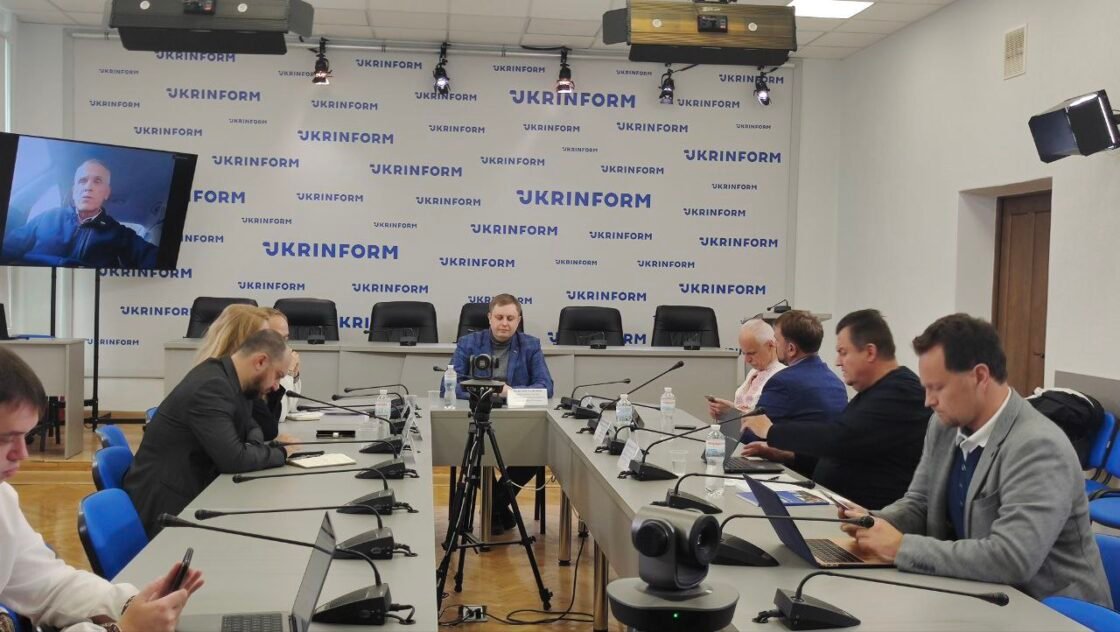
The discussion was moderated by Maksym Mayorov, a representative of the Centre for Strategic Communications . Opening the event, he noted that Ukraine is at war with a multinational country in which, in addition to the titular nation of Russians, many indigenous nations and ethnic minorities also live. Therefore, nations previously conquered by the empire are now forced to fight in this empire’s war of aggression for the sake of subjugating Ukrainians.
On the other hand, national liberation movements publicly supported Ukraine, and many representatives of these nations even joined the ranks of the Defence Forces for ideological reasons. Therefore, the national factor of the current Russian Federation plays a significant role in the war. This is not a new situation, because Ukrainians have a long experience of cooperation with the enslaved nations of the empire during the 20th century.
“In September 1917, the Congress of Enslaved Nations of Russia was held here in Kyiv. At the invitation of the Central Rada, their representatives from different parts of the former Russian Empire came to decide how to organize this political space and live on. It was the Ukrainians who initiated such an assembly. I hope that today we will confirm our reputation among the nations of Northern Eurasia and establish cooperation that will benefit both Ukraine and these nations,” said the StratCom employee.
The coordinator of the expert group “Cossack factor in the Russian-Ukrainian war”, professor of the Ukrainian Catholic University, Vadym Zadunaisky, spoke in more detail about how the nations of the former Russian Empire interacted at the beginning of the 20th century.
“As today, so then, the enslaved nations rallied around Ukraine. This trend persisted throughout the years of the Revolution of 1917-1921, and corresponding ideas spread to other regions as well. Novocherkassk (the capital of the Don Army, which proclaimed an independent state in 1918) and Katerynodar (the capital of the Kuban Republic, in which a separate Ukrainian revolutionary vector was formed with the support of Kuban Cossacks-Ukrainians) became important centres of generating similar approaches and ideas, following the example of Kyiv. Projects of interstate entities were developed and implemented here with the participation of the enslaved nations of the Caucasus and Ukraine, which was to become a guarantee of national cooperation and resistance to Russian imperialism,” the academic said.
Zadunayskyi emphasized the need to also remember the miscalculations of the national elites of the revolutionary era and their allies in order to avoid mistakes and achieve victory for Ukraine, enslaved nations and the entire democratic world this time. Arguments in favour of such a victory should be spread not only among the indigenous nations of Russia but also to convince the Western world of this. Everyone should understand that the future of the democratic system is being decided in Ukraine, which is impossible without justice and freedom of man and nation.
The historical excursion was continued by Volodymyr Vyatrovych , National Deputy of Ukraine and member of the Temporary Special Commission of the Verkhovna Rada on issues of developing the basic principles of state policy regarding interaction with national movements of small and indigenous nations.
According to the parliamentarian, “if we sum up the history of the 20th century, Ukrainian independence turned out to be the greatest threat to the empire. It was like this from the beginning, when Ukrainians first tried to create their state at the final stage of the First World War – during the Revolution of 1917-1921. Even then, the attempt of the Ukrainians started similar processes among other nations that were part of the former Russian Empire, and we see that this trend persisted and is actually continuing until now. There was an immediate understanding that the independence of Ukraine is an important factor for reformatting the empire, and on the other hand, the struggle of the peoples of Russia is an important element that can help Ukrainians to assert their independence.”
Vyatrovych noted that in the 1930s this opinion developed on a theoretical basis. It was actively promoted by the nationalist ideologist Ivan Mitringa – one of the creators of the later famous slogan “Freedom for nations! Freedom for the individual!”, which first appeared in the OUN manifesto of 1940. The thesis about enslaved nations as a key ally of Ukrainians is reflected in the decisions of the II Krakow Assembly of the OUN.
During the Second World War, Ukrainian nationalists had the opportunity to try to put these ideas into practice, which manifested itself, first of all, in the formation of national divisions of the UPA. This year will be the anniversary of the Conference of Enslaved Nations of Eastern Europe and Asia, held by the Ukrainian underground in the village of Buderazh in the Rivne region in November 1943. It adopted a platform of joint struggle against the two imperialist forces. Also, the UPA issued large volumes of leaflets in Russian addressed to the nations of Asia and the Caucasus.
Already in exile in 1946, representatives of the OUN initiated the creation of the Anti-Bolshevik Bloc of Nations (ABN), which united representatives of the nations not only of the Soviet Union but also of those who were under the power of communist regimes in Eastern Europe and Asia. The representative of the Ukrainian diaspora, Lev Dobryanskyi, proposed the concept of Enslaved Nations’ Week, which has been proclaimed annually by US presidents since 1959.
Vyatrovych noted that he is pleased to discuss the topic not only as a historian, but also as a politician, because the tradition established in the 20th century has continued in independent Ukraine. As confirmation of this, he mentioned two resolutions of the Verkhovna Rada, adopted in May 2019 and recently in October 2022, in support of the indigenous nations of the Russian Federation. An important step of the parliament was also the creation of the Temporary Special Commission (TSC) on issues of developing the main principles of state policy regarding interaction with the national movements of small and indigenous nations, of which he is a member.
The head of the aforementioned Commission, National Deputy of Ukraine Yaroslav Yurchyshyn said that the TSK was created by the Verkhovna Rada this year on the Independence Day of Ukraine. Its task is to form a state policy regarding the enslaved peoples of the Russian Federation and to create a demand for such a policy in the world.
To begin with, Ukraine should normalize the official conceptual apparatus, Yurchyshyn believes. There is a concept of decolonization, recently introduced into official circulation with the adoption of the Law “On the Condemnation and Prohibition of Propaganda of Russian Imperial Policy in Ukraine and the Decolonization of Toponymy”. This concept is quite common in UN documents but is unique to Ukrainian legislation, so it needs wider disclosure. It is also necessary to define the concept of an enslaved nation, the organization that represents the enslaved nation, and so on.
It is necessary to understand how to develop a policy towards the indigenous nations of the Russian Federation within the powers and capabilities of the authorities because Ukraine is first and foremost a state governed by the rule of law. Therefore, it is important to have official status and national armed formations that fight side by side with Ukrainians against the empire.
The area that is now called the Russian Federation is not a federation in its essence. Moscow keeps the regions and republics in bondage, suppresses the development of the national cultures of indigenous nations and pushes them against each other in order to maintain the role of arbiter. This can be contrasted with international law, in such principles as the right to self-determination and human rights.
The nations of Northern Eurasia must decide the form and content of mutual relations themselves. Ukraine can help enslaved nations with the implementation of democratic approaches to self-determination. At the same time, Kyiv is in no way going to replace Moscow.
Unfortunately, the West still believes that it is easier to coexist with one large terrorist pseudo-federation than with many different republics formed along ethnic lines. Ukraine has to change this vision.
Unfortunately, our international partners are once again in the grip of “I don’t understand – it’s better not to interfere”, and traditional fears of losing control over nuclear weapons prevail. Although in fact the transfer of nuclear weapons by Russia to Belarus clearly shows where exactly this threat comes from. Failure to realize that Russia is not only “good Russians”, meaning the official opposition, but a large list of adequate non-Russians, unfortunately, slows down the process of understanding of key partners: the United States, the European Union – the deputy explains.
At the same time, TSC is currently actively cooperating with those international partners who see the need for a policy regarding enslaved nations and are actively engaged in it. The visit of the Ukrainian parliamentary delegation to Lithuania took place recently, and it has already been previously agreed that an inter-factional association, or a Commission similar to the Ukrainian one, will be created in the Lithuanian parliament.
Akhmed Zakayev , the exiled Prime Minister of the Chechen Republic of Ichkeria, also focused on the legal justification of the decolonization of the Russian Federation . He recalled the historical circumstances of the collapse of the USSR, on the eve of which the status of the autonomous republics was actually legally equated with the status of the Union.
In 1991, the autonomies (Chechen-Ingushetia, Tatarstan, etc.) were preparing to sign a new Union Treaty together with Russia, Ukraine, Kazakhstan and other Soviet republics. This was prevented by the mutiny of the GKChP, and later by the formalization of the collapse of the USSR without the participation of the former autonomies. Later, in 1992, the Russian centre concluded a Federation Agreement with the republics of the former RSFSR, which is currently not in effect. Zakayev noted that this gives the republics a legal right to self-determination – in accordance with domestic legislation and the principles of international law.
The civilized dismantling of the empire is a task not only for Ukraine but also for the entire international community – believes the leader of Ichkeria. It was the Russian Federation that violated and violates all imaginable and unimaginable laws and regulations, therefore it deserves to be abolished. Only the victory of Ukraine and the military defeat of Russia can guarantee stability and security for all mankind.
Russia did not plan and does not plan to stop, and if anyone hopes that when Ukraine cedes some of its territories, then Moscow will calm down – then they are very mistaken – convinces Zakaev. He emphasized that it started back in 1994, and if Russia had been stopped in Chechnya then, there would not be all these victims in Georgia and Ukraine.
“I am very sorry that this war has started. I am very sorry that there are victims. But historically, it so happened that Ukraine undertook the mission to deal with this empire. Today, the Ukrainian people – whether they want it or not – have become the leader of the free world. The fate and future of all mankind, without exaggeration, are decided in Ukraine,” said the Chechen politician.
The government of independent Tatarstan was represented at the round table by Aida Abdrakhmanova , the Deputy Prime Minister for National and Religious Affairs. The Tatarstan government was founded in 2009 and operates in exile. It is currently headed by Rafis Kashapov.
Abdrakhmanova noted that she also represents the Volga Tatars in the League of Free Nations – a socio-political organization that unites leaders and activists of the national movements of the Russian Federation nations, who clearly envisage the future of their republics – only as independent, free and democratic states.
“We have been waiting for such support from Ukraine for a long time – since our strategic goal, one would like to hope, coincides – it is the victory of Ukraine over the Russian occupiers and the decolonization of the evil empire – the Russian prison of nations. We all understand that the point of no return of our nations as part of Russia has been passed. We now have perhaps the last chance in history to preserve our nations and revive nation-states. We understand that it will not be easy, but we also know the potential of our nations. The thirst for freedom still lives in our nations! And of course, we will not be able to do without external support ,” emphasized the Deputy Prime Minister of the Tatarstan government in exile.
She spoke about the experience of cooperation between Ukrainians and Tatars in the recent past. On March 21, 1992, Petro Perepust, head of the Moscow public association OUN-Rukh, took an active part in the organization and holding of the referendum on the sovereignty of Tatarstan. He was not afraid of numerous threats, right up to the threat of murder, and came to support the Tatars’ struggle for freedom. It was a great moral and psychological support for them at that time.
Abdrakhmanova is convinced: “Russia has never been a democratic state. It is not only unable to protect our rights, it is the first to constantly violate and destroy them. If we are committed to the ideals of freedom and democracy, then it is impossible to talk about the preservation of Russia, which itself trampled on these ideals. For us, the victory of Ukraine is not only an exit to the borders of 1991, because there will be no victory as long as there is a large country with revenge-seeking and chauvinistic ambitions next to Ukraine .
Another representative of the Idel-Ural region, Syres Bolyaen , who is the president of the League of Free Nations, took part in the round table. In 2019, the council of elders of the Erzyan people in Mordovia elected him Inyazor (chief elder). Bolyaen is an officer of the Armed Forces of Ukraine and a veteran of the Russian-Ukrainian war since 2014.
Inyazor described the modern war as a clash between two forces that are incomparable in terms of resources. The Russian Federation has many times more mobilization potential than Ukraine. Moscow is putting industry on military tracks, has intensified the ideological treatment of the population under control, starting from kindergarten. Russia is preparing to fight for a long time – until the complete exhaustion of Ukraine.
In order to defeat the enemy, Ukrainians should split it up – Bolyaen is convinced. The most vulnerable place of the Russian Federation are the nations enslaved by it. Today is not the time to ask: who is an ally and who is a fellow traveller of Ukraine? Ukraine’s future depends on whether it will be able to take advantage of the potential of national movements inside an enemy country.
“Ukraine will definitely win, I have no doubt! But today it depends on us, on Ukraine, on its government, first of all, what the price for our Victory will be, what the price for the freedom of the enslaved nations will be, and most importantly – who will pay for it. The Ukrainian soldier, the long-suffering Ukrainian people, or will other nations also contribute to their own freedom? Ukraine can give them such an opportunity!” – urged the leader of the League of Free Nations.
The enslaved nations consider Ukraine an ally, and the evidence for this is the fact that the Erzya, Tatars, Buryats, Oirats and Sakhas are already fighting in the ranks of the Defence Forces… September 26 was the anniversary of the death, in the battle near Bakhmut, of the Ukrainian soldier, delegate of the Erzyan National Congress Oleksiy Veshchevaylov with the nickname “Lady.”
Bolyaen called on Ukraine to strengthen work on information and propaganda: media channels, such as Voice of America and Radio Liberty, are needed, which would speak in the languages of indigenous peoples. It is necessary to promote the creation of support centres for national movements and provide them with protection and technical means. It is necessary to work with prisoners of war – to single out representatives of enslaved peoples from the general mass.
Inyazor criticized Ukraine’s support of primarily Russian, anti-Putin political organizations and armed formations. For the nations enslaved by Moscow, this is an alarming signal, because they are not satisfied with a simple “change of the sign” in Moscow. Replacing Putin’s regime with another one will not benefit Ukraine either – the Erzyan politician is convinced.
READ ALSO: Victory over Russia is in the interests of the entire free world
Dorzho Dugarov, adviser of the League of Free Nations on international affairs and a representative of the Buryat democratic movement “Buryaad-Mongol Erheten” in the European Union, commented on Russian policy towards enslaved nations .
According to Dugarov, Moscow is outwardly trying to pretend that it complies with its legislation and international obligations to ensure the rights of non-Russian nations. For this purpose, it expresses its care, in particular at the UN and other international platforms, over small indigenous peoples who do not have their own republics and attributes of statehood, and therefore do not pose a threat, in the view of the Russian leadership.
At the same time, the national republics, which were signatories to the Federal Treaty of 1992 and are subjects of the Russian Federation, are completely deprived of legal personality. Moscow directly governs all national republics, appointing their leadership, without looking back at the will of their citizens.
In fact, there is no federalism left in Russia. On September 22 of this year, the Government of the Russian Federation denounced the Framework Convention of the Council of Europe on the Protection of National Minorities. Even earlier, in 2020, amendments were made to the constitution declaring ethnic Russians the only “state-forming nation”. Thus, the status of all other nationalities, on whose behalf the Federation Treaty was signed, was automatically lowered. Russia has turned into a unitary state, in which national autonomies no longer have any rights and no subjectivity.
Therefore, the Buryat politician notes, there are legal grounds for extending the Declaration on Granting Independence to Colonial Countries and Nations, adopted by the UN General Assembly on December 14, 1960, to the indigenous peoples of the Russian Federation. The League of Free Nations appeals to Ukraine to recognize the national republics as occupied by the Russian Federation, and the national movements of their peoples as the only authorized representative subjects, expressing the right to self-determination, in accordance with the mentioned UN Declaration of 1960.
Separately, Dugarov focused on the role of the Buryat people in the Russian-Ukrainian war. The politician called the fact that many of his compatriots are fighting on the side of Russia a great tragedy. The Buryat national movement is making efforts to stop the participation of these people in the war and to draw their attention to the need to fight for the freedom of their own Motherland. The representative of the League of Free Nations recalled that one of the first public actions in support of the Ukrainian Euromaidan took place in Buryatia at the end of 2013. Buryat national activists were also among the first to support Ukraine in connection with Russian aggression in 2014 and 2022.
In addition to the Verkhovna Rada, central bodies of executive power also deal with the issue of enslaved nations in the Russian Federation. The Deputy Head of the State Service of Ukraine for Ethnopolitics and Freedom of Conscience, Ihor Lossovsky, spoke about the work of his institution in this direction.
With the participation of the State Service for Ethnopolitics, various events were held, in particular, Ukrainian-Chechen seminars in Ukraine and Belgium. Losovsky also prepared his own study entitled “Genocide in Russia: how Moscow “utilizes” its national minorities in the war with Ukraine . ”
Based on available sources, the official came to the conclusion that military losses among representatives of the indigenous peoples of the Russian Federation are disproportionately high, and this is not an accident, but a consequence of the Kremlin’s purposeful policy: to protect the main Russian population of Moscow and other megacities, drawing a potentially disloyal population into the war with Ukraine national borders.
Lossovsky believes that this policy can be qualified as genocide, although he had to argue with his colleagues from Germany for a long time about this.
Olha Volyanyuk , an analyst at the Prometheus Security Environment Research Centre, emphasized the value of an independent examination of the problems of the Russian Federation’s enslaved nations. The expert is convinced that system analytics is equally important for the public sector and developers of the international agenda, for national movements, and for the general public.
The consumer of mass information, as well as the academic environment, almost do not notice the differences on the modern ethnic map of Russia, and are under the influence of Putinism’s propaganda about the “barbarism” and “extremism” of non-Russians in the Russian Federation, at best – about the “ethnicity of the last hope”. On the other hand, daily monitoring of the Prometheus State Security Centre records the opposite trends – further institutionalization of the national movements of the Russian Federation, the development of representative bodies, statements about the formation of armed formations of enslaved nations, etc.
“The decolonization of Russia is not a fictional or even a fantastic prospect in the scenario tree. This does not necessarily have to be the result of the work of Ukrainian structures but is quite likely a natural continuing process. The world after the war must be predictable. In the 1970s and 1980s, Ukrainians played an important role in founding international associations and authoritative publications on Soviet studies in the West. Now is the time, with joint efforts, for the institutionalization of independent applied ethnopolitical research of the Russian Federation in Ukraine,” Volyanyuk emphasizes.
Yaroslav Chornohor , Director of the Program of Russian and Belarusian Studies of the Council of Foreign Policy “Ukrainian Prism” supported my colleague regarding the need to strengthen analytical and information support for the national movements of the Russian Federation . In his opinion, special attention should be paid to the training of translators: “It would be difficult for us to support those people with whom we cannot communicate in their native language. Using Russian is, after all, a legacy of colonialism. Of course, supporting cultural projects is also important .”
Montenegro noted the success of the process of forming national units, in particular two international legions, and in general, the creation of military units based on national characteristics.
“I think it is worth continuing this practice and expanding it. For this, I see the need to create institutional support for national movements, which would deal with the organization of state centres of anti-colonial orientation, training of state managers, teachers, and possibly officers,” the expert believes.
A very important task that should be especially emphasized is the solution of migration and related issues for our allies. They need to be worked out in more detail because it is precisely in this area that most problems have accumulated.
The event can be viewed in the recording at the link.
Note: for a quick information search please subscribe to our Telegram channel “Freedom for Nations!” https://t.me/ABN_Freedom_for_Nations
Also, read the Facebook materials of the ABN page and the group
Our site: https://abn.org.uaen/
SPRAVDI





