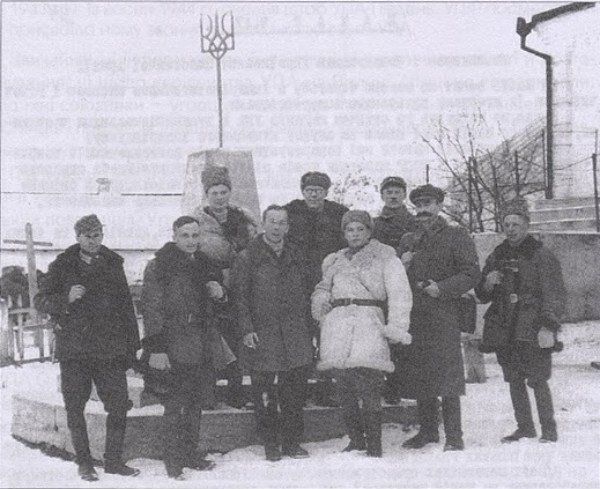
In August 1943, the Third Extraordinary Great Gathering of the OUN on Ukrainian Lands (OUN on UZ) was held in the territory of the current Koziv district of the Ternopil region. We are talking about the Bandera wing of the OUN, also known as the OUN of independent statesmen. Next, we will use the abbreviation OUN(b).
At this congress, the direction of nationalists to reinforce the creation of mass insurgent armed formations (UPA) was confirmed and a programme of open armed struggle against “the two imperialist occupiers – the Third Reich and the Soviet Union” was adopted.
Also, the participants of the Third Great Assembly of the OUN(b) adopted a number of documents regarding the need to democratize and modernize the political and ideological foundations of the OUN, in order to make them comprehensible and acceptable to a wide membership, including independent elements from the Transdnipro region, East and South of Ukraine.
At the Third Assembly, Roman Shukhevich was finally approved in two positions – 1) as the Head of the OUN Leading Bureau at the UZ, although he had performed these duties since May 1943, and 2) took on the role as the Commander-in-Chief, the OUN, and the Ukrainian Insurgent Army, united under the political leadership.
In August 1943, Ukrainian nationalists expressed the guidelines for their activities:
“…for cultural relations with other nations, for the departure of citizens abroad for the purpose of education, medical treatment and familiarization with the cultural heritage of other nations,
… for the full right of national minorities to nurture their own national culture, … for the equality of all citizens of Ukraine regardless of their nationality in all statutory rights and obligations, for the right to work, earn and rest,
…for cultural freedom, for heroic highly-spiritual morality, for general solidarity, friendship and discipline…”.
At that time, the UPA under the command of Shukhevych – “General Chuprinka” extended its military operations to all areas of Halychyna, Volhynia, and partly even to the Dnipro region, and many representatives of other peoples, who were enslaved by the Soviet authorities along with the Ukrainians, fought in its divisions.
UPA – workers’ and peasants’ army. Insurgent sociology
The reports on the UPA combats from the beginning to the middle of 1943 also mention the activities of the national divisions:
“…on June 25, 1943, in the three-day battles of the UPA detachment under the command of Kr. Kruk in the vicinity of Teremno in Volyn, in which the Stalinist partisan robbers, who had been attacking the civilian population for a long time, were completely defeated, the Georgian division was especially distinguished…”.
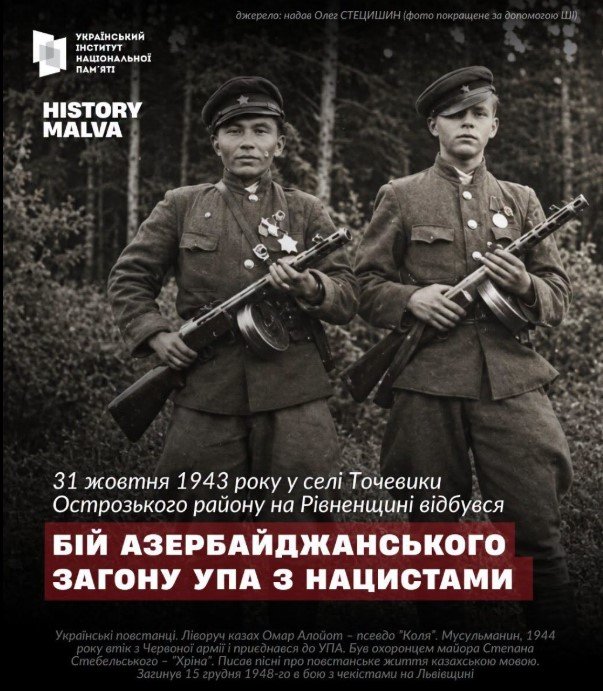
“…In August 1943, the UPA unit, also composed of Uzbeks, Georgians and Russians, destroyed 60 Nazi bandits in battles with the Germans in the Mlyniv district of the Rivne region…”.
“…on April 29, 1944, the national divisions under the command of Colonel Yastrub took part in a major battle between the UPA divisions and the NKVD troops in the village of Zaliznytsia in the Kremyanets region. In this battle, the enemy lost 240 killed…”.
So, a few months after the Third Great Assembly of the OUN, namely on 21-22 November 1943, under conditions of the strictest conspiracy under the auspices of the UPA, which operated under the political leadership of the OUN in the UZ, the First Conference of the Enslaved Nations of Eastern Europe and Asia was held.
It was a kind of meeting of political and military leaders and soldiers of the UPA, representing various peoples enslaved by the Soviet Union, with the aim of forming and strengthening the nationalist movements of various nations throughout the territory of the USSR and unifying their efforts in the fight against the common enemy – Moscow Bolshevism.
The conference of the enslaved nations of Eastern Europe and Asia, which took place in the UPA-controlled territories of the Rivne region – in the area of the villages of Buderazh, Ilyashivka, and Batkivtsi – brought together 39 representatives of 13 nations “enslaved by the Soviet empire” from various departments of the UPA.
Among them: 6 Georgians headed by “Karl”, 6 Azerbaijanis (the head of the delegation is “Fizul”), 5 Uzbeks (“Shimrat”), 4 Armenians (“Antrant”), 4 Tatars (“Tukai”), 2 Belarusians ( “Druzhniy”), 2 Ossetians (“Aram”), Kazakh (“Dezhkman”), Circassian (“Dzhigit”), Kabardian (“Baksan”), Chuvash (“Skvortsov”), Bashkir (“Kagarman”).
UPA against the Nazis. Battle near Zagorov
Also, five Ukrainians – representatives of the leadership of the UPA and OUN at the University of Ukraine – came to the conference.
Among them: a member of the Bureau of the Main Branch of the OUN at the UZ Rostyslav Voloshyn, a member of the Main Branch of the OUN Yakiv Busel, the propaganda officer of the regional branch of the OUN PivdSUZ (South-Eastern Ukrainian Lands) in Dnipropetrovsk Omelyan Logush, as well as the first commander-in-chief of the UPA Dmytro Klyachkivskyi and an activist of the OUN Kateryna Meshko (Logush).
In addition to the official delegates, Roman Shukhevych – Chief Commander of the UPA, head of the OUN Branch in Ukrainian Lands also arrived at the conference.

| From left to right: Roman Shukhevich, Dmytro Hrytsai and Kateryna Meshko-Logush – in the vicinity of the village of Buderazh, Rivne region, November 1943. |
Omelyan Logush (pseudonyms – “Yugen”, “Ivaniv”, “Stepaniv”) later recalled:
“… The convening of this conference was persistently sought by representatives of the revolutionary underground in southern and eastern Ukraine, who worked in areas with a large number of national minorities or in the neighbourhood of the territories of other peoples enslaved by Moscow.
In Volyn, this case became relevant also due to the fact that there were many soldiers of non-Ukrainian origin in the UPA divisions, and there were even some separate national divisions, such as Azerbaijani, Georgian, and Uzbek.
Taras Chuprinka, having recognized all the validity of the theoretical concept of a common front of nations enslaved by Moscow, immediately became interested in a purely practical issue. He was particularly interested in the real possibilities of spreading insurgent actions on the territory of other enslaved nations, and what could be done for this matter in the UPA:
“We chose the right path. From today, our struggle for independence is not an isolated struggle of one nation, but a revolution in the East of Europe and Asia for the freedom of all enslaved nations and for a new order in this part of the world”…”.
(Magazine “Liberation Path”, 1970, part 3 (264). – pp. 347-349).
Omelyan Logush himself, one of the organizers of the Conference and a later member of the Ukrainian Main Liberation Council, about whom, unfortunately, little is known to the Ukrainian reader, should be mentioned separately.
He was born in 1912 in the village of Predmistya near Yazlovets (Ternopil Oblast), later became a student of the agronomic faculty of the Lviv Polytechnic University, and from the fall of 1937 to March 1939 he was a leading activist of the semi-legal union of Ukrainian student organizations, became the leader of the OUN of the Lviv Polytechnic University, was arrested by the Polish police in March 1939 for his underground activities, and was released in September of the same year.
Subsequently, Logush became a member of the Ukrainian National Committee (UNC), which was established in Krakow in June 1941, and with the beginning of the German-Soviet war, he became the propaganda officer of the regional branch of the OUN of the South-Eastern Ukrainian Lands in Dnipropetrovsk and the political representative of the Central branch of the OUN.
Kyrylo Osmak is a Poltava citizen who led the Bandera people
It was Omelyan who, in December 1943 – January 1944, continued the negotiations on the neutrality and cooperation of the OUN and UPA with Hungary .
In the summer of 1944, O. Logush assumed the position of editor-in-chief of the underground magazine “Idea i Chin” , and after the end of the Second World War he emigrated first to West Germany, and later to the USA, where he was an active member of the Foreign Office of the UGVR and headed the Ukrainian department of “The Voice” of America”.
But let’s go back to 1943.
The participants of the conference adopted resolutions and a recall, in which, in particular, they declared the need to “create a joint committee of the nations of Eastern Europe and Asia, which will coordinate all the national-revolutionary forces of these nations, develop a single line of struggle against the common enemy, a single tactic of struggle and, in the corresponding the moment will call for a simultaneous uprising of all enslaved nations.”
At the conference, the Committee of Enslaved Nations was formed, whose functions included the formation of national insurgent armies, the unification and organization of national-political forces in their places of residence, as well as on the land of Ukraine, where they were thrown by the war.

The Anti-Bolshevik bloc of peoples of the post-war period has its origins in the Conference of Enslaved Nations.
On a practical level, the UPA called on other nations, who were enslaved not only by Moscow but also by Berlin, to the liberation struggle – since there were many non-German elements in the German army and in the police or police-auxiliary units of the German administration in Ukraine, natives of the Caucasus, Tatars, Turkmens and others.
Here is an example of such a call:
“Circassians, Kabardinians, Ossetians, Chechens, Adyghes, Lezgins, Ingush!
Sons of the mountains! It is enough to be a blind tool in the hands of German imperialism! Remember the testaments of your proud ancestors who died for the freedom of the Caucasus!
The Ukrainian people call on you to join the fight against the age-old oppressors! Let’s create a strong front against the exploiters of humanity!
With weapons in hand, go to the national divisions of the Ukrainian Insurgent Army.
Prepare forces for a general revolution against Moscow-Bolshevik tyranny. We are united by a common struggle under the slogan “Freedom of the people! Man’s freedom!”.
Such appeals to the nations of the East were printed in Russian, and later in the languages of the nations to whom they were addressed. Flyers in the languages and script of the eastern nations were printed by UPA-South – probably in Odesa printing houses.
Odesa hiding place. How Shukhevych was treated on the Black Sea
In resolutions on political tasks, the Conference of Enslaved Nations of Eastern Europe and Asia (1943) asserted that only national revolutions of enslaved nations would end the senseless war and bring lasting peace to the world.
“The new international system, based on the dominance of the political rights of each nation, will give each nation full opportunities for cultural and economic development. In the system of free nation-states, full freedom is provided to a person who has been oppressed and exploited by the barracks system of imperialism.”
The rebuttal of the Conference stated:
“…the modern war was started and is being waged by the ruling imperialist elites of Berlin and Moscow – the German National Socialists and the Russian Bolsheviks. The war is being waged over which of the imperialist cliques will continue to enslave and exploit the nations of Europe and Asia.
The imperialists have decided that they don’t have enough looted lands, not enough looted wealth, not enough conquered nations, they want to expand their empires even more, suppress the oppressed nations even more firmly and drag new nations to the same yoke.
Striving for those destructive goals, the imperialists forcibly mobilized the entire healthy element of the nations enslaved and oppressed by them and drove them to the front.

| Poster of the UPA, where Ukrainians, together with other nations, destroy the prison of the USSR. Artist: Neil HASEVICH |
Millions of sons of Ukraine, the nations of the Caucasus, Central Asia, Transvolga and the Urals are today in the trenches, giving their lives for their oppressors. At the same time, in the rear, the NKVD terrorizes their families and abuses them…
This system can be implemented only in a merciless struggle with the imperialist ruling elites, only through a national revolution.
In the struggle against the common oppressors – Stalinist and Hitlerian imperialism – a united front of all the Nations of the East, guided by their national lines, is necessary…”.
It becomes obvious that a sharp turn has taken place among the leaders and members of the broad national liberation movement, which operated in 1943 under the auspices of the OUN(b) and the UPA as an irregular army of the stateless people.
It is about a deep break in the understanding not only of nationalism but also of internationalism – a phenomenon whose content has been distorted by Bolshevik practice and propaganda.
As a result, the points regarding national exclusivity, partocracy and authoritarianism disappeared from the liberation and state-building programme of the OUN.
“We are for the equality of all nations and democracy.” Banderiv brochure
It is characteristic that this political maturation of the Ukrainian nationalist movement took place under the conditions of the most intense revolutionary armed struggle. At the same time, the processes of democratic development took place in the midst of critical discussions, but without sharp confrontations.
This development – and later a deep break – was extremely organic, acquired through the hard experience of active underground and insurrectionary actions of the OUN and the UPA together with representatives of other nations who were enslaved in the USSR.

| The cover of the ABN edition dedicated to the 30th anniversary of the Conference of Enslaved Nations in Volyn |
This change is reflected in the atmosphere and documents of the Conference of Enslaved Nations of Eastern Europe and Asia, which took place in Volyn exactly 80 years ago, in November 1943.
And this change is, so to speak, an expression of the international aspirations of Ukrainian nationalists.
From IP: The UPA considered the Russian nation as oppressed by the Bolsheviks as other nations of the USSR. She advocated fraternal relations between independent Ukraine and Russia. Read more in the brochure “Our attitude towards the Russian people” .
Історична правда