

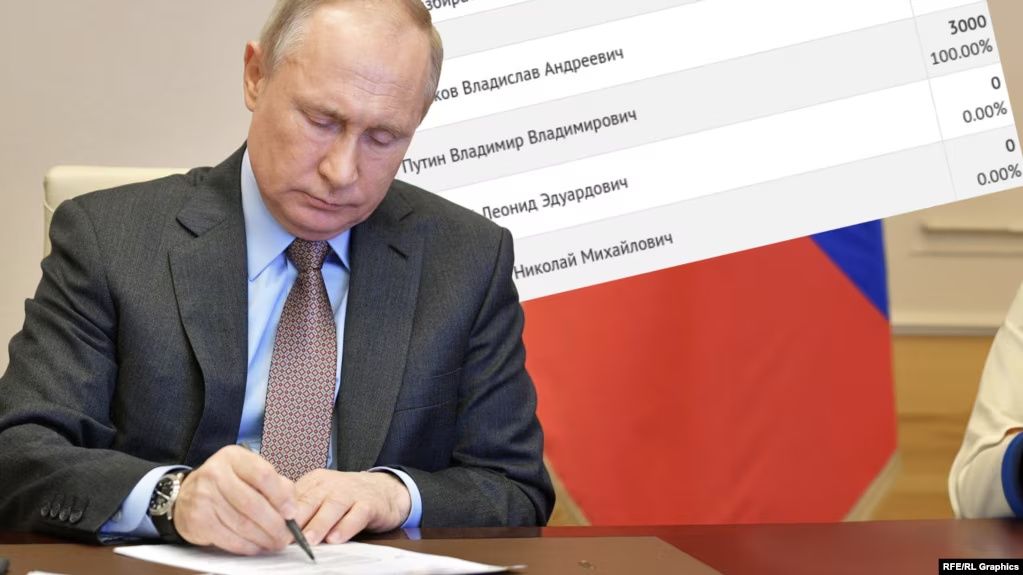
On 8 May 2024, Vladimir Putin signed Decree No. 314 “On approval of the Basics of the Russsian Federation state policy in the field of historical education.” Candidate of Law Harun (Vadim) Sidorov analyzed the document. He believes that the decree itself is revolutionary, not because it contains something fundamentally new, but because it brings to a new, normative level several regime attitudes that have been unofficially voiced for a long time. From now on, Sidorov believes, they can be considered official state guidelines.
The presidential decree takes precedence over the Constitution
At the very beginning of the Foundations of Historical Policy in the field of state education (hereinafter referred to as “state foundations”) approved by this decree, it is declared that their legal basis “consists of the Constitution of the Russian Federation, generally recognized principles and norms of international law, international treaties of the Russian Federation” (clause 2). However, it is safe to say that the principle provisions and the very ideology of these “state foundations” contradict several principles of both the Russian Federation Constitution and some international treaties concluded by Russia.
Thus, Article 13 of the Constitution of Russia (clauses 1-2) approves ideological diversity (on paper) and prohibits the establishment of a state ideology in the country. But the provisions of the adopted “state principles” do exactly that — they establish the state ideology (in the field of history) and limit ideological diversity. Moreover, the incompatibility of the state ideology with the current Constitution was pointed out last year by high-ranking law enforcement officer Oleksandr Bastrykin, who acted as an offender. Instead of defending the country’s Constitution (which he has to do by virtue of his position), he then called for the repeal of the aforementioned article and the introduction of a state ideology clause into the Constitution instead.
But in the Kremlin, it was easier – they did not change the Constitution in this part, but actually “trampled” one of the principle provisions by presidential decree.
State historical ideology is introduced
That this is so is indicated by several points adopted by the decree of “state foundations”. Based on them, historical education in Russia now becomes “a state-regulated activity… to form a scientific understanding of Russia’s past and present” (clause 3, paragraph “a”).
However, what is called “scientific” in this formulation is ideological in nature. After all, a scientific approach to history presupposes the presence of various historical concepts, approaches, and assessments. Meanwhile, the “state foundations” under consideration establish a clear ideological framework for understanding Russian history, the departure from which is seen as a threat that must be countered.
This applies not only to certain historical assessments but also to their methodology itself. From now on, the “understanding of the history of Russia, which develops in a unique civilizational way” becomes official (clause 9, paragraph “b”). Thus, historians who do not believe that Russia, as well as any other country, has some “unique civilizational path” turn out to be dissidents, and dissidents, who are one step away from being declared “foreign agents” under the current conditions.
This is not an exaggeration. The “state principles” refer to “the collective West’s use of falsification of history as a weapon in an information war aimed at destroying the integrity of Russian society and the state” (clause 6, clause “c”). This means that understandings of Russian history that contradict official principles can automatically be considered “weapons of the collective West in the information war.”
By the way, with this decree, the countries of the “collective West” with which it has concluded friendship and cooperation agreements that are still valid, are registered as enemies of Russia. This is to the question that, in addition to the Constitution of Russia, the database of “state foundations” is allegedly its international treaties.
The peoples of Russia are declared a single cultural community of the Russian world
If the current Constitution of Russia is written on behalf of its “multinational people”, then the approved “state principles” fix the commonalities that are at the centre of the Kremlin’s recent discourse – the Russian world and the state-building Russian people (paragraph 8).
However, in my opinion, other provisions of these “state foundations” are more important. Thus, paragraph 5 declares “Russia is a large country with a centuries-old history, a state-civilization that united Russian and many other peoples in the space of Eurasia into a single cultural and historical community.”
Why is this wording important? The Constitution of Russia states that it was adopted “based on universally recognized principles of equality and self-determination of nations.” There is no question of any equality of nations from the moment when only one of them was declared the state-maker. But the ruling circles of Putin’s Russia have long suppressed the second component of this constitutional principle of self-determination of the nations of Russia.
It is important to emphasize that the new wording of the self-determination of individual nations of Russia is denied in the form of the possibility of self-determination separately from it, but also as their self-determination in the form of an equal union of the nations of Russia. Tatars, Bashkirs, Chuvash, Udmurts, Erzyans, Mokshan, etc. Next to the Russians, they are now considered not as a union (federal) political community, the ideology of which corresponded to the concept of “multinational people”, but as parts of one cultural-historical community, about which self-determination in principle is meaningless to talk about.
This understanding is enshrined in another place of the “state foundations”, which refers to the “historical unity of the nations of the Russian Federation” (paragraph 9 paragraph “d”). Considering their other provisions, it is quite obvious how this “historical unity” should be understood.
The Kremlin will write the history of the nations of Russia
After the collapse of the Russian Empire, the communists managed to restore it in a new ideological form, in particular, thanks to their recognition of the nominal right of its nations to national self-determination.
From a historiosophical point of view, this corresponded to the concept that recognized and condemned the national suppression of the nations conquered by the Muscovite Empire and the Russian Empire. “Czarist Russia” as a “prison of nations” (Lenin’s expression) was verbally opposed by the Soviet Union as a new type of state based on the principles of “equality and self-determination of nations.” Early post-Soviet Russia (as well as late-Soviet Russia at the time of the declaration of the Declaration of Sovereignty on 12 June 1990) adopted this approach out of inertia. This was enshrined both in the provisions of the constitutions of many Russian republics on the self-determination of their nations, and in the ideology of the federal treaty concluded with them by the Kremlin.
However, many years ago the ideology of “historical Russia” replaced this. It envisages the rehabilitation of the national policy of the Russian Empire and the Muscovite Empire and, conversely, the condemnation of even the nominal decolonization carried out during the Soviet period. The example of distancing from the images of Salavat Yulayev and Zaki Validi in Bashkortostan and introducing the cult of Shaymuratov instead shows what this ideology consists of. The “Russian world” does not accept national heroes who defended the subjectivity of non-Russian nations, even if they appeared in alliance with the Russians. It is arranged exclusively by obedient loyal subjects who are ready to serve it and give their lives for it, without “shaking their rights” and without asking unnecessary questions.
This is evident from several provisions of the new “state foundations”. Thus, paragraph 6 refers to the inadmissibility of “negative assessments of events and periods of national history.” That is if in the Soviet period, the colonial policy of Russia in relation to the nations it conquered could be condemned at least nominally, now such a thing will be perceived as an officially unacceptable “negative assessment of events and periods of national history.”
Until recently, historians of the nations of Russia could openly speak and write about their bloody conquest or even genocides, even if from the angle that it remained in the sad past. Now, taking everything into account, not only the entire past of Russia will be positioned as “bright” (under the communists they should have had a future), but also a suitable history for the people of Russia will be created and personnel will be trained to promote it. Yes, clause 12 of “d” refers to the need to “develop and adopt a single federal historical and cultural standard and develop, on its basis, regional components of the historical and cultural standard for each subject of the Russian Federation.” And in clause 10 part “c” – about the need for “formation of a state order for the training of academic and pedagogical personnel and conducting scientific research in the field of the history of Russia and all the nations that inhabit it.”
From a sick head to a healthy one
Interestingly, the Kremlin is going to carry out a similar rehabilitation of its imperialism and colonialism, previously condemned in Russia, under the banner of fighting against such. Thus, the necessity of all the aforementioned innovations and measures in these “state foundations” is justified by the “rehabilitation and resurrection of neo-colonialism, neo-imperialism and neo-Nazism” (point 6) – obviously, from the side of the “collective West”.
Meanwhile, while in Russia they are going to ban the discussion of unattractive pages of its history, it is in the West today that its colonial past is openly discussed and condemned. As for the notorious “neo-Nazism”, the fight against it on the part of Putin’s Russia has turned into a policy cover, the similarity of which with the policy of Nazi Germany is actively discussed in the world.
Harun Sidorov, doctoral student of ethnology at Charles University (Prague, Czech Republic)
Idel.Реалии





