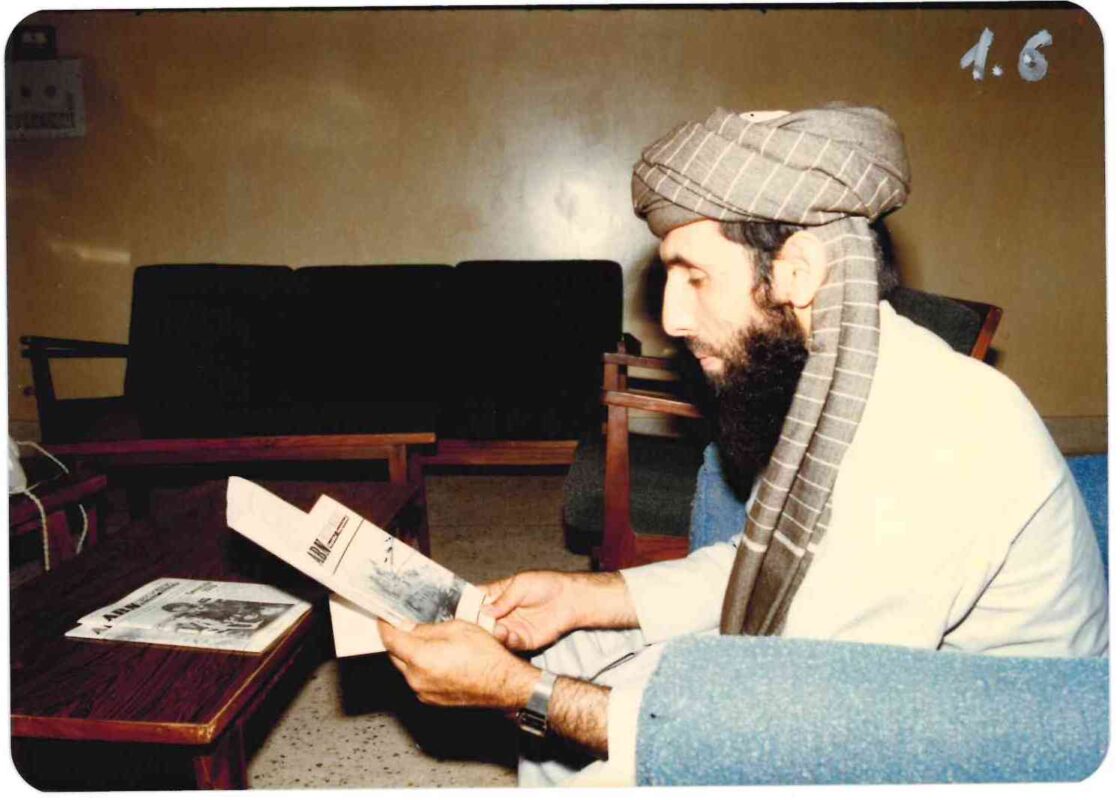
In the corner of the room, in an armchair, amidst the disturbing atmosphere of Peshawar, sits a man in traditional Afghan attire. A long black beard, a penetrating gaze. In the hands of one of the field commanders and leaders of the Afghan mujahideen is not a weapon, but an English-language publication called “ABN Correspondence” (the magazine of the Anti-Bolshevik Bloc of Nations).
This frame is not a random photo. It is evidence of one of the least known, but at the same time most impressive special operations of the Ukrainian Liberation Movement in the 1980s.
Mission “Ihor” and “Petro”: Ukrainian Diplomacy in the Flames of the Afghan War [1]
In 1982 and 1984, when the Soviet Union was waging a brutal and aggressive war in Afghanistan, the leadership of the Organisation of Ukrainian Nationalists (OUN) launched its own geopolitical mission. Two couriers from Bandera’s OUN, under the pseudonyms “Igor” and “Petro”, were sent to the centre of events – Peshawar, Pakistan, which at that time served as the main base of the Afghan resistance and the headquarters of the Mujahideen.
Their task had several important vectors:
Analytical and military-political: Assess the situation inside Afghanistan, study the methods of guerrilla warfare against the Soviet empire, and prepare thorough analytical reports on the prospects for cooperation with various insurgent groups.
Creation of a joint anti-Moscow front: Offer the Mujahideen the assistance that the OUN and the Anti-Bolshevik Bloc of Nations (ABN) can provide in the fight against the common enemy – the Russian occupier.
Humanitarian special operation: To negotiate the release of captured Soviet Army soldiers — Ukrainians who were forcibly sent by Moscow to shed blood for the Kremlin’s imperial ambitions.
Establishing contacts with the leaders of the Afghan resistance, OUN couriers distributed ABN literature among them, explaining: The Soviet Union is a prison of nations, where Ukrainians, Uzbeks, Bashkirs, Tatars, and other nations are just as enslaved victims of the Moscow regime as the Afghans themselves.
The story of Igor Rykov and Oleg Khlan: From Afghan captivity to London
One of the most important practical results of these difficult negotiations was the liberation of Soviet prisoners of war of Ukrainian origin. Among those who were saved from the hell of war and the Mujahideen camps were young Ukrainian boys – Igor Rykov and Oleg Khlan.
The famous British politician and member of the European Parliament, Lord Nicholas Bethell, joined the cause of the liberation of the prisoners. He actively cooperated with the foreign centres of the OUN and the ABN and personally appealed to the Prime Minister of Great Britain, Margaret Thatcher, for help in this matter.
Thanks to international pressure, diplomatic efforts, and direct mediation by the Ukrainian liberation movement, Igor Rykov and Oleg Khlan were rescued from captivity and transported to London.
After arriving in the capital of Great Britain, the boys gave a sensational press conference for the world’s media. Their testimony shocked the Western community:
They spoke in detail about the criminal methods of war used by the Soviet army in Afghanistan.
They presented undeniable facts of targeted purges, cynical bombings of civilian settlements, torture, and targeted killings of peaceful Afghan women and children.
These revelations dealt a devastating blow to Soviet propaganda in the West and clearly demonstrated to the whole world the true face of “Soviet humanism.”
Although the personal history of these guys was sad… They suffered from drug addiction since captivity, lived in a Ukrainian family, and were going to move to Canada. But one of them wrote a letter to his mother, thereby “exposing” their whereabouts. And then… letters from relatives and acquaintances poured in… The decisive letter was a letter from the fiancée of one of them. There was a photo of a daughter he had never seen and a request to come. The guys decided to return to the USSR. Their further fate is even more vague and requires additional research.
From ABN to ABN: Historical Connection and Continuity of Struggle
Analytical reports left by couriers “Igor” and “Peter” (their full text will be published later) indicate: The Ukrainian Liberation Movement clearly understood more than 40 years ago that the collapse of the Soviet/Russian empire was possible only through the coordination of the actions of all nations enslaved by Moscow.
Then this platform was the Anti-Bolshevik Bloc of Nations (ABN), founded in 1943 on the initiative of the OUN, which united representatives of the peoples of Eastern Europe and Asia under the slogan: “Freedom to nations! Freedom to the individual!”
Today, decades later, the successor to this idea and direct cause has become the Anti-Imperial Block of Nations (ABN). The modern ABN continues to coordinate the collapse of the already modern Russian empire, uniting Bashkir, Chechen, Tatar, Kalmyk, Oirat and other national liberation movements within the Russian Federation.
Afghanistan in the 1980s and Ukraine Today: The Final Judgment of Empire
The Soviet Union’s war in Afghanistan was one of the main catalysts that broke the backbone of the USSR’s economy and undermined the legitimacy of the totalitarian regime, hastening the collapse of the empire in 1991.
Today, history is taking a new and final turn. Russia’s full-scale aggression against Ukraine has become the same — but much deeper and more deadly — “Afghanistan” for the modern Kremlin empire.
As 40 years ago in the Afghan mountains, Russia is using the same terrorist methods against Ukraine: genocide of civilians, destruction of cities, torture of prisoners, and slaughter of its own people. However, today Ukraine stands not only as the shield of Europe, but also as the main vanguard of the liberation of all nations colonised by Moscow.
The joint struggle, once spearheaded by OUN couriers in Peshawar, offers its main historical chance today: the final dismantling of the Russian Empire, the liberation of enslaved nations, and the establishment of lasting peace on the Eurasian continent.
_________________________________________________________________________________
[1] Reports on the trips of OUN Escort couriers to Afghanistan, 1982; 1984 // OUN Archives. F.19, op.1, od.zb.116