At the end of October, the Minister of Education and Science of Buryatia announced his intention to transfer almost a quarter of the republic’s schools to the Buryat language of instruction. Idel.Realii familiarized themselves with the plans of the regional authorities and changes in the Russian language policy and also discussed them with researchers and activists from Buryatia and the Volga regions.
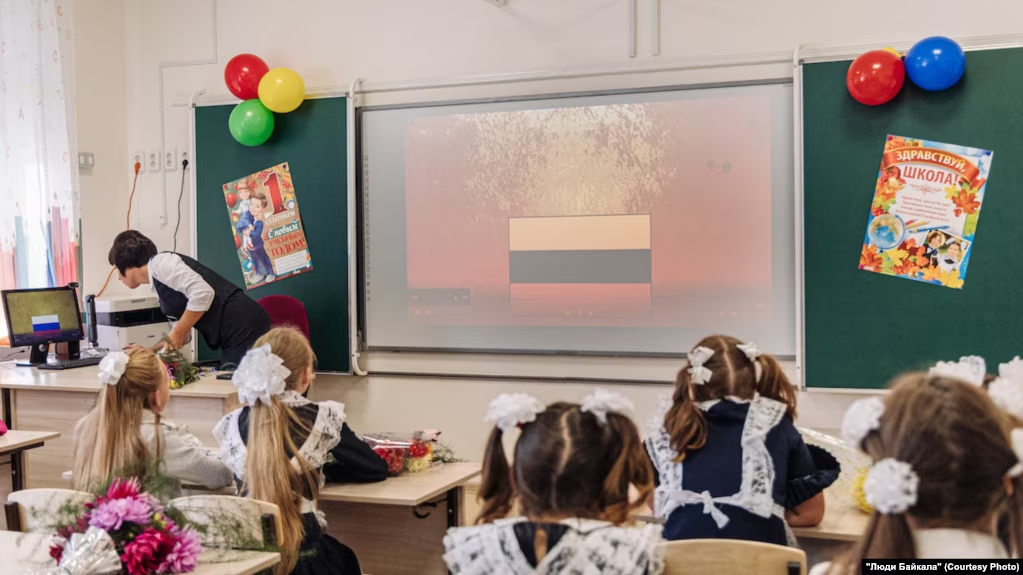
On 21 October, a meeting of the Commission for the Study and Development of the Buryat Language was held in Buryatia. Following the event, the head of the republic, Alexey Tsydenov, announced plans to transfer almost a quarter of the republic’s schools to the Buryat language of instruction.
The Minister of Education and Science of Buryatia Vitaly Pozdnyakov gave the details. He explained that the innovations will only affect elementary grades and only those where Buryat is currently studied as a native language. Currently, such classes operate in 106 schools in Buryatia, mainly in rural areas.
— For this purpose, in 2025, teaching and methodological complexes on mathematics, the world around us, labour (technology), music, and physical education are planned to be translated into the Buryat language. In parallel, primary school teachers will be trained. Then the issue of publishing the translated teaching and methodological complexes will be decided, Pozdnyakov wrote in his Telegram channel.
Russification of education
Although the innovations in Buryatia will affect only a small part of the republic’s schools and will not be reflected in all classes, some researchers and activists speak about them with enthusiasm and call them a pleasant exception against the backdrop of Russia’s language policy in recent years.
Indeed, the decision of the Buryatia authorities contradicts the general trend: from 2016 to 2023, the share of schoolchildren who study entirely in their native languages has halved – from 1.98% (292 thousand students) to 0.96% (173 thousand students). The share of those who study native languages in clubs has also decreased – from 0.7% to 0.4%. Despite the slight increase in the share of schoolchildren studying indigenous languages as a separate subject, the overall involvement of children studying the languages of the people of Russia has been declining all this time, according to statistics from the Ministry of Education.
Language activists have been talking louder about the Russification of education since 2017 when a meeting of the council on interethnic relations was held in the capital of Mari El. At the meeting, Vladimir Putin declared that it was unacceptable to study the republican languages as compulsory subjects.
His speech marked the beginning of the curtailment of the teaching of the languages of the indigenous people of Russia. Their lessons became optional, while in many schools the management pressured parents to indicate Russian as their child’s native language and cut teachers of the republican languages since their lessons allegedly turned out to be unclaimed.
In January 2019, the Advisory Committee of the Framework Convention for the Protection of National Minorities of the Council of Europe criticized Russia for its national policy. Experts expressed concern about the “growing dominance of the Russian language” while “there is a lack of effective support for the languages of national minorities.” In 2020, the Russian Constitution enshrined the provision that Russian is the language of the “state-forming nation.”
In 2024, Moscow started talking about language policy again. In August, Putin signed a decree establishing the Council under the President of the Russian Federation to implement state policy in the sphere of support for the Russian language and languages of the people of Russia. They appointed as head of the council State Duma deputy Elena Yampolskaya, who was elected from Tatarstan, despite the lack of ties to the republic. Soon after taking up her new position, she said: “Russian is equally native. The opposition to Russian and native is unacceptable, in my opinion. If Russian is not native, then Russia is not the Motherland.”
On 5 November, Putin took part in a meeting of this council. Among other things, he ordered the development of new unified textbooks in Russian and the languages of the people of Russia, emphasizing that it is the Russian language that “largely determines spiritual and national identity.”
“The legislation is relatively liberal – if there is a will”
— It is very gratifying that Buryatia has announced such an initiative. I hope it will be implemented, notes sociolinguist and author of the book “Language Policy Without Politicians” Vlada Baranova. But for now, we are only talking about step-by-step preparation, and the project is scheduled to be launched on 1 September 2026. The situation in the regions is changing quickly, so it is too early to say anything definite. Interestingly, the ministry is going to prepare new teaching and methodological complexes that were already developed in the 1990s, but for some reason, they do not want to use the old books now.
The researcher believes that the state policy in recent years has been aimed at the linguistic assimilation of minorities and “gradual Russification under the guise of voluntary choice.” At the same time, says Baranova, the legislation in the linguistic sphere is still relatively liberal: “It allows for the implementation of serious programmes to support languages - if only there is a desire in the regions.”
According to Baranova, heads of republics and regional ministers can seriously influence the situation of languages without conflicting with federal norms: “We have seen more than once how regional officials and leaders made independent decisions in the sphere of language policy – usually to the detriment of local languages, but here there may be a pleasant exception. Now we see that this is Tsydenov’s wish, although he was not interested in the language issue before. But since such interest has appeared, the law and informal agreements give him a lot of room for manoeuver and freedom of choice in what concerns the Buryat language.”
— It is difficult to say what caused the decision to increase the presence of the Buryat language in the educational system. Perhaps it is a PR campaign to improve the reputation of an unpopular leader. But if it is implemented, it will be wonderful, — the sociolinguist concludes.
“The Buryat language is needed by the Buryats themselves and no one else”
The chairman of the Buryat national movement “Erkheten”, advisor to the League of Free Nations on diplomatic issues and philologist-Mongolologist Dorzho Dugarov does not share the assumptions about the sincere interest of the head of Buryatia in the language or about a PR campaign. In his opinion, the decision to transfer primary schools to the Buryat language of instruction could have been made in Moscow.
— Of course, we immediately learned about this news, but it did not cause heated discussions among Buryat activists. Our opinion about the current language policy — of course, negative — was formed around 2012, when the teaching of the Buryat language suddenly came into some contradiction with the holding of the Unified State Exam. It gradually began to be “optimized,” that is, cut in favour of Russian as a supposedly more “useful” language, — says Dugarov.
Dugarov calls Tsydenov and Pozdnyakov’s promises a “handout” and sees political motivation behind them: “Recently, at a meeting of officials on nationalities in Moscow, words were said about separatist sentiments in Buryatia having grown by a thousand percent ( this is about the speech of FADN employee Abdulgamid Bulatov about the growth in the number of messages carrying “the message of a split in Russian society” – “Idel.Realii” ). Obviously, flirting with the language issue is a kind of crisis management, an attempt to stifle discontent related to social problems, war and the growth of the national movement. Music and physical education lessons in Buryat are, of course, good, but this is not enough to preserve the language, and everyone understands this.”
— I have always had this position: the Buryat language is needed by the Buryats themselves and no one else. Accordingly, the Buryats themselves should bear full responsibility for preserving the Buryat language. At the same time, we understand that the majority of the population is not like my family, who speak only Buryat at home on principle. The majority do not attach such importance to their native language and are not ready to exercise self-control in this regard. This upsets me, but objectively it is so. In particular, a Buryat state is needed to instill and support this idea and the status of the language, — Dorzho Dugarov believes.
He grew up in a Buryat-speaking family and learned Russian later than Buryat, but admits that for the capital of the republic, Ulan-Ude, where he lived before his forced emigration, this was an exception even in his youth. Today, the language situation is even worse: according to Dugarov, the spoken language only holds a strong position in remote rural areas. Thus, in the small homeland of Dugarov’s father, in the Kizhinginsky District, Buryat remains even the language of communication with government bodies: for example, it is often spoken within the walls of the village administration, but the paperwork is carried out exclusively in Russian. In the cities of the republic, according to Dugarov, even oral communication in formal situations requires switching to Russian.
The activist of the national movement sees historical continuity in the curtailment of the spheres of application of the Buryat language in modern Russia – he recalls the stories of old people about how the Bolsheviks destroyed Buddhist temples: “The Buryats call the temples datsans. Actually, this word can be translated as “faculty”. They have always been centres of knowledge and learning, they had huge libraries of manuscripts in Tibetan and Mongolian script. When they were destroyed in the first years of Soviet power, the steppe looked white from the number of torn and scattered pages.”
— A significant part of knowledge was destroyed — not only many texts but even the names of their authors were not preserved. Perhaps we will never know about many Buryat writers, thinkers and scientists of the past. But the attachment to education and science and to language as their tool has been preserved in the culture and identity of the Buryat people. In addition, we have the example of Mongolia — a state where a closely related, mutually understandable language is used in all spheres, develops and feels great. By the way, Buryat coexists with it in some border areas, and its position there is much better than in the Buryat lands controlled by Russia, — says Dugarov.
He believes that the combination of these factors – the ancient written tradition and Mongolia’s experience – will help the Buryats quickly restore the prestigious status, widespread use and dominant role of the Buryat language if the republic gains political sovereignty. In this regard, he is inspired by the history of Israel, citing the revival of Hebrew as an example to follow.
“All nations want to pass on their languages to their children”
Rifat ( name changed ), a cultural scientist from Almetyevsk (Tatarstan), who often writes about the problems of the Tatar language on social networks and communicates with activists from other regions, reacted to the news from Buryatia with cautious optimism.
— I hope that this programme will be implemented because 106 schools is a lot, and it is a serious step forward. I suspect that the schools are mostly rural. It is a pity because the language needs to be present in the urban environment, in various institutions and spheres of life. But in conditions when the contexts of language use are constantly being squeezed, even a kindergarten, a school is much better than nothing, — the Tatarstan resident believes.
Rifat connects the intentions of the Buryat authorities with the desires of local residents: “I think there is a grassroots demand for this – all non-Russian people want to pass on their languages to their children. I see that in recent years, this has been thought and spoken about more. Probably, the demand has always been there, but now it is articulated more clearly. There is, however, a reverse process, which is led by the federal authorities and Russian nationalists, sometimes even neo-Nazi forces, which are supported by the state. There is enormous pressure on national minorities from their side, for example, the fight against hijabs. Total linguistic Russification is one of their goals.”
— There are different officials in the republics’ offices. As far as I can judge, many of them sincerely care about their people and languages and try to do something for them within the framework that the system allows. In Tatarstan, we have many “national schools” on paper, but the presence of the Tatar language in them is gradually decreasing. The first step towards this was the mandatory Unified State Exam in Russian and the impossibility of taking general education subjects in the state language of the republic. We have a demand for the preservation, transmission and development of the language, but the big question is whether we as a society will be able to implement it, and how repressively the state will react to this, — the culturologist reasons.
Rifat notes that there are projects to create multilingual gymnasiums in Tatarstan, “but against the backdrop of the general pressure on the Tatar language, this is a drop in the ocean.” He calls the creation of such schools in cities a positive development: “There is no strict tendency to ‘push’ the language into rural areas. This is symbolically and socially important because the urban environment is closer and more interesting for young people. In addition, this is a matter of prestige — the language should not be limited in space or associated with stereotypes about the ‘hinterland’. It is important that a layer of people who speak and think in Tatar and can produce meanings in this language be formed in the urban environment. The same applies to the languages of other people and republics. School is not the only space where the language should live, but it is an important foundation — this is illustrated, for example, by the positive experience of Catalonia.”
— I consider the language situation in Tatarstan to be catastrophic currently. I live not far from the school. Previously, children, leaving classes, spoke to each other in Tatar, and now — in Russian, and they do not even respond to Tatar. The shift is happening even in villages. There are urban movements that are trying to bring the Tatar language into modern culture, to convince people to consciously learn it in adulthood. But this, of course, is a trickle against the backdrop of the consequences of the federal policy of squeezing out languages. In an ideal world, minorities should be provided with education in the language at all stages — middle school, high school, college, and university. But in the reality that we have, we have to be happy even about elementary grades, the Tatarstan resident concludes.
“Full-fledged education in one’s native language causes growth of self-awareness”
The leader of the Bashkir National Political Centre, Ruslan Gabbasov, views the language situation in Buryatia and other republics pessimistically.
— I have serious doubts that serious innovations in the sphere of language policy of Buryatia will be implemented. The matter may end with only minor, cosmetic changes. Why do I think so? Because today Putin’s domestic policy is aimed at the destruction of national languages and any rights of national republics. He has been purposefully moving towards this from the very beginning of his rule and will not grant language development to colonized nations in defiance of his entire chauvinistic policy of linguicide, — Gabbasov believes.
He agrees with Dordzho Dugarov: “Even if some steps are taken to improve the situation of the Buryat language, it will only be to silence the increasingly frequently raised questions about the disenfranchised position of the indigenous population. In any case, the availability of primary education in the native language will not save the nations of Russia from losing their language.”
— The Bashkirs, like the Tatars, still have schools with primary education in their native language, but the total number of native speakers is still decreasing every year. It is necessary to introduce not only primary but also complete secondary and higher education in the language. But the Putin regime will never agree to this, because full-fledged education in the native language causes the growth of national self-awareness – a new national intelligentsia will appear that will understand and, most importantly, convey to its people the disenfranchised position of the national republics. People will start writing and reading more in their native language, creating content. It is not for nothing that the empire destroyed the national intelligentsia first of all, — Gabbasov believes.
In his opinion, the policy of the republican authorities is not independent: “It is completely dependent on decrees from the Kremlin. It was the State Duma deputies from the national republics that destroyed the mandatory study of native and state languages in the national republics. The local authorities have always saluted, fulfilling the will of Moscow. Of course, they try to show the people that they care about the language, but things do not move beyond a couple of memorized phrases and attending a general dictation in Bashkir once a year. There are no national leaders in power who care about their people, there are only Gauleiters.”
Like Dugarov, Gabbasov sees the salvation of the Bashkir language in the political independence of Bashkortostan: “In our project for the future independent Bashkortostan, we stipulate the status of the Bashkir language as the only state language. We need to break away from the Russian language and switch to Bashkir in all spheres of life. But we understand that it will not be possible to immediately replace the Russian language. Therefore, we propose leaving it the status of the language of interethnic communication for 30 years. This time is quite enough to raise several generations of young people who will not only know the Bashkir language perfectly but also receive it in higher education. We need Bashkir-speaking doctors, lawyers, engineers, IT specialists, economists.”
— At the same time, we have written in our project that in places of compact residence of certain people of the Republic of Bashkortostan, it will be possible to receive a complete secondary education in the native language, open private higher education institutions in the native language, and conduct internal office work in the administrations of rural settlements in it. We are for the development of native languages in our future independent Bashkortostan, — concludes Gabbasov.
“Children are being used as cannon fodder – does it really matter in what language?”
The approach of “good, but not enough” to innovations in the republic’s schools is shared by the activist of the Buryat national movement, a native of Ulan-Ude Chingiz Dugarov. According to him, positive changes in the sphere of language policy are levelled by the militarization of the education system.
— What can I say, I can’t even believe that they want and will do this. Teaching in the native language is definitely good and right. But, on the other hand, these same schools conduct “Conversations about Important Things,” training in shooting and digging trenches. In short, children are being prepared as cannon fodder for war — and does it really matter what language it’s in? I hear about military training and patriotic “pumping” even in the school where I once studied, and it’s a lyceum for gifted children. Previously, they paid attention to academic electives, not to assembling machine guns, — the activist shares.
Idel.Реалии