
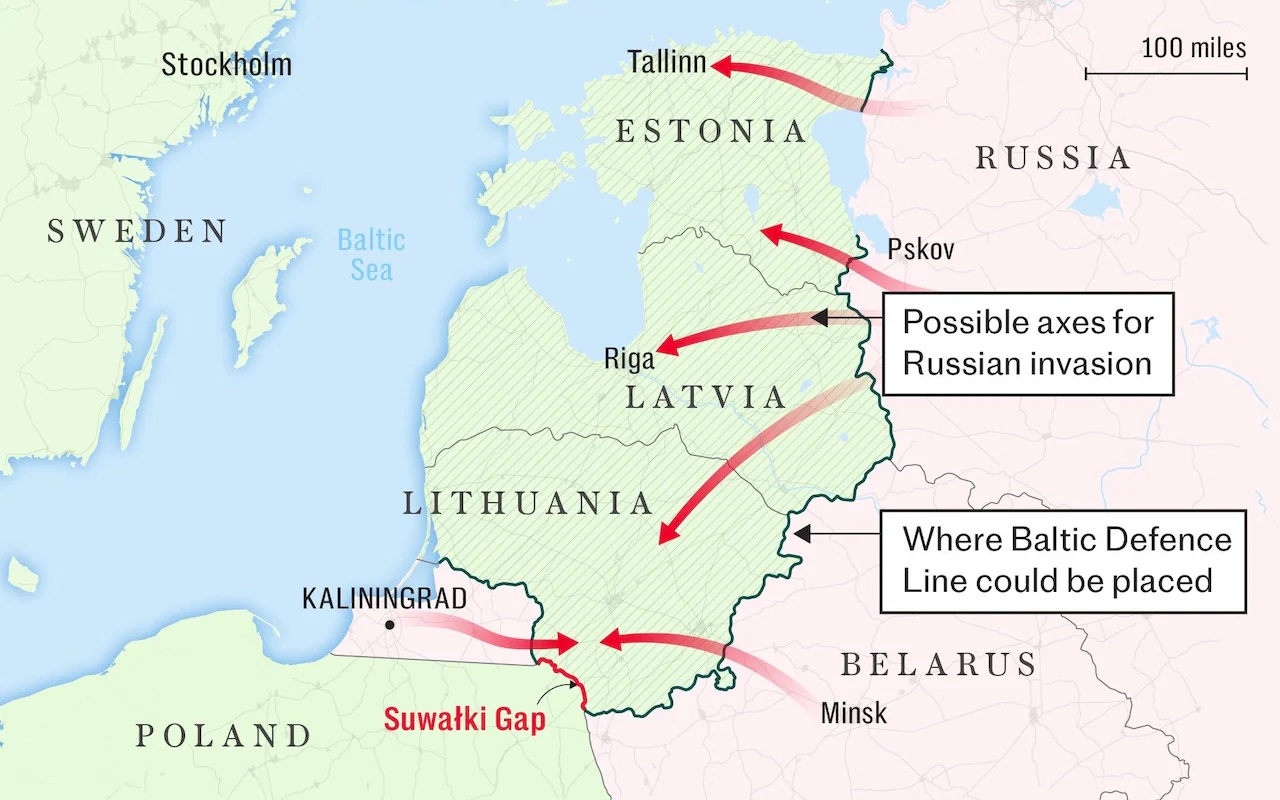
Estonia, Latvia and Lithuania are hastily building 1,000 concrete bunkers with anti-tank ditches. The project aims to strengthen a nearly 1,000-kilometre stretch of the Baltic border.
This is reported by The Telegraph.
The Baltic countries are hastily fortifying their eastern borders, planning to build about 1,000 concrete bunkers, trenches, anti-tank ditches, and ammunition depots.
However, the 10-year defence reinforcement project may come too late, say officials in the region, who fear that a peace deal in Ukraine could quickly draw Moscow’s attention to the most vulnerable part of NATO’s eastern flank.

“Putin will not let us wait these 10 years. The most dangerous time for the Baltic states will come immediately after the ceasefire in Ukraine,” warned Gabrielius Landsbergis, who served as Lithuania’s foreign minister until November.
His comments followed similar warnings from Baltic leaders that a ceasefire could have unintended consequences. The Kremlin has already outlined plans to increase military production and redeploy troops to NATO’s northeastern border if Donald Trump brokers a truce.
To strengthen their defences, the Baltic states, as well as Poland and Finland, recently announced their withdrawal from the international treaty banning anti-personnel mines.
Lithuania also recently withdrew from the cluster bomb treaty. Regional leaders say they want freedom of choice in using new weapons systems because of the Russian threat.
According to Lithuanian Defense Minister Dovilė Šakalenė, the “strategic message” is that the Baltic states are ready to use absolutely everything to defend against a Russian invasion.
A recent Danish intelligence report suggests that as soon as the war in Ukraine stops or freezes, Russia will be able to quickly rearm, regroup, and start a war with NATO.
It is estimated that in six months Moscow will be able to “fight a local war in a country bordering Russia.” In two years it will “be ready for a regional war against several countries in the Baltic Sea region.” In five years it will be able to wage a “large-scale war” in Europe (without US involvement).
NATO, alarmed by the catastrophic destruction in Ukraine and the atrocities committed by Russian soldiers against civilians in occupied cities, signed a 2023 plan to defend “every inch” of the Baltics with reinforcement lines from Finland, Poland, and Germany.


The alliance currently deploys a battalion-sized multinational force on a rotational basis in each Baltic state to act as an extension of the defence strategy to deter Russia.
Latvia is defended by an international force led by Canada, Lithuania is guarded by a German brigade, and Estonia is defended by about 1,000 British soldiers.
“We lack strategic depth. The Russians can go through the whole country in hours, if not days, so we defend from the first inch. Look at Ukraine and their recaptured cities, what they recaptured was a wasteland,” Landsbergis said.

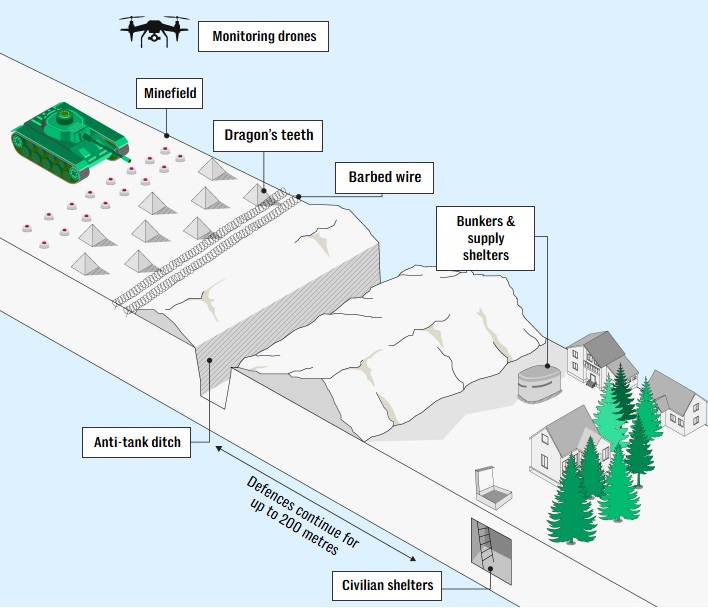
Simply put, the goal of the new line of defence is to prevent the Baltic cities and towns from suffering the same fate as the destroyed Ukrainian cities.
Estonia, Latvia and Lithuania will each spend £60 million on this, a huge chunk of their defence budgets, which are the second largest in Europe in terms of GDP after Poland.
Landsbergis said that the message he received from NATO was: “How much do you do yourself before you ask us for help? When are you going to start digging trenches and mining your border?”
“We are there now. We are sending a message. I hope we use every minute that the Ukrainians give us to prepare,” he said, noting that it is a “race against time.”
Both Kaliningrad and the Suwałki Corridor are considered a serious threat that Russia could use to cut off the Baltic states from the rest of Europe by land and then blockade them from the sea.
Фокус