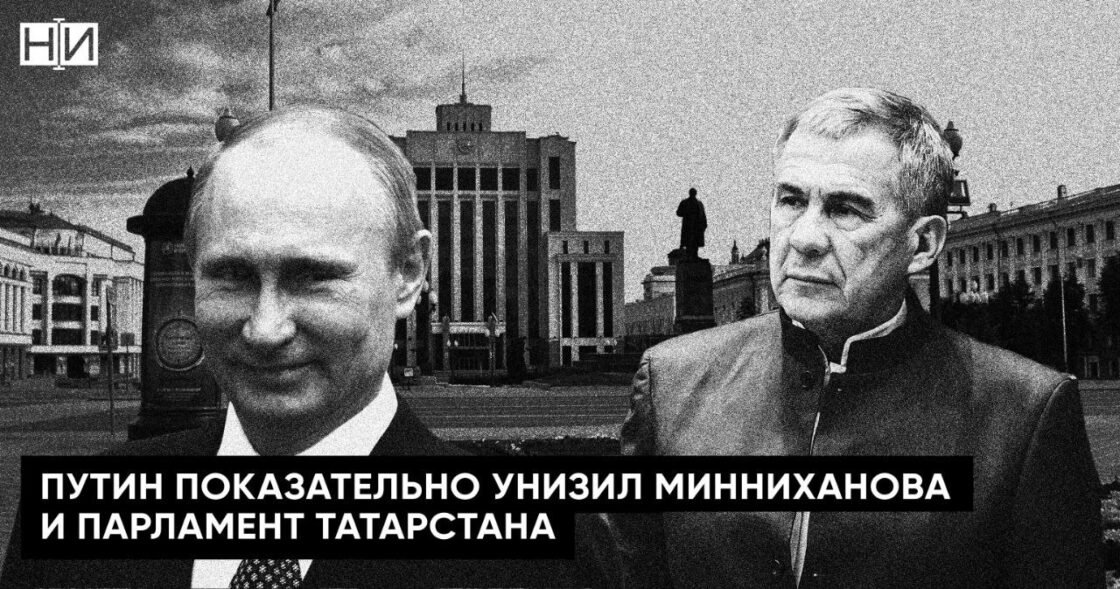
In 1999, the Tatar Community Centre (TCC) held a citywide meeting in Naberezhnye Chelny, where, after discussion and voting, it adopted a document that was later sent to the State Council of Tatarstan. The document stated that Tatarstan’s residents should not participate in hostilities; the State Council of Tatarstan supported the proposal, and the republic’s first president, Mintimer Shaimiev, signed a decree aimed at protecting residents. As soon as Putin, who at that time was serving as prime minister under President Boris Yeltsin, and at that time Putin was still only Yeltsin’s sixth, learned of this, he summoned Shaimiev “to the carpet”. All leading Russian television channels showed footage of Shaimiev sitting in front of Putin, noticeably pale; as one would expect, Shaimiev later cancelled his decree.
On 15 February 1994, Boris Yeltsin and Mintimer Shaimiev signed the first treaty in Russian history, “On the Delimitation of Subjects and the Management and Mutual Delegation of Powers between State Authorities.” The leaders of the Tatar national movement, both then and now, regarded this treaty as a betrayal.
The agreement expired on 11 August 2017, and Putin refused to extend it. When the Tatarstan leadership later tried to renew the signing of the agreement, Putin summoned Shaimiev and other high-ranking officials of the Republic of Tatarstan to the Moscow Kremlin and showed them the criminal cases opened against them. In the United Russia party, everyone is 100% corrupt: if you don’t give bribes, you are considered a foreigner. This is how the leaders of Tatarstan got caught — and this mechanism operates throughout Russia.
On 9 November, Putin met with his protégé in Tatarstan, Rustam Minnikhanov, in the Kremlin. Officially, it was stated that urgent issues for the good of Russia were discussed, but in my opinion, the matter is different:
First, Putin is involving Minnikhanov in dubious affairs related to the leadership of Turkic and Muslim states;
second, he intends to take over large industrial enterprises in Tatarstan;
and third, he seeks to squeeze even more people and resources out of Tatarstan for the war against Ukraine.
By the way, the largest industrial enterprise in Tatarstan, KAMAZ, does not belong to the people of Tatarstan; its management consists of relatives of Vladimir Putin and his former KGB comrades. A native of Tatarstan, Sergei Kogogin, has been the CEO of PJSC KAMAZ since 2002, but in reality he is only a puppet of the Moscow Kremlin. The position of Chairman of the Board of Directors of KAMAZ is traditionally held by Sergei Chemezov, the head of the Rostec state corporation and Putin’s former KGB comrade with whom he worked in the GDR. Moreover, the KAMAZ plant produces military equipment and supplies vehicles for the needs of the army, which are used in the war against Ukraine.
I remind you that Sergei Kogogin personally closed the Tatar newspaper Nur in Naberezhnye Chelny and fired all Tatar journalists.
Thus, individuals close to Putin and representatives of the security forces have been introduced into the management structures of many large industrial and military enterprises in Tatarstan, while the leadership of Tatarstan itself only serves the Russian colonialists. In this situation, the military underground needs to act more actively in Tatarstan and the Idel-Ural republics.
Sincerely, Rafis Kashapov – Prime Minister of the Government of Independent Tatarstan in Exile, Tatarstan – Great Britain
Правительство Независимого Татарстана