

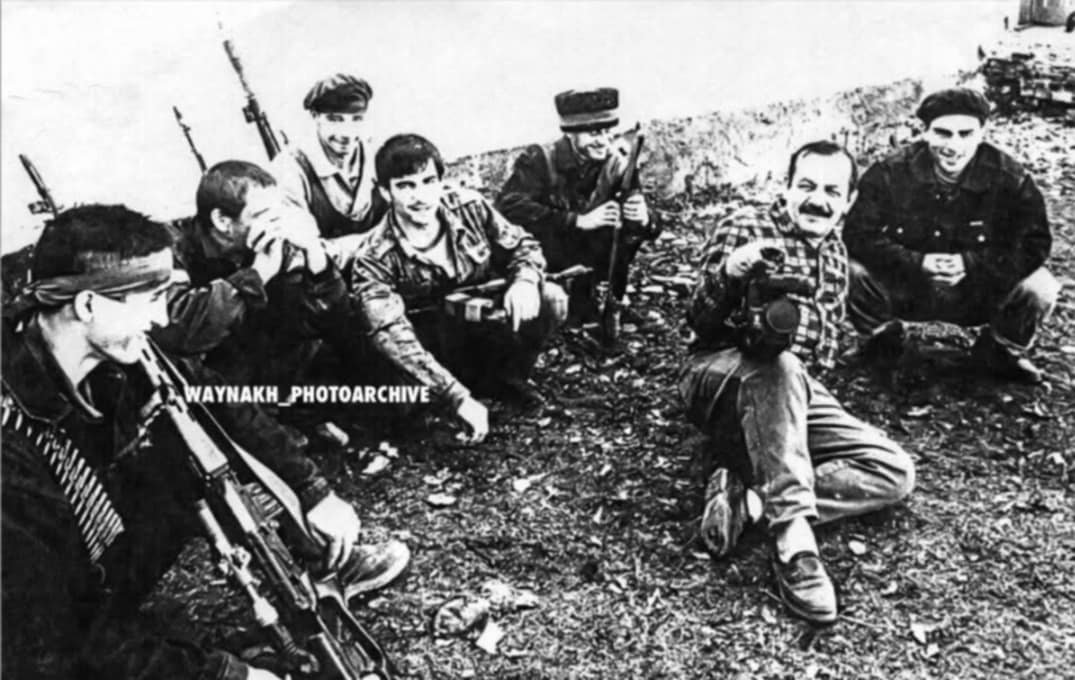
In this unique photo from the “Chechen Photo Archive” – April 1995. The Chechen Republic of Ichkeria is fighting for its independence. A delegation of the Congress of Ukrainian Nationalists arrived to the fighters, bringing humanitarian aid. In the centre with a camera – at that time a People’s Deputy of Ukraine, a well-known researcher of mass graves of communist repression victims in the Demyaniv Laz tract in the Ivano-Frankivsk region, later – the director of the Museum of the Soviet Occupation of Ukraine in Kyiv, the head of the Kyiv city organization of the Ukrainian Voluntary Historical and Educational Human Rights Charitable Society “Memorial” named after Vasyl Stus Roman Krutsyk.
This was not the only visit of Mr. Roman to Ichkeria. He was well acquainted with the leader of the Chechen people, Dzhokhar Dudayev, and after his death, he was one of the organisers and coordinators of the special operation to rescue the Dudayev family and transport them to a safe place.
Roman Krutsyk was born 80 years ago, on 6 July 1945, in the village of Yabluniv, the Halytskyi district, Ivano-Frankivsk region, into a simple peasant family. He was lucky to avoid direct KGB persecution, but his childhood was not easy. There were five children in the family, and he had to work hard to get everyone on their feet. He was interested in history from childhood but had to choose a different specialty. “I was born in Western Ukraine, and getting into the history faculty there, or any humanitarian faculty related to history, was very difficult for us locals. For this, you had to go to Russia or eastern Ukraine. You could have entered a technical or medical university, but where there was politics, there was such a thick “sieve”, – he later admitted in an interview with the BBC.
Another of his dreams was to see the world. To make it come true, he graduated from the Lviv Technical School of Railway Transport, was a locomotive driver, and travelled throughout the Soviet Union. He loved his job. And yet, as soon as the opportunity arose, he returned to his greatest calling – the restoration of historical justice and memory of the victims of the Soviet totalitarian regime. He was one of the first in the Ivano-Frankivsk region to draw attention to the tragedy of Demyaniv Laz, initiated the exhumation and examination of bodies at the mass grave site, then outlined everything in the book “Demyaniv Laz. The Genocide of Galicia”. Already during the perestroika, he entered the law faculty of the Ivan Franko Lviv State University in order to professionally protect the rights of Ukrainians.
He stood at the origins of many Ukrainian democratic movements and organisations that emerged in the late 1980s: the Ukrainian Helsinki Union, the People’s Movement of Ukraine, and the Congress of Ukrainian Nationalists. He helped create a memorial to the victims of the shootings in Bykivna. He organized trips to Solovki and other places of crimes of the Soviet regime. He became one of the initiators of the Museum of the Soviet Occupation of Ukraine (he liked to emphasize this word – Soviet) and headed it.
Roman Krutsyk was at the origin of the creation of the Ukrainian Institute of National Remembrance. In 2006–2007, he served as deputy head of the UINP Igor Yukhnovsky. It was then that one of the main areas of UINP activity was the study of the crimes of the Soviet regime, the discovery of the truth about Demyaniv Laz, Bykivnia and other places of mass burials of the regime’s victims, the opening of the archives of the NKVD and other repressive bodies, and the return from oblivion of the names of fighters for Ukraine.
Until his last days, Roman Mykhailovych was concerned with the issue of reviving our historical memory. Our column “Historical Calendar” tells more about his life and ascetic work: https://surl.li/zltpgm
Ukrainian Institute of National Remembrance
Facebook





