
Only the national liberation movement and the independence of the republics can stop Muscovy. The pre-empire must be destroyed.
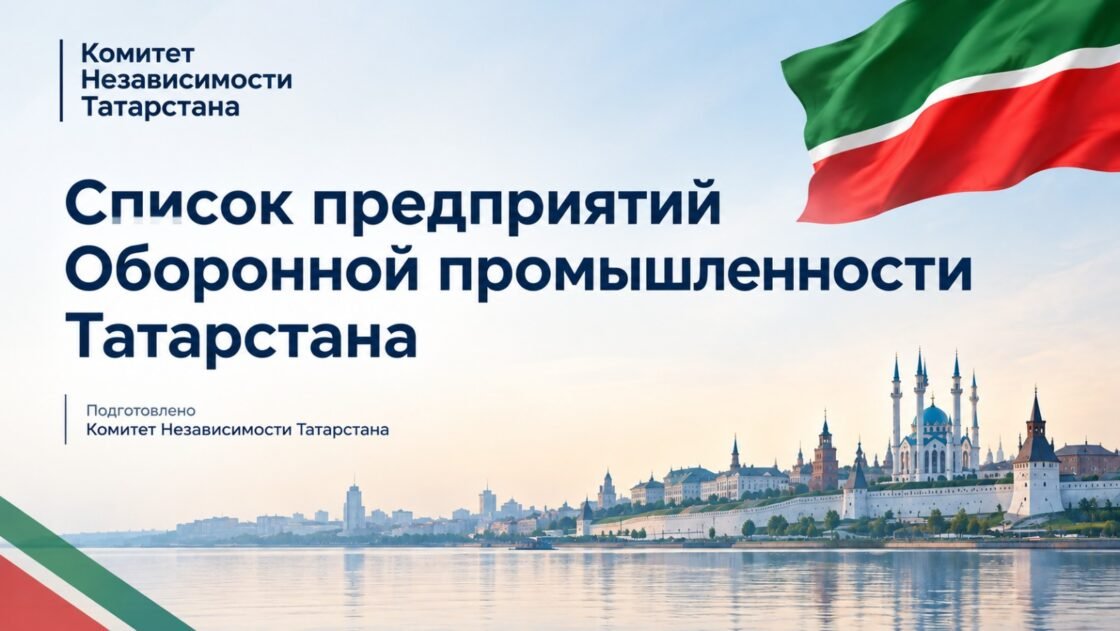
The modern Republic of Tatarstan is a resource powerhouse in the heart of a prison of indigenous nations. This country (not a territory) was independent back when Moscow was literally a swampland.
How does the successor state of Volga Bulgaria, the Golden Horde, and the Kazan Khanate fare today? To get answers, we spoke with Marat Akhmerov, the delegate of the Government of Independent Tatarstan in Exile for legal and legislative issues.
– Congratulations, Marat! What does the phrase “Free Tatarstan” mean to you personally?
– Good afternoon! “Free Tatarstan” is not just a phrase; it is an idea. For me, it means the idea of restoring Tatarstan’s Independence from the Russian Federation. It is the desire for Tatarstan to be recognised as a sovereign subject of international law.
It is also a belief that the people of Tatarstan have the right to self-determination — to choose their own path, develop their culture, language, and economy, and manage their resources without a diktat from Moscow. It is a dream of a future in which the voice of the Tatar people will be heard freely, with dignity and independence!
– Why, in your opinion, is Tatarstan not just one of the regions of the Russian Federation, but a nation with the right to self-determination?
– Tatarstan is a historically formed nation with its own statehood, language, culture and religion, a compact territory of residence and millions of Tatars. It has its own Constitution, state symbols and titular language.
In the 1990s, Tatarstan officially declared sovereignty and signed a treaty with Moscow, and in 1992, an independence referendum was held, in which almost 65% of the population voted “yes.” All this gives it the full right to self-determination under international law.
– Can we say that after the annulment of the 1994 treaty, the republic lost part of its autonomy?
– Yes, after the treaty was annulled, the republic lost some of its autonomy. The treaty gave it expanded powers, including control over resources, language, and foreign relations. With its termination, the republic began to obey general federal rules, which reduced its independence.
– How has the situation with the Tatar language changed over the last 10-15 years?
– Over the past 10-15 years, the situation of the Tatar language has worsened: in 2017, it was no longer taught in schools as a mandatory requirement — now it is only optional. The number of hours has decreased, and many children do not learn the language at all. The number of native speakers is decreasing, especially in cities. Tatar is being pushed out of education, media, and public life.
– Does Tatarstan have allies outside its borders?
– Potential allies of Tatarstan could be:
- Turkic countries (for example, Turkey and Azerbaijan) – by cultural and linguistic affinity;
- The European Union, especially the Baltic countries;
- also Ukraine.
We know that a bill on the recognition of the independence of Tatarstan has been registered in Ukraine, and a commission has also been created in the Verkhovna Rada to work with the enslaved nations of the Russian Federation. The Tatar diaspora abroad is especially in Europe, Turkey, and the USA. Movements of other nations of the Russian Federation advocate decolonisation.
– How does the Putler regime create a screen of legitimacy for its own aggressive actions?
– Fake structures are being created to simulate “national representation.” The so-called World Congress of Tatars is nothing more than a Kremlin puppet. It claims to protect the interests of Tatars, but in reality, it serves the interests of the occupying Kremlin regime.
Genuine national activists are being discredited by creating the illusion of the “unity” of the people with the dictatorship. The leaders of these pseudo-organisations have long since sold out – they are trading the symbols and dreams of the people for personal gain.
The Kremlin’s collaborators and Gauleiter – Mintimer Shaimiev, Rustam Minnikhanov, Farid Mukhametshin – are just the tip of the iceberg. Reliable sources report that the FSB has compromising material on many Tatarstan officials.
This is a weapon of blackmail that Moscow uses in exchange for loyalty. Secret conspiracies are woven in the corridors of the Kremlin’s power, and behind the facade of imaginary federalism, a hidden operation is unfolding to eliminate the national republics.
One of the main targets of this campaign was Tatarstan. It is of strategic importance for the empire – it is not a suburb, but the heart. And the Kremlin understands this perfectly well, so for now, the peripheral regions are declaring independence – the empire is crumbling, but holding on.
– Does Moscow have a plan to destroy the national republics?
– Moscow is already working on a plan to destroy the national republics under the pretext of “optimisation” and “regional consolidation.” From what I know, in 2035:
- The Altai Republic will be united with the Altai Krai.
- Tatarstan – with parts of Kirov, Samara and Ulyanovsk regions.
- Bashkortostan – with Perm Krai, Sverdlovsk and Chelyabinsk regions.
- Mordovia – with the Penza region.
- Udmurtia – with the remaining parts of the Kirov and Perm regions.
- Chuvashia and Mari El – with the Nizhny Novgorod region.
- Karelia – with the Leningrad Region.
- Komi – with the Arkhangelsk and Vologda regions.
The goal of this “regional consolidation” is the complete destruction of national republics as a form of self-government and historical identity. The Kremlin seeks to erase from the map everything that reminds it of the sovereignty, culture, and rights of indigenous nations.
This is not reform — it is the dismantling of the last remnants of federalism and an open policy of ethnocide. However, there are those in Tatarstan who continue to resist. We do not mention their names for their safety, but it is thanks to such people that we know the truth: a struggle lives within the system.
These patriots advocate for the complete independence of Tatarstan and work against the regime. After Ukraine, the Kremlin is already preparing a new aggression against Poland and the Baltic countries. A full-scale mobilisation will come and again Tatars, Bashkirs, Chuvashs, Erzya, Moksha, Mari, Kalmyks, Buryats and other enslaved nations will go to die in a foreign war…
This is not just a political scenario. This is a crime. This is ethnocide! And only national liberation and independence of the republics can stop this empire of destruction.
– What would you say to young Tatars who feel like they are “just Russians”?
– I would say: remember and value your roots, your lineage. After all, this is strength, not division. Tatars need to unite and strive for the independence of Tatarstan!