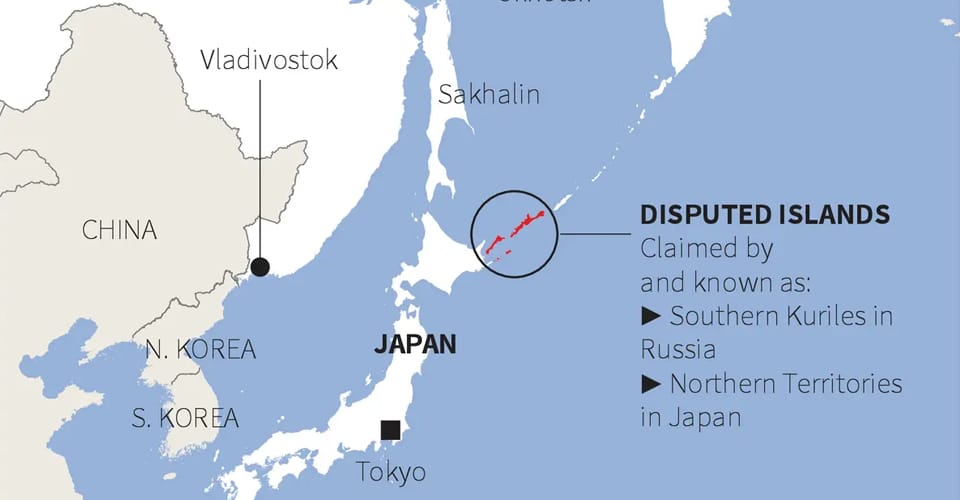
On 13 August, 2026, Putin flew to the Russian-occupied Northern Territories of Japan for the first time in more than a quarter century of his rule. He visited the Japanese island of Etorofu, or Iturup as the Russians call it.
The choice of place and time is hardly accidental. Etorofu is the largest of the four islands of the Northern Territories, which the USSR seized in 1945 and which Japan considers its integral territory. Together with Etorofu, these are Kunashiri, Shikotan and the Habomai group of islands. Their total area is about 5 thousand square kilometres.
Japan immediately protested. Prime Minister Sanae Takaichi called the visit unacceptable, and the Russian ambassador was summoned to the Foreign Ministry. For Tokyo, this is not an abstract dispute about history – it is a question of sovereignty. Ukraine takes an absolutely unambiguous position here. Back in 2022, our state officially recognised the Northern Territories as an integral part of the sovereign territory of Japan, which is under occupation by the Russian Federation. So the question arises: why did Putin, who for decades avoided personal trips to these islands, decide to fly there now?
The first answer is obvious — it is Tokyo’s demonstrative revenge. Japan supported Ukraine, imposed sanctions against Russia, helps our state financially and politically, and is increasingly actively strengthening its own defence and alliance with the United States. Putin actually flew in to tell the Japanese: Moscow is not going to discuss anything. Once upon a time, the Kremlin left the territorial issue a subject of negotiations. Now the Russian dictator has personally stepped on Etorofu, demonstrating that he considers the issue closed.
There is also the Chinese factor. Russia is increasingly dependent on Beijing, and China is interested in weakening Japan, a key US ally in the Pacific region. Therefore, Putin’s demonstrative visit can also be seen as an element of broader Russian-Chinese pressure on Tokyo.
But I see another reason. Putin is stitching together an empire that is beginning to crack at the seams. It is no coincidence that Putin declared 2026 the “Year of Unity of the Peoples of Russia.” Formally, to strengthen interethnic unity. But the Kremlin’s very need to so persistently emphasise “unity” is a rhetorical device.
The war against Ukraine is costing Russia dearly. Huge military spending, sanctions pressure, technological limitations, human losses, disparities between Moscow and the regions, dependence on China — all this is gradually exposing the weakness of the imperial structure.
Then the ruler of the empire goes to its far eastern edge. Why? To show: the empire is still here. The borders are controlled. What is captured remains captured. This message is addressed not only to Tokyo.
It should be heard within the Russian Federation as well — by Tatars, Bashkirs, Yakuts, Buryats, the peoples of the Caucasus, Siberia, the Volga region, and other nations whose lands are held by Moscow. Because the Russian Federation is the last great European empire that was not decolonised.
Let’s just look at the last century.
Finland.
As a result of the Soviet-Finnish wars, Finland was forced to cede significant territories to the USSR: most of Finnish Karelia with Vyborg, part of Salla, the islands in the Gulf of Finland, and later Petsamo – Pechenga, which caused the country to lose access to the Arctic Ocean. According to Finnish government sources, the country lost approximately 11–12% of its territory. More than 400 thousand Karelian Finns were forced to leave their native lands.
Japan.
In August–September 1945, the USSR occupied Etorofu, Kunashiri, Shikotan, and Habomai. Today, their combined area is about 5,003 km². The southern part of Karafuto Island (Sakhalin) was also occupied. The Japanese population was evicted from there. Eight decades later, the territorial dispute remains unresolved, and Japan and Russia have still not concluded a full peace treaty after World War II.
Moldova.
After the collapse of the USSR, the Russian army did not leave Transnistria. As a result of the 1992 war, a separatist regime was established there, which is not controlled by the constitutional authorities of Moldova. Even today, Russian military personnel are stationed in the territory of Transnistria.
Ichkeria.
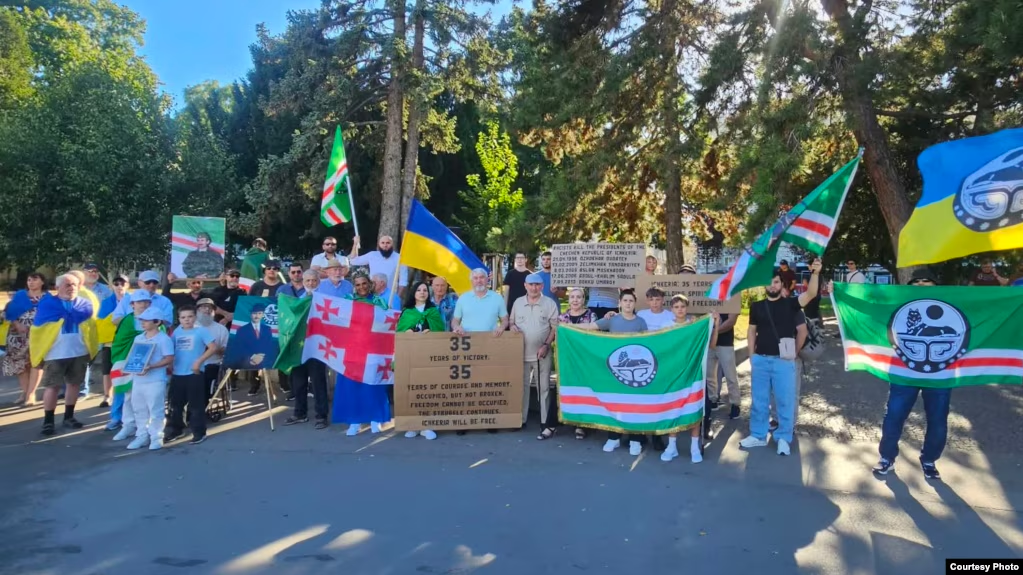
Two bloody wars were waged against the Chechen state. 10% of its population was physically destroyed.
Georgia.
After the 2008 war, Russia occupied Abkhazia and South Ossetia, about 20% of Georgia’s internationally recognised territory. Moscow called the territories “independent states,” distributed Russian passports, and stationed troops there.
Decades have passed. The colours of the flags above the Kremlin change. But the method remains the same: war — occupation — deportations — Russification — declaring the occupied territory “historically Russian.” From Etorofu and Karafuto to Crimea and South Ossetia.
That is why Ukrainians should understand the Japanese especially well. Etorofu for a Japanese is not a nameless piece of land in the middle of the ocean. Just as Crimea for a Ukrainian is not just a peninsula on the map. In 2022, Ukraine took an extremely important step. The Decree of the President of Ukraine No. 692/2022 directly states: The Northern Territories are an integral part of the sovereign territory of Japan and “continue to be under occupation by the Russian Federation.”
Our Japanese allies must understand: the fate of Etorofu, Kunashiri, Shikotan, and Habomai is to some extent being decided in Ukraine today. The weaker Russia emerges from this war, the less opportunity Moscow has to maintain a vast imperial periphery and dictate to its neighbours what borders they should consider “final.”
Therefore, Japan has every reason to act more actively. To support Ukraine more actively. To raise the issue of the Northern Territories more actively in international organisations. To explain to its own society more actively the connection between Russian aggression against Ukraine and the Russian occupation of Japanese territories. Because we have one enemy. And his methods have not changed.
And what after Russia? Not only the Japanese should think about the future. The Finns remember Vyborg and Karelia. The Georgians – Abkhazia and South Ossetia. The Romanians of Moldova – Transnistria. The Ukrainians – Crimea, Donbas and every metre of occupied Ukrainian land. The enslaved peoples of Russia about state building in the deoccupied territories.
No one can say for sure today what the Russian Federation will be like after this war. It will most likely not exist at all. Therefore, Russia’s neighbours must be prepared for different scenarios and use the historical chance to return their lands. When the empire begins to disintegrate, the window of historical opportunity may be very short. And then each state will have to have its own strategy: diplomatic, legal, political and security.
I am convinced: this war could be the last great war of the Russian Empire. Putin started it to restore the empire. He wanted to return the status of a colony to Ukraine and create a powerful outpost for another Russian expansion into Europe. But it didn’t happen that way. The result could be exactly the opposite. A war started to restore the empire could end in its collapse.
That’s why Putin is flying to Etorofa today. The last guard walks around the farthest walls of his empire. Checks the castles. Shows the flag. Convinces his subjects, neighbours, and perhaps himself, that everything is under control.
But history has one rule – empires do not last forever!