

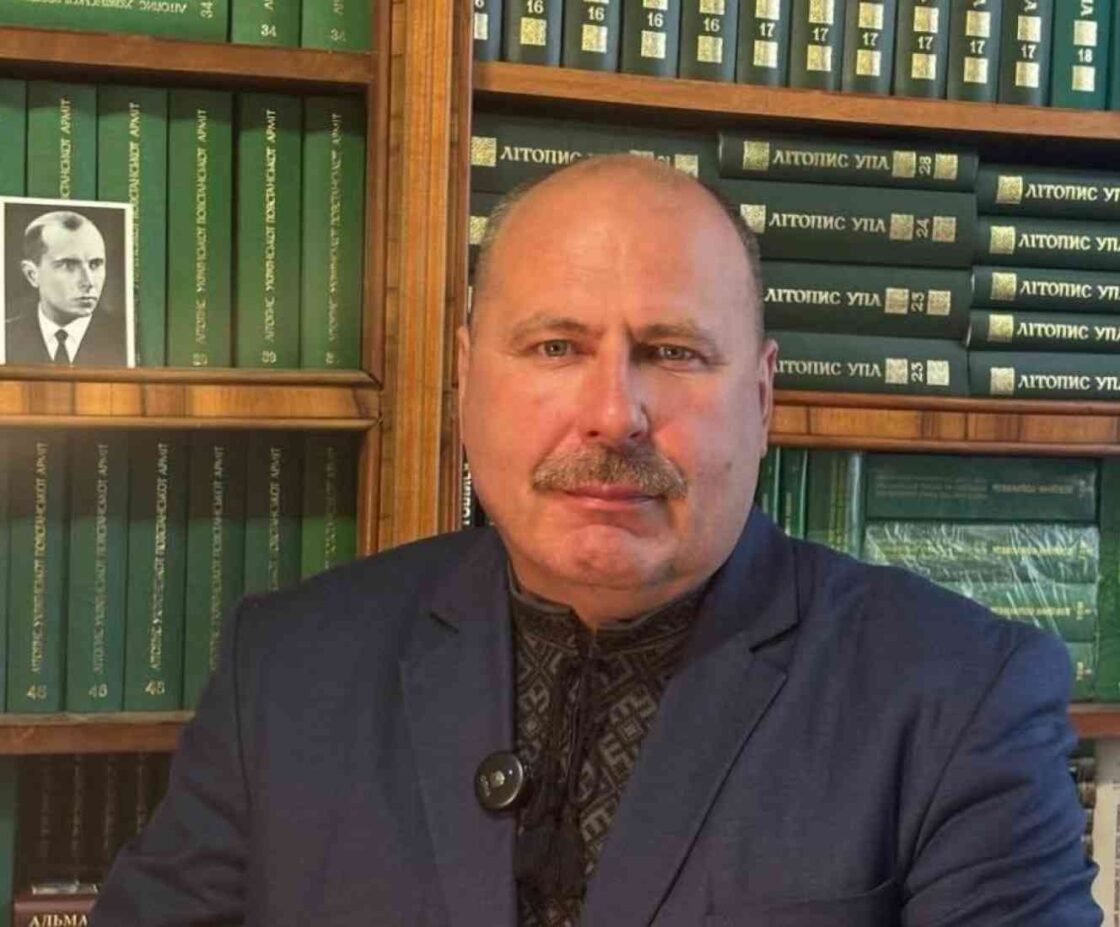
Recently, at the XVI Grand Assembly of the Organisation of Ukrainian Nationalists (Bandera followers), Oleh Medunytsya, a well-known public and political figure, was elected head of the Organisation for a second consecutive term. We offer you a conversation with the head of the OUN (B) about the current challenges of our time and the specific features of the Bandera movement’s activities amid the war.
Dear Oleh, we sincerely congratulate you on your election to such a responsible position. First of all, we would like to know how significant the participation of OUN members in Ukraine’s Security and Defence Forces is today, and what tasks has the Organization set for itself in this area?
Since the beginning of the full-scale war, the security, defence, and volunteer sector has become one of the priority areas of the OUN (Bandera movement)’s work. We have prepared a separate Concept of Activities defining the Organisation’s main tasks in this sphere.
First and foremost, this involves keeping records of our members, candidates, and supporters serving in Ukraine’s Security and Defence Forces, maintaining constant communication with them, and providing informational and organisational support. It is important that a person who has gone to defend Ukraine does not lose contact with the Organisation, and that the Organisation knows about their service, problems, and needs.
Another area is the development of training initiatives aimed at preparing our membership to defend Ukraine, supporting patriotic youth organisations in preparing for national resistance, and, of course, volunteer work.
How many OUN members and supporters are currently serving, what is known about their combat experience, and what losses has the Organisation suffered in this war?
As of the summer of 2026, our registry contains information on 124 members, candidates, and supporters of the Organisation involved in Ukraine’s Security and Defence Forces.
It is noteworthy that a significant number of OUN members have earned officer ranks during the war and become commanders at various levels. These are people who have taken responsibility not only for carrying out combat missions themselves, but also for their subordinates, units, and specific sections of the front. More than ten of our members have already been demobilised.
But war also means, unfortunately, heavy losses. Since 2022, we have learned of the deaths, disappearances, or deaths from wounds of ten members and candidates of the Organisation. They include Vitalii Benchak “Tur,” Oleh Yurchenko “Shchaslyvyi,” Oleh Kutsyn “Kum,” Vasyl-Yakiv Kapustynskyi “Marmus,” Nazar Matlak “Pavlo,” Volodymyr Lychahin “Ares,” Volodymyr Bartsios “Viter,” Ivan Lut “Psykh,” and Oleh Pelykhatyi.
For us, these are not statistics. They are our friends, comrades-in-arms, people with whom we worked and fought together. The memory of them is part of the memory of the Organisation and of Ukraine’s contemporary struggle for independence.
How is the Organisation’s interaction with its members serving in the military structured, and to what extent does information coming directly from the front influence the decisions of the OUN Leadership?
We have tried to make this work systematic. We regularly hold working meetings involving military members of the Organisation. We discuss the situation at the front, the needs of units, the problems faced by service members, and what specifically the Organisation can do to help.
After each such meeting, a consolidated analytical report is prepared. This makes it possible not simply to respond to individual requests, but to see the overall picture and plan our activities accordingly.
My regular working contacts with commanders of military units, representatives of special services, and other components of the security and defence sector are also important. This allows us to receive information directly from people inside these processes, promptly identify problems, and determine the current needs of Ukrainian defenders.
At every meeting of the Leadership, I report on the current situation at the front, the main trends in the development of the military situation, existing challenges, and possible scenarios for further developments. For an Organisation whose significant number of members are directly involved in combat, understanding what is happening at the front is fundamentally important.
You have personally made numerous trips to areas of active hostilities. What was the purpose of these visits, and what role does the OUN Ukrainian Defence Fund play in supporting the military?
During the reporting period, I made 15 trips to areas of active hostilities. For me, it is important not only to receive information through reports or telephone conversations, but also to meet personally with our service members and commanders directly where they are carrying out combat missions.
A significant part of these trips was connected with delivering and handing over assistance to military units from the OUN Ukrainian Defence Fund. At the same time, every trip is an opportunity to talk to people on the ground, hear their assessments, and understand the real needs of the units.
Such direct communication is extremely important. The war is changing very quickly, and technologies, tactics, and military needs are changing along with it. Therefore, volunteer assistance must also be as specific as possible and correspond to what is actually needed at the front today.
What results of the security, defence, and volunteer sector do you consider the most important, and what should become a priority going forward?
The most important thing is that we have managed to build a systematic connection between the Organisation and our people in the Security and Defence Forces. We know where our members serve, maintain communication with them, assist units, analyse information from the front, and try to use the Organisation’s capabilities where they are needed most.
The high level of professionalism, courage, and dedication to Ukraine demonstrated by our military and civilian members has repeatedly been recognised with state awards and departmental distinctions. For us, this is important evidence of their contribution to the defence of the state.
At the same time, there is still a great deal of work ahead. We need to develop our training programmes, prepare our membership to participate in national resistance, support the patriotic education of young people, strengthen volunteer assistance, and, most importantly, maintain constant contact with our people at the front.
Today, for the OUN, supporting the Ukrainian military is not a separate area of civic activity. It is the Organisation’s direct participation in the struggle for the existence and independence of the Ukrainian state. The OUN’s activities have been, are, and will remain a foundation of Ukrainian state-building.
The Ukrainian Defence Fund has a long history, but after the XV OUN (B) Assembly, its work was essentially relaunched. What task did you set for the Fund, and what has changed?
The Ukrainian Defence Fund did not emerge out of nowhere. Its foundations were laid by previous generations of OUN members, who understood that the struggle for an Independent and United Ukrainian State requires not only political and organisational work, but also material support for those directly engaged in this struggle.
After the XV OUN (B) Assembly and the corresponding decision of the Leadership, we effectively relaunched the Fund’s work in accordance with the realities of the large-scale war. The main task became the creation of an effective volunteer platform capable of systematically raising funds, purchasing the necessary equipment, and delivering it to Ukrainian military personnel as quickly as possible. The priority was, and remains, supporting service members, primarily members of our Organisation who are defending Ukraine with weapons in their hands.
OUN (B) Leadership members and our regional leaders in Ukraine and abroad played a major role in this. They organised fundraising campaigns, attracted donors, and coordinated volunteer efforts. As a result, we managed to build a system trusted both by people who donate funds and by military personnel who receive assistance. This is particularly important to us.
What scale of assistance can we talk about today? What lies behind the Fund’s activity figures?
The scale of our work is best demonstrated by concrete results. From February 2023 through the end of March 2026, more than US$809,000 was raised through the Ukrainian Defense Fund. The largest contribution came from the Ukrainian branch, which provided more than US$425,000. At the same time, the support of our branches in Canada, the United States, European countries, the United Kingdom, and Australia was extremely important.
During the same period, more than US$784,000 was spent. Of this amount, almost US$693,000 was directed directly toward purchasing what the military needed and repairing equipment.
But for me, behind these figures are primarily specific soldiers and units. Assistance from the Fund has been received by more than 40 units of the Armed Forces of Ukraine, the National Guard, the State Border Guard Service, the Security Service of Ukraine, and the Main Directorate of Intelligence, fighting in various areas of the front. We also conducted 37 public fundraising campaigns for specific military needs through the Fund’s Facebook and Instagram pages and during individual events.
So this is no longer episodic volunteer assistance, but systematic work that has continued for years.
Is this primarily a volunteer project, or is it part of the Organisation’s broader activities?
For us, it is much more than simply a volunteer project. Today, it is not enough merely to speak about the struggle for Ukraine’s independence — we must provide practical assistance to those waging that struggle at the front.
The Fund’s experience has shown that even with limited resources, organisation, discipline, responsibility, and trust make it possible to achieve very serious results. We have managed to unite OUN members, Ukrainians in different countries around the world, our supporters, and simply concerned people around helping the Ukrainian military.
The Ukrainian Defence Fund has become one of the most practical areas of the OUN (B)’s activity during wartime. And I believe the most important conclusion from our work is very simple: the Organisation does not merely declare its support for the Ukrainian military — every day, it turns that support into concrete assistance to the front.
Together with the Ukrainian Defence Fund, the ABN — an international association once headed by Yaroslav Stetsko — was also revived. Why did you decide not simply to restore it, but effectively relaunch it as the Anti-Imperial Block of Nations?
When we made this decision, it was important for us not simply to restore the historical name or structure. We set ourselves a much more ambitious task — to restore the ABN’s role as an international centre coordinating the liberation struggle of subjugated peoples, but in accordance with the challenges of the 21st century.
That is why we made the fundamental decision to change the name from the Anti-Bolshevik Bloc of Nations to the Anti-Imperial Block of Nations. We preserved the ABN acronym and our historical continuity, while at the same time defining the main adversary more clearly. Bolshevism was one form of Russian imperialism, but the Russian Empire existed before the Bolsheviks and, as we can see, continued to exist after the collapse of the Soviet Union.
Today, Russia may change its flags, names, and ideological slogans, but its imperial essence remains unchanged. Therefore, our task is not to fight a particular political regime in Moscow, but Russian imperialism as a system for subjugating other peoples.
Time has shown that this decision was correct. Within a few years, we managed to transform the ABN into an effective international platform bringing together representatives of national liberation movements of subjugated peoples, Ukrainian politicians, experts, human rights defenders, and our international partners.
How broad is the ABN’s international network today, and have you managed to bring the issue of peoples subjugated by Russia to the level of Ukrainian state policy?
I consider this one of our most important achievements. Today we have stable partnerships with dozens of organisations and representatives of the national liberation movements of Bashkortostan, Tatarstan, the Chechen Republic of Ichkeria, Ingushetia, Sakha-Yakutia, Buryatia, Kalmykia, Karelia, Circassia, and other peoples subjugated by Russia.
At the same time, we restored the ABN’s own international network. Today, our structures and representatives operate in many European countries, in the United States, Canada, and Australia. We hold international conferences, forums, round tables, exhibitions, public lectures, and briefings. It is important to us that the voices of subjugated peoples are heard not only in Ukraine, but also in the parliaments, governments, expert communities, and human rights circles of the democratic world.
But what has become fundamentally important is that this issue is gradually moving from the civic and expert level into the sphere of Ukrainian state policy. At the initiative of the ABN, the Verkhovna Rada renewed the work of the Temporary Special Commission on Supporting National Liberation Movements of Subjugated Peoples.
With the active participation of our experts, a draft law entitled “On the Fundamental Principles of Ukraine’s State Policy Regarding Interaction with National Movements of the Subjugated Peoples of the Russian Federation” was also prepared. It has already passed the relevant parliamentary committee and is awaiting consideration for a vote.
We are convinced that supporting the liberation struggle of peoples subjugated by Russia is neither charity nor a secondary area of Ukrainian foreign policy. It is a matter of our national security. The Russian Empire will always pose a threat to Ukraine, regardless of the surname of its leader. Therefore, Ukraine’s strategic interest should be the dismantling of this empire and the emergence of independent national states in its place.
One of the ABN’s most prominent international projects was the exhibition “Putin’s Real Prisoners. Political Prisoners of Subjugated Nations.” What has this project achieved, and what does its international success say about the ABN’s place today?
For us, it was fundamentally important to show the world what often remains overlooked: Russia persecutes people not only because of their political views, but also because they struggled for national rights, freedom, and the future of their own peoples. This is precisely what our human rights project “Putin’s Real Prisoners. Political Prisoners of Subjugated Peoples” is about.
After its first presentation in Kyiv, the exhibition effectively began its own international journey. It has now been presented in 25 countries worldwide. It has been exhibited in the parliaments of Canada and Spain, the Senate of Italy, the Municipality of Paris, and numerous state, civic, and international institutions across Europe and North America.
For us, this is not simply a matter of geography. Behind every event is an opportunity to bring to foreign politicians, diplomats, human rights defenders, and journalists the truth about Russia’s colonial policy and about the specific people who have become its victims.
At the same time, this project clearly demonstrates how much the ABN itself has changed. We have managed not simply to restore the historical organisation founded by Yaroslav Stetsko. Today, the Anti-Imperial Block of Nations is an international centre coordinating liberation movements of subjugated peoples, an expert and human rights platform, and one of the instruments shaping Ukrainian policy toward the decolonisation of Russia.
Within a few years, the ABN has once again become recognisable within the international community. But this is not the result of one person’s work. It is the product of the collective efforts of OUN members, our representatives in different countries, international partners, and, most importantly, the representatives of the subjugated peoples themselves.
We seek to build a broad international coalition of peoples who understand one simple thing: lasting peace in our part of the world is impossible without freedom for peoples subjugated by Russian imperialism. This is where I see the main task of the modern ABN.
Amid the large-scale war, work with young people is becoming particularly important. What has the OUN managed to accomplish in the youth sphere, and what tasks do you consider most important here?
For us, youth work has always been strategic. An organisation that thinks about the future must prepare people capable of taking responsibility for the state ten, twenty, or thirty years from now. And under conditions of full-scale war, this task has become even more relevant. It involves developing national identity, worldview, leadership qualities, and the physical and military-patriotic training of young people.
Even amid the full-scale war, we managed to restore nationwide camps and training programmes, strengthen personnel and organisational work, develop cooperation among patriotic youth organisations, and establish partnerships with military structures in the sphere of military-patriotic education.
Within the framework of the activities of the National Youth Corps (MНК) alone, 13 nationwide training programmes were held, including the “Hurby-Antonivtsi” field game, the “Insurgent Campfire” and “Courage named after Ivan Havdyda” camps, and ideological training for young activists in the Sich region. In addition, 19 regional training programmes were held: 12 summer camps and seven field games. In total, almost 1,500 young people took part in these activities.
But we do not limit ourselves to our own projects. Cooperation with the Ukrainian branch of the Union of Ukrainian Youth (SUM), Plast, the “National Alliance,” “Poklyk Yaru,” and other communities, including within the framework of NUMO, is an important area. We also work in the field of national-patriotic education through the “Sokil” (“Dzhura”) game system. Through the Ukrainian Defence Fund, we also assist members of patriotic youth organisations who are currently serving in the Defence Forces.
Representatives of the Organisation also participate in shaping state youth policy and national identity policy. It is important for us not only to hold our own activities, but also to influence what the state system of national-patriotic education will look like.
This work is not limited to Ukraine. Winter camps are traditionally held in the United States; we have met with young people at SUM camps in Frankopole, Belgium, and held meetings in Edmonton and Toronto during a trip to Canada.
We view all of this activity as a single process. Our task is not simply to hold a certain number of camps or training programmes. Our task is to raise a generation of Ukrainians for whom an independent national state is a value, and the willingness to work for it and, when necessary, fight for it, is a personal responsibility.
Information and propaganda work has historically been one of the OUN’s key areas of activity. What significance does it have today?
Today, the information space is a fully-fledged battlefield. For decades, Russia has invested enormous resources in propaganda, falsifying Ukrainian history, discrediting the liberation movement, and denying Ukrainians’ very right to their own state. Therefore, our task is not only to respond to Russian propaganda, but also to shape our own Ukrainian national agenda.
We have reviewed and organised the OUN’s information resources. Today, we have an entire system of platforms: the “Nationalist Portal,” “Ukrainian View,” the OUN Archive, resources of the Anti-Imperial Bloc of Nations, the Ukrainian Defence Fund, the Ukrainian Information Service, and the print publications “The Path of Victory,” “The Voice of Ukraine,” and other media.
We also need a more effective system for responding promptly to political, social, and international events. The OUN’s position on fundamental issues must be communicated quickly, clearly, and in a coordinated manner across all our information resources.
Publishing and historical-educational work remains a separate area. What results here do you consider the most important?
A Ukrainian book, a historical document, and professional research are also weapons. Especially now, when Russia is trying to justify its aggression through historical myths. The “Bandera Bookstore” is developing successfully. Moreover, this project has long gone beyond simply distributing our publications. Together with the Ukrainian Defence Fund, we provide books to military units, training centres, and hospitals. I consider this extremely important: a Ukrainian book should be beside a Ukrainian soldier.
I would also single out the “Bandera Readings,” of which the Organisation remains a co-creator and partner. They have become a serious intellectual platform where Ukrainian nationalism is discussed not merely as a historical phenomenon, but as a system of ideas capable of providing answers to contemporary challenges.
The work of the OUN Archive is also extremely important. We preserve, systematise, process, and introduce into academic circulation documents of the Ukrainian liberation movement. This is an enormous part of our national memory. If we do not preserve our own documents and tell our own history ourselves, others will inevitably try to write it for us.
In 2029, the OUN will mark 100 years since its founding. How do you envision the Organisation’s development leading up to this anniversary, and what should the centenary itself look like?
There is not much time left until the OUN’s centenary, so preparations must begin now. And I absolutely would not want the Organisation’s 100th anniversary to be reduced to a ceremonial academic gathering, several conferences, or laying flowers. The scale of this date is entirely different. We must use the anniversary for a major Ukrainian and international information campaign. We should show the history of the OUN, its contribution to the struggle for independence, and the people who endured prisons, concentration camps, underground resistance, and armed struggle.
But it is no less important to explain why the ideas of Ukrainian nationalism remain relevant today, when Ukraine is once again waging a war against Russian imperialism.
In the 21st century, wars are not won by weapons alone. The victor is the one capable of defending their historical memory, convincingly articulating their own ideas, and conveying them to their people and to the world.
The full-scale war has effectively put Ukraine’s normal political life on hold. Under these conditions, does the OUN still have opportunities to influence state policy?
It is clear that during wartime, political life in its traditional sense is significantly restricted. But this does not mean that civic and political work should stop. On the contrary, it is particularly important now to establish, at the state level, decisions that will have strategic significance for Ukraine.
As I have already mentioned, at our initiative, a Temporary Special Commission was established in the Verkhovna Rada which, with the active participation of our representatives, developed the draft law “On the Fundamental Principles of Ukraine’s State Policy Regarding Interaction with National Movements of the Subjugated Peoples of the Russian Federation.”
It is fundamentally important to us that support for liberation movements cease to depend on political circumstances and become part of Ukraine’s long-term state policy.
Another important area is national memory policy. I personally took an active part in the work of the relevant working group of the Office of the President on the reburial of Ukrainian national Heroes and the creation of the National Pantheon of Remembrance. The Ukrainian state must properly honour the people who fought and gave their lives for its independence.
We also have concrete results at the local level. At the initiative of members of the Organisation who are deputies of the Ternopil Regional Council, 2026 has been proclaimed the Year of Ivan Havdyda in the Ternopil region. This is an example of how representative government bodies can work to preserve historical memory and promote prominent figures of the Ukrainian liberation movement.
Another area of your work is shaping national identity and national-patriotic education. What has been achieved at the legislative level?
We proceed from the principle that national identity and patriotic education cannot exist solely through civic initiative. A systematic state policy and an appropriate legislative framework are necessary. Therefore, members of the Organisation actively worked in working groups on legislation concerning the strengthening of Ukrainian national and civic identity.
It was important to us that this legislation establish a regulatory basis for national-patriotic and military-patriotic education of young people, including the development of the nationwide children’s and youth military-patriotic game “Sokil” (“Dzhura”).
Another area on which we have been working systematically is the state recognition of Heroes’ Day. Several years ago, we launched a broad information and advocacy campaign so that 23 May would become not merely a date traditionally observed by nationalist circles, but a nationwide day honouring Ukrainians who fought and continue to fight for the freedom and independence of the state.
Today, this initiative has already been taken to the legislative level: the relevant bill is to be considered by the Verkhovna Rada.
For us, this is precisely the meaning of the OUN (Bandera movement)’s civic and political work today: not participation in political struggle for the sake of politics itself, but promoting ideas and decisions that strengthen Ukrainian statehood, national identity, and historical memory.
Interview by Oleh Klych, UIS






