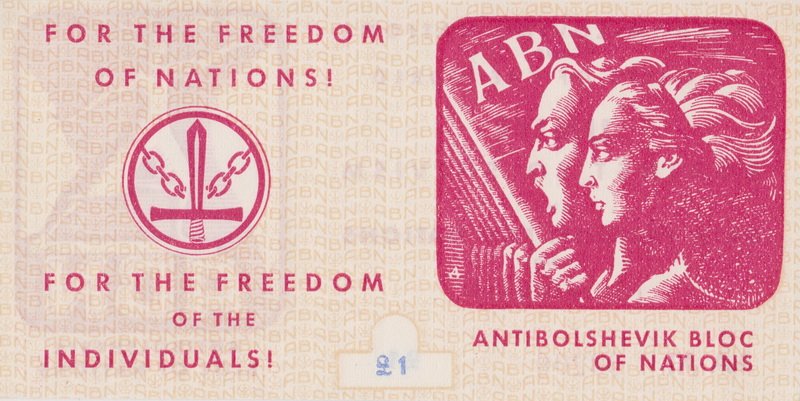
On 16 April 1946, the First Congress of the Anti-Bolshevik Bloc of Nations (ABN) began its work in Germany, which set the goal of liberating the nations enslaved by Moscow imperialism by organizing a common front of struggle and coordinating the efforts of anti-communist factors around the world.
As early as 21 November 1943, delegates of various nationalities, who represented the liberation forces of the nations who fought against the imperialists, gathered secretly, under the protection of the UPA, for the Conference of the Enslaved Nations of Eastern Europe and Asia, in the village of Buderazh in the Rivne region, to create a common front of revolutionary struggle against the invaders.
The conference strongly condemned Hitler’s and Stalin’s imperialisms, which denied the right of nations to their free political and cultural development in independent national states and brought political, social and cultural enslavement to all nations in the form of Hitler’s “new Europe” or “Bolshevik USSR”. The conference practically implemented the idea of a common front of enslaved nations, proclaimed in December 1940 in the Manifesto of the OUN, and became a prologue to the creation of the Anti-Bolshevik Bloc of Nations, which from April 1946, under the constant leadership of Yaroslav Stetsko, elected President of the ABN, and after he died in 1986, under the chairmanship of Slava Stetsko led a decisive and uncompromising struggle against Moscow-Bolshevik imperialism, building a network in all corners of the world, rallying the progressive forces of all nations in the fight against red Moscow.
The leaders of the revolutionary OUN, Stepan Bandera and Yaroslav Stetsko, were clearly aware of the mission of Ukraine, its leading place in the struggle for the freedom of nations and people. “Ukraine is a revolutionary problem of the world,” Yaroslav Stetsko noted, and Stepan Bandera insisted that “without the national-state liberation of Ukraine, the national-state sovereignty of Estonia, Lithuania…, Belarus, the nations and their states of the Caucasus, Turkestan cannot emerge or really hold”… This circumstance imposes on Ukraine, on its national policy, extremely large and decisive tasks for the success of the struggle of the front of the enslaved nations.”
That is why, in the early 1990s, the activities of the ABN were resumed in their native lands, and in November 1993, on the occasion of the 50th anniversary of the Conference of Enslaved Nations, the Congress of the ABN was held in Kyiv, which gave new impetus and new orientations to its activities.
Today, the relevance of the ideas and experience of this organization is obvious. Russian imperialism, disregarding the rights of nations and people, continues the policy of ethnocide of nations seeking national self-determination on the territory of the Russian Federation, and launched a war of aggression against Ukraine, using enslaved people as cheap “cannon fodder”.
Last year, already during the war, on the initiative of the OUN (B), the activities of the ABN were reformatted into the Anti-Imperial Block of Nations. The main goal is the collapse of the so-called Russian Federation and the preparation of enslaved nations to fight for their own states.
So, celebrating the next anniversary of the creation of the Anti-Bolshevik Bloc of Nations, we should first of all look not to the past, but to the future, because the threat of Moscow imperialism looms over the whole world today, and therefore the ideas of the ABN remain acutely relevant.
Let’s remember that freedom loves not the one who praises it, but the one who acquires it.
COMMON FRONT AGAINST IMPERIAL MOSCOW!
FREEDOM TO THE PEOPLE! HUMAN FREEDOM!
Український погляд