

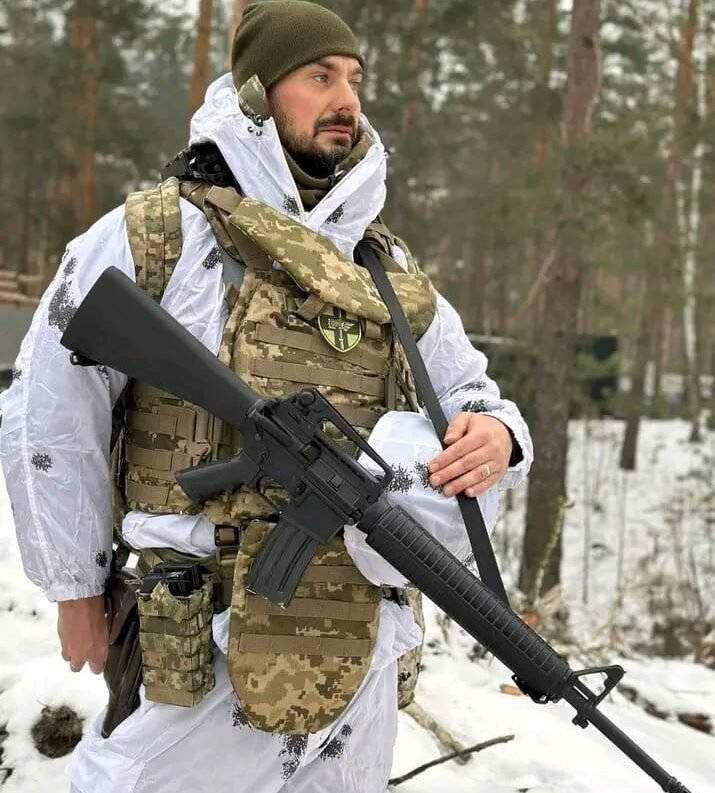
Did you prepare for war as a Ukrainian nationalist?
Probably back in 2002, when I had just entered the first year of Shevchenko University and joined the ranks of the Youth Nationalist Congress, I began to realise: we would still have to face Russia, or rather Muscovy, on the battlefield. The events of 2003-2004 (the escalation around Tuzla Island and the events of the Orange Revolution) further strengthened my belief that this moment, the moment of open armed conflict, was steadily approaching. And what convinced me personally that Russia’s future aggression would soon be a fait accompli? Now I will explain in detail. I was born in the Kuban. This is a region occupied by Moscow. Before the Holodomor and Stalin’s repressions, it was mainly inhabited by Ukrainians and Circassians. Until 2014, I hardly visited there, certainly not every year. I did not watch local television programmes (needless to say, there was plenty of this crap on Ukrainian TV before the war). But sometimes I went to local bookstores, and it was interesting what Russian printed propaganda was offered to the “population”. I began to track the following trend: starting in 2005, bookshelves began to be massively filled with Ukrainophobic literature. Every year, the level of Ukrainophobia grows. The local population (not only the Katsaps, but also the Russified Ukrainians of the Kuban) was frightened by Banderites, fighters of the “Galicia” division, all this was spiced up with books about the “aggressive NATO bloc” and about “wrong Kuban Cossacks who went to serve Hitler”. Another thing that caught my eye: more and more reading material appeared every time about the information and psychological “special operations” of the West against the Soviet Empire, as well as literature on how to confront this West. In the information field and not only. I had no doubts: Moscow was preparing for a global geopolitical revenge. When the events of the Russian-Georgian war of 2008 took place, I happened to be in the Kuban. I saw with my own eyes how Russians were taught to hate Georgians, how from all the receivers and television boxes they shouted about “what a great guy Putin is, he who punched the impudent Saakashvili in the teeth.” Note: it was Putin, not Medvedev, who was then formally the president of the Russian Federation (or rather, the TVO of the president of the Russian Federation). And then, in particular, in the columns of “The Path of Victory”, on the website of the Nationalist Portal, we, Ukrainian nationalists, were the first to declare: “Ukraine will be next”. As you can see, we were not mistaken. At the time Yanukovych came to power in Ukraine, the feeling of an imminent war was irreversible. Therefore, the war did not catch me by surprise. Morally, both my brothers and I had been preparing ourselves for it for many years. But to say that when it all started, we were not at all afraid is not true. But the main virtue, I believe, is not to learn not to be afraid. The main virtue is to learn to overcome fear.
What enables the Ukrainian army to resist the enemy?
I cannot explain this rationally. There is no rational explanation for the fact that we can defeat the enemy, being many times inferior in manpower, in terms of economy (here the enemy’s advantage is probably dozens of times), and in terms of the amount of equipment. Many people talk about higher motivation. Someone talks about the desire to avenge the fallen brothers and sisters. But there is something more here. Apparently, the Ukrainian land itself helps to stop the enemy; apparently, the entire strength of our ancestors, warriors of past generations, stood against the Muscovite horde and gives us strength. Honestly, I cannot explain it. You have to feel it.
How does a Ukrainian nationalist see the current state of the army and the development of the army in the future?
Let’s start with the fact that the most effective units on the front are currently those formed by people with a nationalist worldview. It is where there are battalions, brigades, and corps formed by nationalists that the front line is most stable. The command of these units has managed to combine the unique Ukrainian experience of waging war with the best Western practices. Nationalist commanders achieve results thanks to a combination of patriotism and professionalism. But it is important for a nationalist in the army now, not only to cultivate his combat skills and leadership. It is important to prevent the revival of the “scoop” in the army! And he, this “scoop”, unfortunately, is actively raising his head in many brigades.
The struggle consolidated Ukrainians. How to maintain unity?
For the military, it is not orders that help to maintain unity, but a sense of a common goal, a sense of support, of a comrade-in-arms. For society, it is the right accents in the information field (and we are currently having trouble with this). It is also important to be in the right environment. Such an environment should become expansive; it should, figuratively speaking, crush the chatter of evaders and outright pro-Moscow capitulators.
Who can be our allies, besides Western partners?
Ukrainian nationalists once clearly formulated the rule of our struggle: first of all, rely on your own strength. If we talk about geopolitics, then allies, first of all, are the countries of Europe. I emphasize – Europe. Natural allies are also the enslaved peoples of Russia. They have been increasingly actively involved in the armed resistance to Moscow, starting in 2014.
What windows of opportunity does war open, despite its cruelty?
The war gave us geopolitical subjectivity. No boxing, football, or Eurovision has made the whole world talk about Ukraine. There is one more thing that has made our nation absolutely unique in the history of the 21st century: for example, I am giving this interview in the midst of the disgusting sounds of a Russian drone and the explosions of KABs. So, at this very time, thousands and thousands of Ukrainians, in breaks between combat activities, write poems, prepare scientific reports, shoot videos, and do absolutely unique things that can enrich the cultural fund of humanity. No nation can do that. We give the entire civilized world a unique experience. If the world strives for development, not chaos, then it is simply obliged to help us win this war.
How to combat hostile IPSOs?
And here is the question of the political will of the Ukrainian leadership. Is it ready to block hostile resources (Telegram, for example) for the sake of victory? Is it ready to put in place those who spread hostile narratives? Is it ready to get rid of Russian agents, in particular, the Yanukovych-Sivkovych-Portnov-Lyovochkin-Boyko agent network? Yes, the authorities are really consistently fighting Medvedchuk’s followers. But why are Portnov’s henchmen still at large? Why haven’t sanctions been imposed against Yanukovych’s former head of the Presidential Administration, Serhiy Lyovochkin? Why are Buzhansky, Boyko, and other scum from the OPZH sitting in the Verkhovna Rada? It’s not really that difficult to confront hostile IPSOs if you eliminate the promoters of the Russian narrative. But for someone, having extra button-pushers for dubious bills and their own people in the judicial branch of power is more important than the prospect of victory over Russia. And until there is a total purge of Russian agents, we will lose in the information field.
What role can Ukraine play after the war?
Ukraine has already given the world experience, the experience of victories over an enemy that many times surpasses it in all components. In addition to the following components: love for the Motherland and for your neighbour. Ukraine is already showing the world that wars cannot be won by having nuclear weapons, bottomless mobilisation resources and other nuts and bolts. Ukraine will give the world knowledge of how to outwit a stronger opponent, relying primarily on its intellect. And strength of spirit, too.
What will historians call this war?
It will be called differently: Russian-Ukrainian, continental, the beginning of the Third World War, Russian-European, Asian-European (the aggression of the Russian Federation against Europe with the support of its satellites – Iran and the DPRK in agreement with China – seems inevitable to me, given the indecision of some of our allies)… And for us, it was, is, and will remain the War of Independence without a doubt.
What would you like to say to Ukrainians, both those in the military and those outside it?
If you love – act! If you love your Motherland, if you love your family, your neighbours. And if not – put your passport away and go wherever you want, just don’t get in the way, don’t show your sly snot here! The state can survive without clowns, football players and other “fighters of the informational-economic-demographic front”. But without soldiers – no.
Taras Mudryi spoke.






