

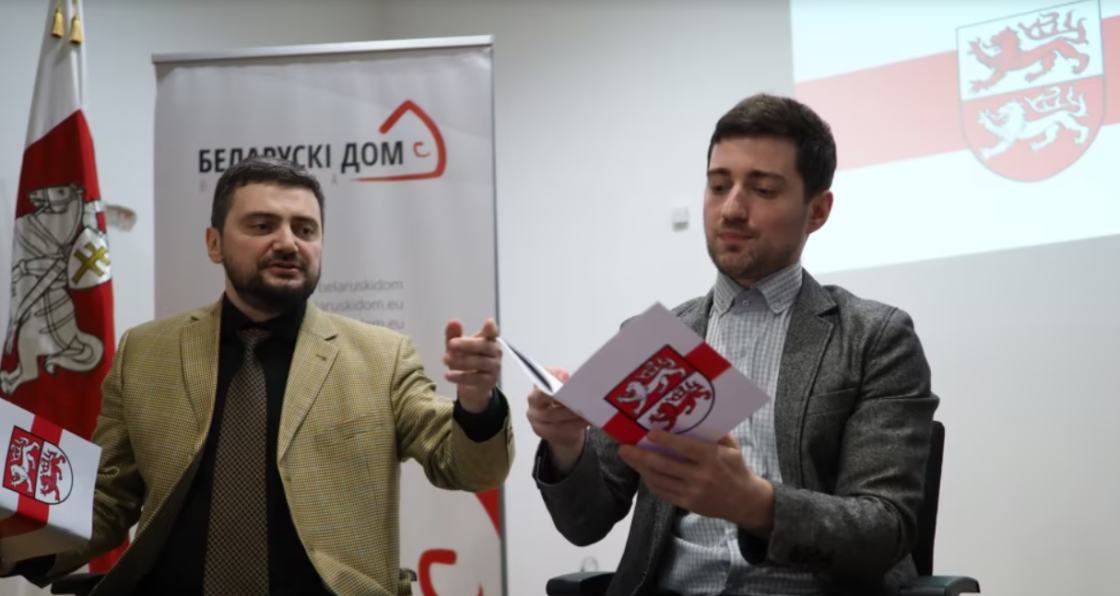
They expect that the independent Smolensk region will speak three languages.
On the evening of 21 March, in Warsaw, representatives of the Smolensk Republican Centre (SRC) presented the draft Constitution of the future Smolensk Republic. Activists advocate for the revival of the lost statehood of their region. In their opinion, the development of an independent Smolensk region is possible only in a close union with Belarus – also liberated from the regime of Alexander Lukashenko – and the main languages in the republic, in addition to the now dominant Russian, should become the Belarusian and Starosmolensk languages ( the activists themselves consider the Starosmolensk dialect a dialect of Belarusian – “Idel.Realities”).
A draft Supreme Statute of the Smolensk Republic was presented by a doctoral student in ethnology at Charles University (Czech Republic), an expert on national movements of the nations of Russia, Harun Sidorov, and ex-deputy of the Smolensk Regional Duma Vladislav Zhivitsa. (The latter left Russia in 2023, was declared a “foreign agent” by the Ministry of Justice of the Russian Federation in the winter of 2024 and was deprived of his deputy mandate after he announced in Warsaw, the creation of a movement for the independence of the Smolensk region).
The current Russian deputy announced the creation of a movement for the independence of the Smolensk region
Sidorov explained why they decided to develop the draft document now when further developments of events are still impossible to predict, and mainly, representatives of the SRC speak openly about the independence of the Smolensk region.
“As the events currently taking place in the Belgorod region show, what was unimaginable just a couple of years ago is becoming a reality. The Smolensk region is also a border region. We do not wish such trials for the civilian population of our homeland but we need to prepare for an even more rapid development of the historical process,” the expert warned.
According to Sidorov, when preparing the document, they “largely used” the provisions of the Lithuanian Constitution and “partially, since we are talking about a parliamentary republic, the experience of Germany.”
“This is a project that we are now putting forward for discussion.” Starting next week it will be available on the Smolensk Republic telegram channel. Ready for amendments and modifications. Of course, the constituent assembly will adopt the constitution if everything goes the way we see it,” the ethnologist added.
Activists assured that the Smolensk Republic plans to remain within the very borders in which the Smolensk region is now located and will not have territorial claims against neighbours who respect its integrity and sovereignty.
The authors of the draft Constitution of the SR announced a language reform, which will begin with the fact that “the literary Belarusian language will receive official (optional) status on an equal basis with Russian.”
Sidorov explained that the ideologists of the movement plan to “preserve the practical use of the Russian language in the Smolensk region – simply by the fact that it dominates,” although “the most conscious participants in the movement are trying to learn the Belarusian language” (the ethnologist himself began his speech with a small part in Belarusian, but then switched to Russian – “Idel.Realities” ).
— From experience, this [ language issue ] is one of the most psychologically difficult things for such an “adult” population. This will take time. We want this to be smooth and comfortable for people. Programmes, projects, student exchanges, the appearance of Belarusian subtitles… We are in favour of accustoming the population to the Belarusian language – but doing this tactfully, so that there is no situation in the region – which has not even been subjected to Russification, but to an even more thorough Muscovization than Belarus – based on speculation and protests,” the expert explained.
According to the ethnologist, the problem “is not the Russian language as such for the Smolensk region, the problem is its lack of alternative.”
Activists plan to make Starosmolensk the official language of the Slovak Republic. Sidorov agrees that it can be considered one of the dialects of the Belarusian language, but insists that the independent Smolensk region needs its own language.
– If we are talking about statehood, then our Smolensk dialect is beneficial for us – initially even such an expression appeared – [ make it state ]. It’s more about status language. Even at Smolensk State University, there is a group of scientists who are reconstructing this language. There is an Irish example. I know that it is not applicable to Belarus, but it is completely applicable to the Smolensk region. There is a status language that guarantees Irish identity, Irish statehood, but at the same time they speak English for the most part,” Sidorov explained.
To the question of how ready the residents of the real Smolensk region themselves are to accept the Smolensk identity, Vladislav Zhivitsa answered.
— We receive feedback from young people in the Smolensk region. They are now having a giant identity crisis. They understand that they have no future in Russia. At all. And now they are trying to find some kind of identity. They look at some right-wing radical movements like the RDK and think that we are also trying to create something like that, some kind of separate Russian republic. But, unfortunately for them, this is not the case. “A lot of young people want to jump out of Putin’s Russian matrix and, while remaining Russian, jump to some Russian republic,” the ex-deputy outlined the problem.
The Second Coming of Merya: “You can no longer recognize us as a dead nation”
The representatives of the SRC themselves do not hide their pro-Belarusian vector, speaking about “the common Kriv and Litvinian roots of the autochthonous population of Belarus and the Smolensk region.” In relations with Belarus, they expect to be guided by the principle “One people, two states,” citing as examples Azerbaijan and Turkey and Moldova and Romania.
Vadim Sidorov assured that there are supporters of the ideas of the SRC within the Smolensk region, but they are still deep underground since Russian security forces monitor and harshly suppress such movements.
“It is clear that the region is in a scorched earth state. People are afraid. Nevertheless, over these six months, we even held two events in the Smolensk region with our stickers and stencils. But unfortunately, even though we asked people to be careful, they did not fully comply with this. After we were faced with the consequences, we decided to suspend these actions for now,” the ethnologist explained.
Finno-Ugric activists began posting leaflets in Russian cities
— We ask people to maintain information security. It is very difficult for us to break through the information bubble in which Russia and the Smolensk region are now located. I was declared a foreign agent – people are afraid of this, and in Belarus, our telegram channel was generally recognized as extremist,” Zhivitsa added, complaining that this also did not add opportunities for SR supporters to “propagate their ideas.”
- The Smolensk Republican Centre is not the only association of regionalists who promote the ideas of independence and a different identity from the all-Russian one for their regions. Most representatives of such movements participate in the Forum of Free Nations of Post-Russia. Before the large-scale invasion of Ukraine by the Russian Federation, regionalists held discussions within the framework of the Free Russia Forum, founded by opposition politicians Garry Kasparov and Ivan Tyutrin, but after 24 February 2022, most of them gathered at the Forum of Free Nations of Post-Russia.
- At the same time, the themes of regionalism and one’s own identity are increasingly being developed not only within ethnic movements from the Russian republics but also in the case of conditionally Russian regions. Thus, along with the Tatars, Bashkirs, Buryats, Kalmyks, representatives of the Pskov region, Smolensk region, Ingermanland (a region that includes St. Petersburg and the Leningrad region), etc., also speak about the future independence of their regions.
- The rhetoric of most regionalists underwent significant changes precisely in connection with Russia’s attack on Ukraine. If previously the main topic on the agenda was genuine federalization, then from 24 February the vector shifted towards complete separation from the Russian Federation. Regionalists believe that this is the most effective way to combat imperial narratives.






