

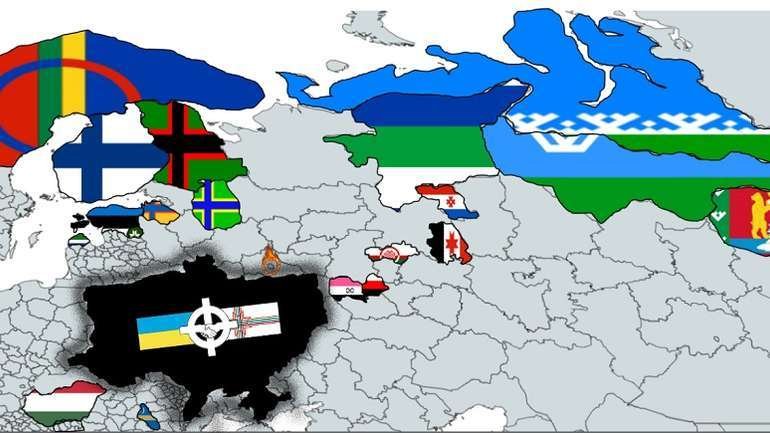
(In this three-part series, the author expresses his own views on the role of Ukraine in restoring the Eurasian balance, disturbed by the Kyiv state during the wars for the Finno-Hungarian lands in the 9th-11th centuries. The first part is devoted to the geography of all Finno-Hungarian countries of the Russian Federation). Detailed information about the resettlement of the Finno-Ugric peoples in the 9th-11th centuries is contained in the works of Nestor the Chronicler. His information about the Finno-Ugric character of the current ethnic center of the Russians is confirmed and expanded by modern archaeological and linguistic data.
Thus, the Ukrainian scientist Orest Tkachenko proved that Moscow was built by the Kyivan Prince Yuriy Dolgoruky in the ethnic heartland of the mayor’s people. This tribe was linguistically assimilated only at the end of the 18th century. At the beginning of the 17th century, the Moscow principality consisted almost exclusively of Finno-Hungarian lands, Moscow had Slavic lands only in its south and northwest. Actually, it was the eastern outskirts of Belarus and Ukraine.
So, Muscovy achieved the main successes in the process of “collecting land” precisely on the Finno-Hungarian territories. Both in the 17th century and today, these areas were not and are not enclaves in the Slavic Sea, on the vast expanses from the Kola Peninsula to Voronezh and from Pskov to the Yenisei, they form a continuous and “firmly stitched” Finno-Ugric continent. After the annexation of Finland in 1809, the Russian Empire united all the Finno-Hungarian peoples of the world (with the exception of Central European Hungarians). For the first time since the prehistoric dispersion of the Finno-Ugric people, they began to live under one state roof! With the collapse of the USSR, the Russian Federation took on an even greater, so to speak, appearance of a Finno-Hungarian country. However, the political influence of ethnic Finno-Ugric people on modern Moscow is limited by their internal diversity. Currently, there are four large enclaves of the Finno-Hungarian peoples in Russia. All of them aspire to regional formations and have, accordingly, different geopolitical centers of gravity. Finno-Baltic, consisting of Karelia, Izhoria, Votlandia, Ingermanlandia, Vepslandia and Seto Country. Eastern Saami stands separately in this row, which, together with the Kola Peninsula, tends to integrate into Swedish and Finnish Saami. Finno-Volga, consisting of Erzyan Mastor (East Mordovia), Mokshen Mastor (West Mordovia), Meshcheria and Mariy El. This also includes the now dead Muroma, first assimilated by the Erzians, i.e. the Mordovians, and then finished off by the Suzdal occupiers. Finno-Permian is Udmurtia, Besermyania, Komi and Komi-Parma. The Ural enclave consists of the Khanty and Mansi, who today not only associate with the small non-Finno-Hungarian peoples of the North, but also make attempts to integrate into their communities.
According to official statistics, the total number of Finno-Ugric citizens of the Russian Federation reaches almost four million people, and more than a million of them are Erzyans. However, I note that for most Finno-Ugrians, the name “Russian” is also acceptable – they attach their own identifying meaning to it. That is why official statistics in estimating the number of Finno-Ugric population are unacceptable. Rather, it reflects an ethnically active, conscious element of the Finno-Ugric peoples, as if only members of the OUN-UPA and their families were recorded in Ukrainian. According to the data of the FSB of Russia, made public by People’s Deputy of Ukraine Mykola Haber in the winter of 2001, out of approximately 150 million citizens of the Russian Federation, more than 50 million are either Ukrainians, or have Ukrainian relatives, or come from Ukraine, or bear Ukrainian surnames. The same number in one way or another belong to the Turkic peoples. Well, the rest are just “pure Russians”, or, as a matter of fact, Finno-Russians. Therefore, I am inclined to believe that today in the Russian Federation there are not 4, but about 50 million Finno-Ugric people.
An important task of Ukrainian ethnographers and politicians is to promote the restoration of the “original identity” of these Eurasians. After all, during internal self-identification, the generic term “Fino-Ugric” is just as unproductive as “Slav”. In addition, most of the Finno-Hungarian peoples have their own diasporas within the Russian Federation, which play an independent role in Western Siberia, the Far East, and the Urals. I note that the most powerful of these diasporas are Mari and Erzyan. All Finno-Hungarian nations of the Russian Federation currently practice Orthodoxy; the exceptions are Ingermanland Lutherans and part of pagan Maris. So there is no civilizational watershed between the 17 Finno-Hungarian nations. It is quite obvious that they, like Ukraine, are the heirs of the Byzantine sacral tradition! The political potential of the Finno-Hungarian peoples depends on their federal status, the level of independence of republican constitutions from the Basic Law of the Russian Federation, and their proximity to non-federal geopolitical players.
Rostyslav Martyniuk
Останній бастіон





