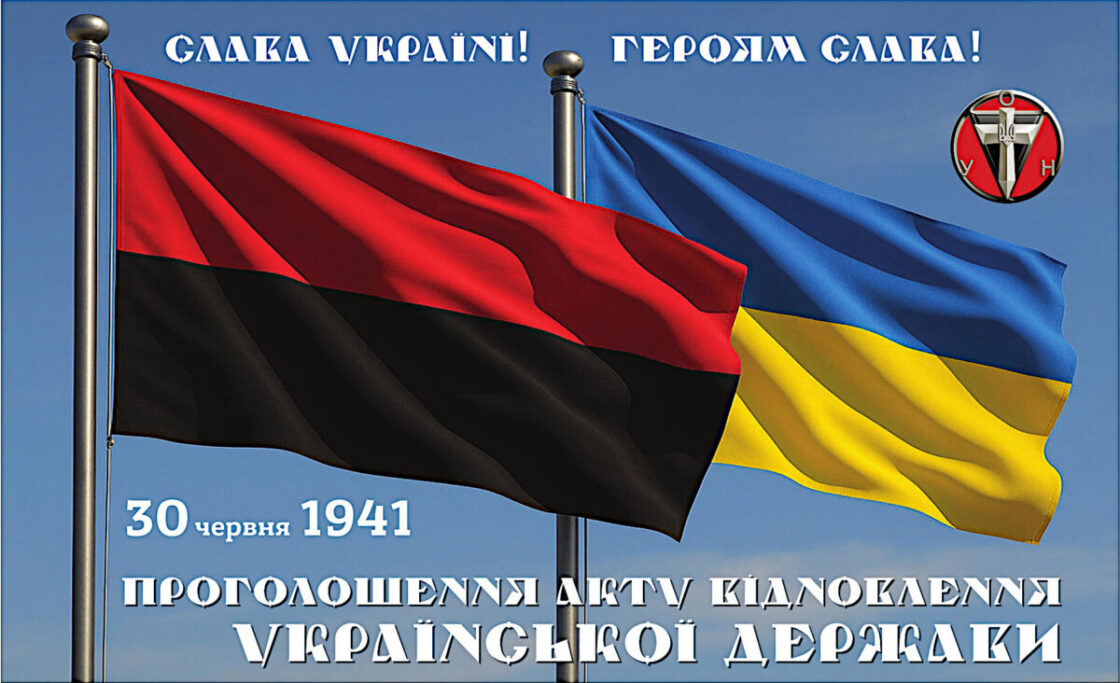
On 30 June, we celebrate the 85th anniversary of the beginning of national statehood, initiated by Ukrainian nationalists in extremely difficult conditions. On the last day of summer 1941, the first deputy leader of the OUN, Yaroslav Stetsko, proclaimed the Act of Restoration of the Ukrainian State at the National Assembly in Lviv. Unfortunately, the then Ukrainian statehood is still one of the most mythologised and underestimated pages in the history of our Motherland in the modern era. It is still often perceived distortedly. What is the historical significance of the Act of Restoration of the Ukrainian State?
First, the Act of 30 June confirmed the subjectivity of the Ukrainian Nation in the historical arena. Without waiting for permission from the Nazis, the OUN under the leadership of Stepan Bandera began to create history, striving to restore the independence of Ukraine. A policy of fait accompli was chosen, which was to confront Berlin with the reality of Ukrainian independent existence. The leadership of the OUN(r) initiated a national revolution. Ukrainian nationalists raised an uprising against the Moscow occupiers and liberated entire regions of Western Ukraine and several important settlements with their own forces. In particular, before the arrival of the Germans and their allies, they took control of Kolomyia, Stanislaviv, Terebovlia and other cities. The decisive actions of the OUN(r) became a challenge not only for the USSR, but also for Hitler’s Germany, whose representatives already on 30 June 1941 demonstrated a negative attitude towards Ukrainian statehood. Despite this, the head of the Ukrainian State Board – the Provisional National Government, Ya. Stetsko, continued his state-building activities. On 4 July 1941, at a meeting with the public in Lviv, he emphasised that the Nazis should be confronted with fait accompli, “without waiting for their permission or consent.” The Ukrainian state, restored 85 years ago, along with Lithuania, where local nationalists proclaimed the Act of 24 June, became the only political organism in Europe that emerged without external support from any of the great powers in the conditions of World War II. The Ukrainian liberation movement demonstrated that it was a sovereign force. The Act of 30 June manifested the will of the Nation for independent political existence and became a symbol of the uncompromising desire for national freedom.
Secondly, the Act of 30 June and the subsequent Ukrainian state formation demonstrated the effectiveness of the OUN liberation struggle. Over 12 years of resistance to the overwhelming forces of the occupiers, the Organisation of Ukrainian Nationalists managed to realise its central goal – to gain national statehood for Ukrainians. The state formation of 1941 had not only symbolic weight, but also quite specific practical fruits. Ukrainian authorities were created at various levels: from village to regional administrations and a temporary national government. Despite the arrest of Ya. Stetsk on 9 July 1941, the state formation process continued, thanks to the advance of OUN detachments to the east. Ukrainian authorities subordinated to the UDP at the regional level appeared in the modern Lviv, Ivano-Frankivsk, Ternopil, Volyn, Rivne, Khmelnytskyi, Zhytomyr, Dnipropetrovsk regions, and at lower levels of government also in Vinnytsia, Kyiv, Cherkasy, Kirovohrad, Odesa, Mykolaiv, and Kherson regions. It was a grandiose, large-scale process of state formation. The formed Ukrainian authorities contributed to the realisation of the interests of local Ukrainians, establishing order, providing assistance to those affected by the war, and establishing socio-economic, cultural, and public life. For the first time in a long time, Ukrainians felt like masters of their own land. In general, the process of Ukrainian state formation lasted about 2 months and was finally suppressed by a wave of large-scale Hitlerite repressions in the fall of 1941.
Thirdly, the OUN’s approaches to Ukrainian statehood under the leadership of S. Bandera demonstrated the maturity of the national elite of that time. The mistakes of the first liberation struggles were taken into account when the Ukrainian statehood was torn apart from within by internal party struggle, and the lack of timely development of the armed forces led to a catastrophe. Ya. Stetsko formed the composition of the UDP not according to political, but according to professional principles, guided by the concept of national solidarity. He actively encouraged the cooperation of yesterday’s political opponents of the OUN, who belonged to the legal interwar parties of Western Ukraine: the right-wing FNE, the centre-right UNDO, the left-wing USRP. Among the 13 departments (ministries) of the UDP, only two – state security and foreign affairs – were headed by members of the OUN (r). In an effort to unite the independent forces around the development of the Ukrainian state, Yaroslav Stetsko made attempts to attract opponents from the camp of Andriy Melnyk and the leaders of competing emigration political forces to cooperate – the head of the State Centre of the UNR in exile, Andriy Livytsky and Hetman Pavlo Skoropadsky. The national interest was placed above narrow political ambitions. At the same time, Ukrainian nationalists began active measures to form an army. Already in the Act of 30 June, the creation of the Ukrainian National Revolutionary Army (UNRA) was mentioned, the commander of which was Ivan Klymiv on 1 July 1941.
Fourth, without the Act of 30 June and the state formation of that time, there would have been no heroic two-front struggle of the UPA, which allowed Ukrainians to become an independent belligerent in the realities of World War II. After their arrest by the Nazis, Ya. Stetsko and S. Bandera, despite fierce pressure, categorically refused to revoke the proclamation of the restoration of the Ukrainian state and dissolve the government. On 15 September 1941, due to their uncompromising defence of national interests, the leaders of the Ukrainian liberation movement were sent to a Berlin prison, and later to the Sachsenhausen concentration camp. Under the pressure of repression, the OUN (r) went underground and began to prepare for active resistance to the German occupiers. At the same time, the military construction of the summer of 1941 largely laid the foundations of the UPA in material and personnel terms. When creating the UNRA, dozens of senior and junior officers’ training sessions were held, veterans of the first liberation struggles were involved in cooperation, and a significant amount of weapons and equipment was collected. For example, the UNR army officer Leonid Stupnytsky, who was the chief of staff of the Rivne UNRA regiment, would later head the UPA-“North” headquarters, and the commander of the aforementioned Kholodny Yar unit, Serhiy Kachynsky, would become one of the first organisers of the insurgent units. Significantly, the Ukrainian liberation movement in its documents repeatedly called for the restoration of the Ukrainian state in the summer of 1941. In particular, in the resolutions of the II Conference of the OUN (r) in April 1942, it was stated: “In our modern struggle, we stand on the principles, on which the Act of 30 June 1941 was based.” It is quite fair to believe that without the decisive state-building measures of the revolutionary OUN in the summer of 1941, the Ukrainian liberation movement would have suffered the fate of the Belarusian patriotic camp, which in the conditions of World War II chose a passive position and was discredited due to cooperation with the German administration.
Thus, the Act of 30 June 1941 opened a new page in the history of the Ukrainian liberation struggle, bringing it to a new level. Relying exclusively on its own forces, the OUN activists under the leadership of Stepan Bandera managed to restore the Ukrainian state on a significant stretch of territory, where independent Ukrainian power reigned. These events are a vivid example of how, in difficult circumstances, bold and decisive actions can have a far-reaching impact on the fate of the nation. Without a doubt, the national state formation of the summer of 1941 became an important stage in the history of Ukrainian statehood, a precedent that motivated Ukrainian nationalists to heroic feats in the subsequent extremely difficult two-front war. Modern Ukraine is the heir not only to the tradition of the UNR of the era of the first liberation struggles, but also to the Ukrainian state restored by the Act of June 30, 1941.
Український погляд