

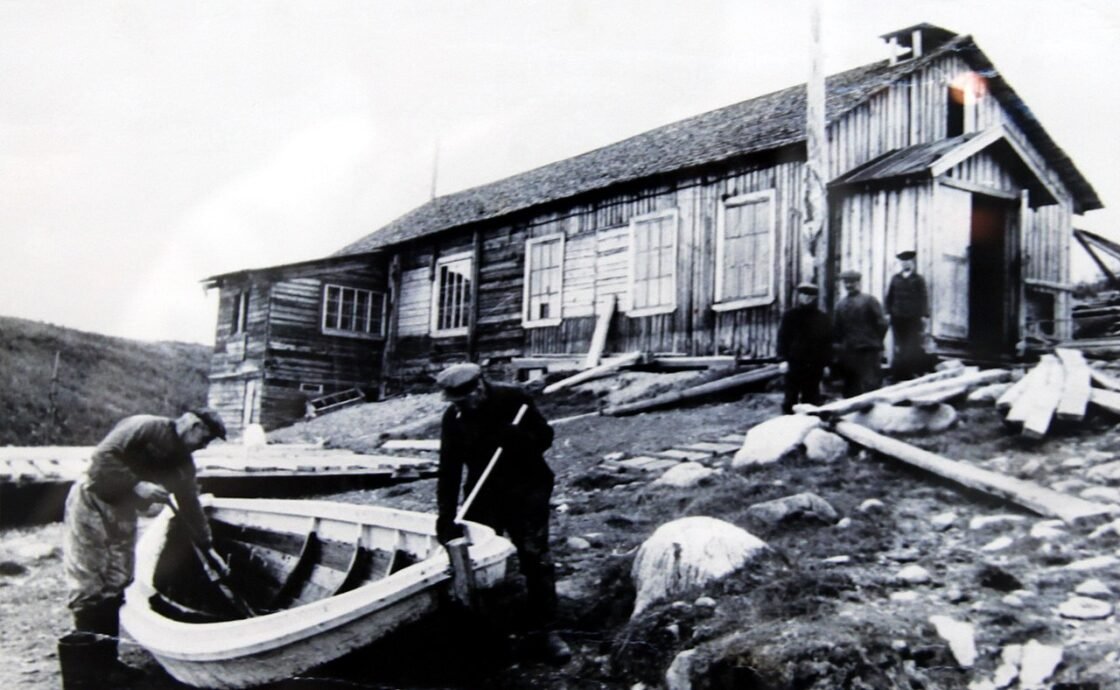
Before the First World War, the majority of the Norwegian diaspora lived on the Rybachy Peninsula. According to Russian sources from 1915, there were only 290 colonists residing on the coast of the Murmansk Bay. They maintained connections with Vardø and Norway, and their location allowed them to engage in trade and fishing in the Barents Sea. However, after the Russian Revolution, Norwegians began to anticipate challenging times, and the situation in Tsypnavolok began to deteriorate. The Rybachy Peninsula was a restricted area, and obtaining permission to travel there was extremely difficult.
The 1917 Revolution in Russia radically changed the situation of Norwegian colonists on the Kola Peninsula. They lost contact with Norway and became part of the new states – Finland and the Soviet Union. In the 1930s, Norwegian colonists joined the fishing collective farm “Polar Star.” Thanks to modern equipment and new vessels, the fishermen of “Polar Star” were able to significantly increase their catch, making Norwegians among the most prosperous residents in this part of the USSR.
“By the beginning of collectivization, we were earning good money from fishing, but then the crackdown began. Gradually, many of us were arrested and deported. We never saw them again,” Bjørne Jørstad recounted.
Norwegian colonists were accused of maintaining contacts with Norway and having a negative attitude toward Soviet authority. Many Norwegians were arrested and sent into exile in several waves. The NKVD established quotas for “enemies of the people” who were to be eliminated.
Among those executed were Karl and Ragnar Ulseen, Herman and Gustav Aronsen, Arne Tursen, and Emil Martinsen, all of whom were fishermen from Tsypnavolok. They were executed in Leningrad on September 21, 1937, and were buried in a mass grave north of the city. Every fourth Norwegian from the colony, which comprised about 150 people, fell victim to political terror. Approximately 20 Norwegian colonists were killed or perished in camps in the late 1930s.
“At first, they relocated us to Karelia to work the land. We weren’t very good at it, you see, as we were all fishermen. After a year, they moved us to the forest, to Arkhangelsk. That’s when things truly became difficult,” said Jørstad.
In Arkhangelsk, the conditions were extremely challenging, and Norwegian colonists faced acute food shortages. Many of them died of hunger, effectively marking the end of the Norwegian colony in Russia. After the end of World War II, some of the surviving “Kola Norwegians” returned to the Murmansk Region. However, there were never any plans to recreate a Norwegian settlement similar to Tsypnavolok before 1940.
Note: for a quick information search please subscribe to our Telegram channel “Freedom for Nations!” https://t.me/ABN_Freedom_for_Nations
Also, read the Facebook materials of the ABN page and the group
Our site: https://abn.org.uaen/






