How It All Began
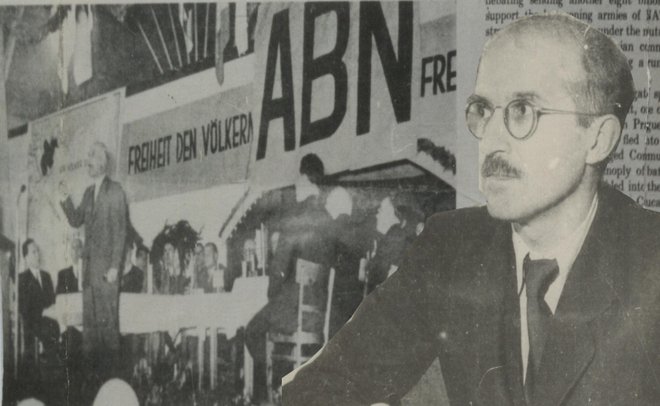
From today’s point of view, declassified materials about the activities of the ABN are perceived in a special way. Programme documents stored in the intelligence archive, speeches, addresses, and publications of the leading figures of this organization make it possible to understand the aggressive essence of the current policy of the Kremlin, to estimate the reaction of Western countries to this policy in different historical periods, to bow our heads to the caring Ukrainians who never believed in any of Moscow’s promises, did not entertain themselves with illusions, did not stop the struggle for a free and independent Ukraine, and therefore called on all nations enslaved by the Bolsheviks to stand under their banners in this fierce struggle.
The activity of the Ukrainians in the ABN is a vivid example of how the nation, in extremely difficult circumstances under the communist totalitarian system and in the conditions of emigration, relying only on its own strength, managed to turn the tide of events and restore its independent state.
The way the KGB monitored the ABN activities, collected information, developed plans to prevent various actions to discredit and even physically destroy the leaders of this organization, on the instructions of the Kremlin, also testifies to the ABN’s power, influence and real threat to the Moscow empire.
An extract from the “Encyclopedia of Ukrainian Studies” published abroad by the Taras Shevchenko Scientific Society is kept among the archival documents. It states: “ABN (Anti-Bolshevik Bloc of Nations) is the name of the coordination centre of the revolutionary liberation organizations of nations enslaved by Bolshevik Russia. Founded on the initiative of the OUN on November 21-22, 1943 at a secret conference in the Zhytomyr forests with the participation of delegates from 12 nations, reorganized in 1946 in exile. Organizations of the following nations (as of 1954) are represented in the Block: Albanians, Belarusians, Kazakhs, Latvians, Lithuanians, Slovaks, Turkestans, Hungarians, Ukrainians, Croats, and Czechs. Since 1948, the ABN has been headed by Y. Stetsko, who was elected as the head of its Central Committee in 1954”.
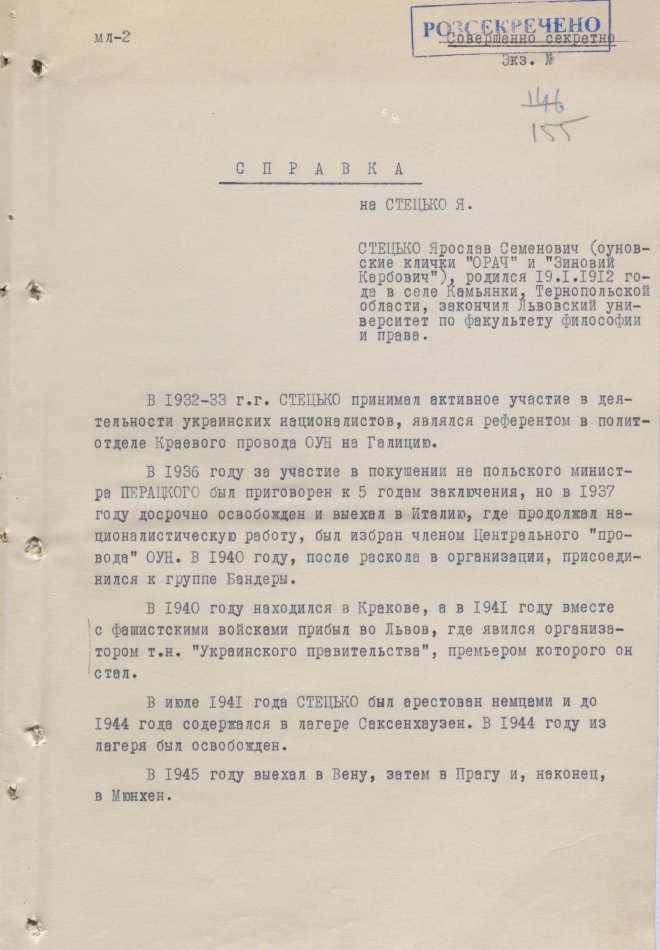
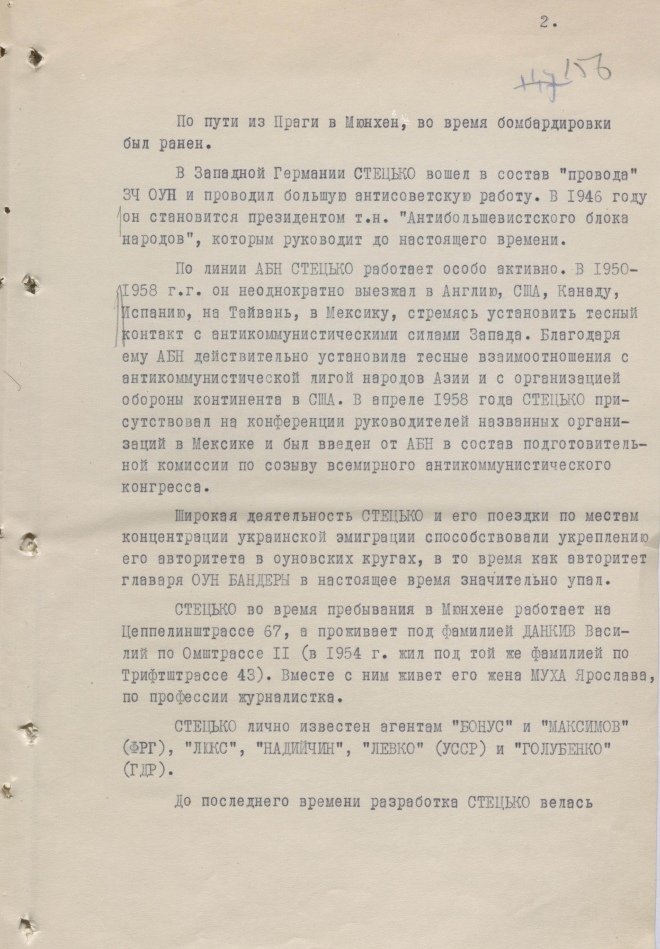
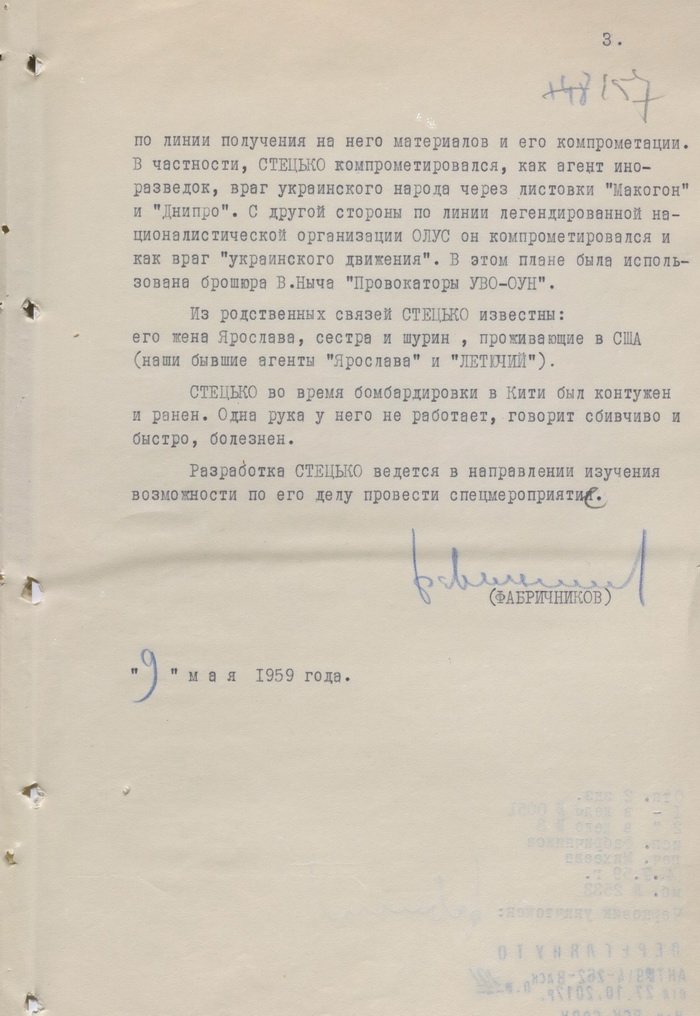
Other documents supplement and clarify this information. For example, the reference of the KGB under the Council of Ministers of the Ukrainian SSR from December 1958 on a member of the Foreign Units of the OUN and the head of the ABN, reads as follows: “The idea of creating a single anti-Bolshevik bloc has long been held by the Banderites and Stetsko himself. Back in 1943, the “First Conference of Enslaved Nations of Eastern Europe and Asia” was held in the territory of the Volyn region, but it was not possible to create a single centre on the territory of the Soviet Union at that time due to the successful offensive of the Soviet Army”. (BSA of the SZR of Ukraine. – F. 1 – Case 13091. – V. 3. – P. 40).
There is more detailed information about that conference. In May 1945, People’s Commissar of State Security of the Ukrainian SSR Serhiy Savchenko informed Moscow that “during the liquidation of an underground printing house in the Rivne region, an OUN-UPA document entitled “The First Conference of the Enslaved Nations of Eastern Europe and Asia” was seized”.
That was a sort of extended report on the event. It stated that 39 delegates from 13 nationalities took part in the work of the conference in the village of Buderaj, Zdolbuniv district: 6 Georgians, 6 Azerbaijanis, 5 Uzbeks, 5 Ukrainians, 4 Armenians, 4 Tatars, 2 Belarusians, 2 Ossetians, 1 Kazakh, 1 Circassians , 1 Kabardian, 1 Chuvash, 1 Bashkir. First, the participants observed a moment of silence in memory of the fighters of all enslaved nations who died in the struggle for national independence. Then, after a series of reports and discussions of the political situation, they agreed on the need to create a common front for the “struggle for national liberation from the oppression of the Stalinist and Hitler invaders” (BSA of the SZR of Ukraine. – F. 1. – Case. 7088. – V. 1. – P. 359-360).
After the Second World War, the OUN had to adapt to new conditions and change the tactics of the national liberation struggle. Millions of Ukrainians found themselves in exile, the Ukrainian Insurgent Army (UPA) continued its underground armed struggle on the territory of Ukraine. In the conditions of unequal confrontation, it was necessary to seek support among the countries of the West, to unite with other organizations and movements that were fighting for their freedom in a similar situation.
Therefore, the ABN underwent a reorganization. In 1948, 14 more nations joined it — Komizerians, Mordvins, Maris, Cossacks, Lithuanians, Latvians, Romanians, Slovaks, Balkars, Turkmens, Tajiks, Kyrgyz, Kara-Kalpaks and Serbs. By 1954, representatives of 6 more nations had joined the Anti-Bolshevik Bloc, including Albanians, Bulgarians, Estonians, Croats, Czechs, and Hungarians. In the 1970s, Cubans and Vietnamese joined the ABN. So, in total, representatives of 35 nations were part of the ABN. During 1946-1986, the leader of the ABN was Yaroslav Stetsko.
“The Struggle Against Russia Is Ukraine’s Historical Destiny”
In the period of 1943–1955, the organizational formation of the ABN took place, there was the implementation of a number of ideas, actively seeking ways to enter the world political arena. What were the political goals that contributed to so many supporters joining?
Among the archival documents, there is a programme article by Yaroslav Stetsko entitled “Problems of the Ukrainian Revolutionary and Liberation Policy”, published at one time in the socio-political and scientific-literary monthly “Vyzvolnyi Shlyakh” (“Liberation Path”) for July 1960, which partially answers this question.
Already in the first paragraph, the author declares: “Our concept of liberation is the Ukrainian national liberation revolution, together with the liberation revolutions of nations oppressed by Russian imperialism and communism, meaning, nations enslaved within the framework of the Russian empire”.
Yaroslav Stetsko further develops his idea and emphasizes: “The restored Sovereign United Ukrainian State will be a revolutionary phenomenon in the foreign-political and international aspect as well because it will create a completely different concept not only in Eastern Europe but also in Asia: due to the collapse of the Russian Empire, which today covers the great territory of two continents, revolutionary changes will take place in the structure of the international forces of the whole world. Therefore, the restoration of the Ukrainian state belongs to the most important problem of world politics. But this cannot be achieved by any means of separate, isolated liberation, nor by way of diplomatic negotiations, but only through a fundamental change of the current order in the East of Europe and in subjugated Asia, i.e. through the collapse of the Bolshevik empire”.
The struggle against Russia as “an eternal invader, enslaver, destroyer of cultural and social values, an enemy of human and national freedoms”, according to the author of the article, is the historical destiny of Ukraine, and in this struggle “Kyiv has always been a symbol of the freedom of people and nations, justice and faith in God, as opposed to Moscow, which is a symbol of slavery, tyranny and impiety”.
Therefore, Yaroslav Stetsko concludes that “The ABN is the only real, vitally justified concept of the liberation of the nations enslaved by Moscow Bolshevism” and that “the enemy of Ukrainian national-state independence is the entire Russian political world, regardless of its party-political colour”, because among Russians there are no anti-imperialist political groups.
An important place in programme provisions is given to the activities of international organizations and their capability of protecting the rights of enslaved nations and being real guarantors of freedom and independence. “From this point of view”, the ABN leader notes, “the United Nations will fulfill its positive role in the future, when the right of veto is eliminated and all states have equal rights, and if, after the collapse of the Russian Empire, the United Nations include spokespeople from the nations that have been subdued so far… The current United Nations must be reorganized in the sense of excluding from it the representatives of the Russian Empire — the USSR and all its satellite ranks, and accepting national representatives of the nations under Moscow’s yoke. UN should become not a forum for coexistence with tyrants, but a combat formation of organized world anti-Bolshevik forces, a world anti-Bolshevik bloc of nations”.
There are many other interesting theses, which have not lost their relevance today, among the programme provisions and strategy of activity made public by Yaroslav Stetsko. In particular, the point of view on the issue of armament and disarmament. “Despite the unprecedented development of military equipment”, he notes, “man, and an armed nation, will still play a decisive role in the future clash of two worlds: the world of freedom and the world of enslavement. Because as the technology develops, the importance of the nation’s armed forces, its revolutionary and insurgent personnel is increasing, not decreasing”. Regarding disarmament: “In the current political situation, the West should not disarm, because the circumstances demand just the opposite: resolute opposition to the Moscow-Bolshevik world aggression and a simultaneous policy of liberation”.
There are also thoughts about the use of nuclear weapons in the program provisions. “The free world’s fear of Moscow’s nuclear weapons”, the author of the article emphasizes, “is unjustified”. Fulfilling his duties to God and his motherland, defending his right to freedom and fighting for the victory of truth and goodness on earth, every person should be ready to take any risk in this understanding that the responsibility for the fate of mankind — its existence or death — in honest fulfilling our responsibilities, lies in the hands of God, not humans. But then, attributing to Kremlin criminals the almighty power to destroy humanity is a consequence of a lack of faith in a higher power and capitulation to evil out of fear for one’s physical existence. When we serve a good cause, we do not need to worry about our lives, but should only care about the victory of this cause” (BSA of the SZR of Ukraine. – F. 1. – Case 13091. – Vol. 4. – P. 174-179).
These and other statements and remarks of the leader of the ABN, Yaroslav Stetsko, testify to the fact that he realistically looked at the current situation in the world, at possible scenarios of its development, threats and risks for the civilized world. Of course, the centre of his attention was always Ukraine and his care for its future. Therefore, in his numerous speeches, there is often excessive emotionality and harshness regarding the position of Western countries, which, in his opinion, did not show due persistence in providing assistance to enslaved nations for their liberation.
For example, during his speech at the Edinburgh ABN conference, he stated: “It would, of course, be criminal to belittle the sense of security of the Western world by the fact that war with Russia can be avoided by the resistance of the enslaved nations. On the contrary, we must resolve the problem of how to achieve a final victory over Bolshevism in order to save our culture and the world from enslavement. Bolshevism is advancing aggressively. In all enslaved countries, an unprecedented struggle is taking place against the aspirations of the Soviet-Russian rule to suppress national life” (BSA of the SZR of Ukraine. – F. 1. – Case. 13091. – V. 4. – P. 28).
In this regard, in his speech, he reproached Western countries for not properly supporting the aspirations of enslaved nations for liberation from Moscow-communist oppression after the Second World War, and for trying to flirt with the Soviet Union and agree on something. He emphasized that the totalitarian system can adapt to new conditions and partially transform, but in essence, it will always remain a prison of enslaved nations.
“Bolshevism and Russia can be defeated only by the united forces of the whole fair world”, Stetsko urged again. – There is no need to seek any more compromises with the Bolsheviks. There cannot be any agreement between a fair democracy and totalitarian ideas, between humane freedom and slavery” (BSA of the SZR of Ukraine. – F. 1. – Case 13091. – V. 4. – P. 30).
This was said in 1950, when the ABN was still developing its activities and gaining momentum.
“To Bring Liberating Ideas to All Continents”
In general, the 1950s and 1970s were marked by the greatest political successes of the ABN in the international anti-communist field, gaining world recognition and authority. In 1947, the Bloc was united with the Freedom International and the Prometheus League of the Atlantic Charter. In 1955, it managed to conclude an agreement on a joint anti-Bolshevik struggle with the “Anti-Communist League of the Peoples of Asia” (APACL). “Subsequently, —as noted in the archive materials, —the ABN delegation took part in the work of the conference of the “Anti-Communist League of the Peoples of Asia” in Saigon (Vietnam) in 1957 and established very important contacts with the nations of Burma, Korea, Malaya, Pakistan, Vietnam, Philippines, Singapore, Thailand, Indonesia, Australia, Greece and Turkey”.
After that, Yaroslav Stetsko visited Spain, Italy, Australia, Turkey, the USA, Mexico and other countries, where he was received warmly and kindly. In particular, the main achievement of the ABN in relations with the United States in the 1950s was the introduction by the Congress of the Week of Enslaved Peoples. This event itself, according to the members of the ABN, confirmed that Russia was recognized as an aggressor and occupier of Ukrainian land.
The speech of the head of the Central Committee of the ABN in the Congress at the meeting of the Commission on foreign affairs at the end of July 1958 was a fact of special favour on the part of the USA, as evidenced by documents from the archive of the SZR of Ukraine. The theme of the hearing, as noted with reference to the publication in the newspaper “Shlyakh Peremohy” (“The Way to Victory”), was “Moscow’s Aggression in the Middle East and the Policy of Liberating the Nations Oppressed by Moscow”. Instead of 30 minutes, which were usually allocated for testimony, Yaroslav Stetsko was given the opportunity to speak and answer questions for two hours, which showed the great interest of the commission members in the prepared materials. He did not miss the Ukrainian issue at the meeting. Therefore, the publication notes that “at the end, the members of the commission expressed their solidarity with Stetsko’s statements and supported the idea of Ukraine’s independence”.
Among the archival materials, there is a document entitled “Information on “Pavuk”’s Anti-Soviet Activities in 1968 (based on the materials of the nationalist press)”. “Pavuk”(“Spider”) was Stetsko’s operational pseudonym, which was given to his investigation by the KGB. This information indicates the active and quite eventful activity of the leader of the ABN. Here are just a few points from the list:
– took part in the meeting of the Executive Committee of the European Freedom Council;
– published the book “June 30, 1941”;
– in Grenoble during the Olympics, organized the distribution of ABN leaflets;
– received a response to a request from the Commission on Human Rights at the UN about the preparation of the issue of political prisoners in the USSR;
– in Sweden, a protest action of Ukrainians — members of the ABN was held in connection with the arrival in the country of the Head of the Council of Ministers of the USSR Kosygin;
– published a number of articles on the tasks and strategy of ABN activity;
– sent a telegram to the President of France, Charles de Gaulle demanding “armed resistance to Moscow”;
– during the events in Czechoslovakia (September 1, 1968), participated in the jubilee conference of the ABN, which was held in London.
(BSA of the SZR of Ukraine. – F. 1. – Case 13091. – V. 3. – P. 161–165).
“To Take a Set of Active Measures to Discredit the OUN’s Foreign Units”
In the 1970s and 1980s, the activity of the ABN gained maximum development and activity. This greatly disturbed the KGB of the USSR, which tried to diligently monitor all the movements of Yaroslav Stetsko and his wife Slava Stetsko (she headed the ABN 1986 – 1996). Such concern had a real basis. In many documents of the KGB at the time, it is said that the ABN posed a significant danger to the Soviet system.
Characteristic in this regard is the encrypted telegram dated 2 December 1985 entitled “On the Extremist, Inciting Policy of the Foreign Units of the OUN”, which was sent to Kyiv from Moscow. It contains the following note: “A telegram is being sent from Bonn at the order of Comrade Kryuchkov (PGU)”. Here they mean Volodymyr Kryuchkov, the head of the First Main Directorate (Foreign Intelligence) of the KGB of the USSR.

The telegram points out that the leaders of the OUN “are launching an inciting hostile campaign against the USSR, its foreign and national policy with renewed vigour”. What caused the concern? The telegram states that the leaders of the OUN have developed a new strategy and are putting forward a number of demands to the West in this regard.

Among these demands, there are quite interesting provisions from today’s point of view, namely:
– to cancel international treaties as those that do not correspond with the principle of protecting people’s rights and ensuring the sovereignty of nations;
– to develop a universal strategy against the “historical Russian imperial-communist policy”;
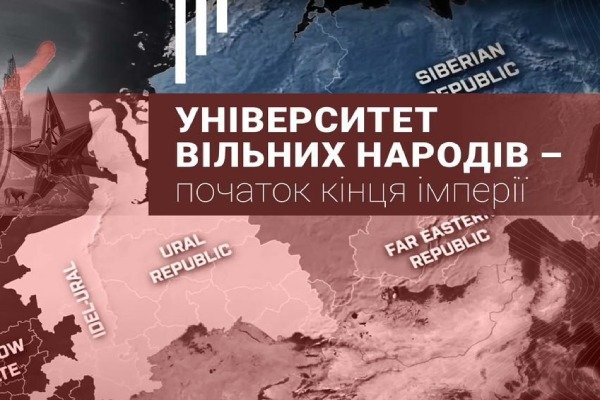
– to insist that the West “create a special “psycho-strategy department” under NATO or the Pentagon, which should include representatives of “liberation movements of nations enslaved by Bolshevism” and a service that would organize insurgent or liberation wars on the model of Afghanistan or the UPA, create the so-called “Academy of Freedom” in opposition to P. Lumumba University in Moscow for the purpose of in-depth study of the problems of the liberation struggle of “enslaved nations”, their spirituality, culture, philosophical system, as well as the training of relevant personnel”;
– “in order to really be successful, the West, according to the estimates of the OUN Foreign Units, must stop lending, supplying equipment, technologies and thereby “force Moscow to abandon further armaments”;
– At this, the leaders of the OUN draw attention to the fact that the USSR cannot compete in the arms race due to the degradation of the economy, the low level of development of technologies, electronics, microelectronics, etc.
In connection with this, the telegram contains the following conclusion: “To recommend that the Ukrainian branch take a set of active measures to discredit the foreign units of the OUN and other Ukrainian nationalist formations that are under its influence” (BSA of the SZR of Ukraine. – F. 1. – Case 13091. – V 5. – P. 74).
The KGB’s special operation against Yaroslav Stetsko was called “Nekro”. The calculation was to cause Stetsko, who had a number of health problems, severe psychological trauma that should have caused his death. In the end, this idea worked.
The report note of the KGB of the Ukrainian SSR “On Special Measures Against the Leader of the ABN and Foreign Units of the OUN Yaroslav Stetsko”, dated July 1986 and addressed to the head of the Central Committee of the Communist Party of Ukraine V. V. Shcherbytskyi, reads: “With the agreement of the USSR KGB, on 15 April 1986, through the operational capabilities abroad, an obituary was broadcast on the radio, on behalf of the Ukrainian editorial office of Svoboda radio station regarding Stetsko, which was also published by some Melnyk’s press. According to the received operational data, the obituary caused Stetsko a serious nervous breakdown and, according to his close circle, in particular the church authorities Kovalskyi and Kornelyuk, this led to a serious illness”. (BSA of the SZR of Ukraine. – F. 1. – Case 13091. – V 5. – P. 109–110).
This is how Moscow at all times dealt with all of those who exposed its imperial policy, its real essence, not veiled by the Kremlin propaganda, who tried to convey the truth to the civilized world and constantly sought support from the West for the restoration of Ukraine’s independence and the liberation of all enslaved nations from the imperial yoke, who realistically assessed all existing threats to the liberation movement and announced ways to continue the struggle.
The long-time leader of the Anti-Bolshevik Bloc of Nations, Yaroslav Stetsko, is a vivid example of this. It is he, who said in an interview with Mackenzie Porter, a correspondent of the Canadian magazine “Macleans” (the interview is kept among other documents in the Intelligence’s archive, under the title “Hero of the Persecuted”): “Only open resistance can save us from slavery. It is necessary to remember that we will not receive help from the West until we prove that we ourselves are strong enough”. He said this 70 years ago, in 1952. Prophetic words like many others.
Oleksandr Skrypnyk
Note: for a quick information search please subscribe to our Telegram channel “Freedom for Nations!” https://t.me/ABN_Freedom_for_Nations
Also, read the Facebook materials of the ABN page and the group
Our site: https://abn.org.uaen/
FOREIGN INTELLIGENCESERVICE OF UKRAINE