(On the freedom that Russian oppositionists are willing to defend for themselves, but are not willing to recognize for others)
Dzhambulat Suleimanov,
a participant in the struggle for the independence of the Chechen Republic of Ichkeria in two Russian-Chechen wars, as well as in the confrontation with Putin’s puppet project of Kadyrov,
diplomat, special representative of the President of the Chechen Republic of Ichkeria Zelimkhan Yandarbiyev in Malaysia, head of the first permanent Chechen delegation to PACE, historian, linguist, political scientist, elected leader of the Chechen national liberation movement “United Force”
* * *
There are things that cease to be surprising with time, but that doesn’t make them any less disgusting. One of them is the willingness of the absolute majority of representatives of the Russian anti-Putin opposition to talk about freedom, democracy, and European values, while simultaneously demonstrating arrogance and disdain for the peoples who for centuries were subjected to conquest, colonial subjugation, and forced retention within the Russian Empire, the Soviet Union, and then the Russian Federation.
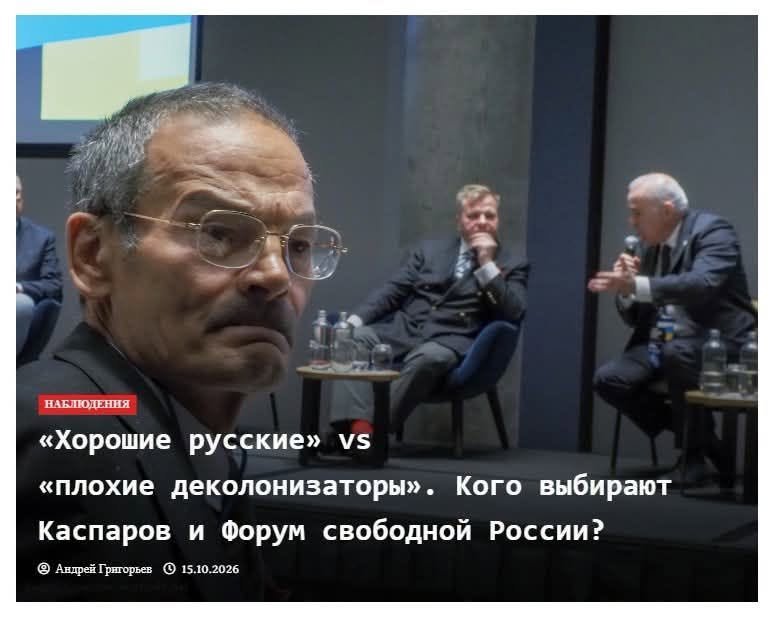
Garry Kasparov, despite his seemingly encouraging public statements regarding national policy in Russia, was one of them. It turned out that he, too, views the decolonization agenda as a domestic issue of expanding the nominal powers of national republics. Kasparov’s supporters, however, posit that genuine political self-determination for peoples requires independence to be achieved through force or the inability of the metropolis to keep them within the empire.
The issue here isn’t even about understanding the real mechanisms of independence—who better than the Chechens, who have been through seven circles of hell on earth, can understand them?—but rather the cynicism of the Russian opposition in its attitude toward the principles of a free, democratic society with which it identifies itself.
The recent discussion surrounding the 15th Free Russia Forum, as reported by Andrey Grigoriev and the story of the gift—a magazine dedicated to Dzhokhar Dudayev—has once again highlighted a problem that cannot be resolved by fine-grained declarations about the fight against the Putin regime. Kasparov prefers to decide the fate of nations without the participation of their representatives, a discussion for which he is clearly unprepared. Moreover, he is arrogant toward independence activists, which was clearly evident in his attitude toward the gift of the magazine.
My comment on Andrey Grigoriev’s post, that Kasparov’s arrogant attitude toward representatives of nationalities and the national question became obvious to our “United Force” movement at its first meeting in PACE, provoked a fit of foul language and baseless accusations from Kasparov’s fan club.
The problem isn’t one person, one forum, or even one demonstratively rejected gift. The problem is much deeper: all the prominent public leaders of the Russian opposition continue to think in terms of the imperial state even when they publicly oppose the man who leads that empire.
Putin may leave, but the imperial consciousness may remain.
This is exactly what I’m talking about. And it’s precisely for this position that I’ve been bombarded in the comments with insults, rudeness, and attempts to question my right to speak about the fate of my own people and the right of other peoples to freedom.
But let’s get to the bottom of it.
1. Freedom under Moscow’s sanction is not freedom, but a new form of empire.
A certain Anna, wildly delighted by Harry’s handshake, writes, “If you can, take it, win sovereignty from Putin and Kadyrov, and don’t beg it from Kasparov.” And who begged Kasparov for freedom? Name them, or at least one name. I might be unaware. All that’s required of Kasparov, who presents himself to the world as a liberal, is unconditional adherence to democratic values and unconditional recognition of Chechnya’s right to restore its state sovereignty, as well as Russia’s obligation to compensate for the damage caused by its two wars in Chechnya.
I wonder what parallel reality Anna lives in if she doesn’t know that Chechens defended their freedom in wars against Putin, that Kadyrov isn’t the Chechens’ choice, but rather a system imposed by Putin to suppress the idea of Chechen independence. It’s precisely this Kadyrov-like “extended powers” that Kasparov and other anti-Putinists are proposing to the people.
Vitaly Ginzburg also surprised in the comments by stating:
“No one is against the independence of all who make it and can achieve it.”
And then he added that a weakened Russia would begin to disintegrate itself, and the peoples and regions would be freed from Moscow.
I believe my friend Vitaly is completely sincere in his statements. However, this seemingly benevolent position contains a fundamental contradiction.
Why should a people’s right to independence depend on their ability to achieve it? Why is the question of a people’s freedom being replaced by questions of their strength, military capabilities, and ability to take advantage of a weakened metropolis?
A people has the right to self-determination not because it is strong enough to defend it with arms in hand. Every people has the right to independence by virtue of the divine nature of its identity and the inviolability of the very principle of self-determination, enshrined in international law.
The ability to exercise a right and the existence of the right itself are completely different things.
Otherwise, the logic that is convenient for any empire is:
while the people are weak, they are asked to wait;
when he resists, he is accused of separatism;
when he loses the war, he is declared incapable of independent existence;
And if he wins, they try to discredit his victory in order to deprive him of international support and subject him to re-occupation, which is exactly what happened with the independent Chechen Republic of Ichkeria.
This fact is enshrined in the legislative act of the Verkhovna Rada of Ukraine.
No!
The right to freedom is not awarded as a reward for victory. Victory is one possible means of realizing this right, but not the source of the right itself.
The International Covenant on Civil and Political Rights and the International Covenant on Economic, Social and Cultural Rights enshrine in Common Article 1 the right of all peoples to self-determination. This provision does not contain any clause requiring a people to first obtain permission from the parent state, prove their military capability, or await the dissolution of the state in which they find themselves.
Of course, the specific issues of self-determination, international recognition, and the change of state borders have a complex legal history. But this complexity does not give Russian oppositionists the right to turn the very existence of another people into a subject for their own political sanction. International law on territorial integrity does not contradict the right of peoples to self-determination, but rather defines the inadmissibility of external aggression, which Russia brazenly indulges in, in violation of all international rules and its obligations.
And another fundamental question: who exactly should decide which peoples “will be able” to become independent?
Moscow? The Russian opposition? A forum in a European city? Or the peoples themselves, whose historical fate is being debated without their consent?
For me the answer is obvious.
2. A single legal space is an old imperial idea in new packaging
When asked about the future structure of Russia, Garry Kasparov once stated: a single legal space and unified legislation.
A unified legal space and the unification of legislation are not, in themselves, proof of imperial intentions. They can exist in different states and political systems. The question is: who has the authority to decide in which state and by what rules a people demanding independence should live?
If the underlying premise is that Russia must remain a single state, and that all others are obliged to discuss their future exclusively within this framework, then what we are facing is not liberation from the imperial model, but a debate about how best to manage its legacy.
One can propose democratic institutions, fair elections, independent courts, federalism, and the rotation of power that the anti-Putin opposition so often talks about.
But if the right of peoples to secede from the state is preemptively excluded, this entire program has a clear boundary: democracy ends where the right of peoples to political sovereignty is curtailed and talk of preserving the integrity of Russia—read empire—begins.
It is here that the dividing line lies between the supporters of the “democratization” of Russia and the supporters of decolonization.
These are not the same thing.
Democratization can change the mechanism of governance of the state, which in structure may remain imperial, and accordingly suppress the freedoms of individuals and entire nations, which excludes the possibility of genuine democratization.
Decolonization raises the question of the legitimacy of the very domination of one people and its state over other peoples, which is the sure path to democratization and healing of a society ill with great power, by restoring the rights of man and peoples suppressed by the empire.
Putin can be replaced with a democratically elected president without abandoning imperial notions of territory, historical heritage, and Moscow’s right to determine the fate of Chechnya, Tatarstan, Sakha, Buryatia, and other peoples and regions.
But then what exactly has changed in the old relationship between the center and those it deems obligated to remain within it? Everyone has learned the lesson of Chechnya, torn to pieces as a warning to other peoples. And that’s precisely why they want nothing to do with this renewed empire.
The ruler will change. Political rhetoric will change. Perhaps some laws and state institutions will change.
However, the question of freedom and the rights of peoples will remain unresolved. Human rights, as a fundamental value of democracy, cannot be respected in a state that violates the right of peoples to self-determination.
Democracy cannot justify a pre-established ban on self-determination.
3. Chechens have been fighting for independence for centuries and do not need permission to be freed from Russian oppositionists.
I am Dzhambulat Suleimanov, and I am not speaking about this as an outside observer or as someone who has become familiar with the Chechen issue from books or social media.
I resisted Russian aggression in two wars unleashed against the independent Chechen Republic of Ichkeria. With my own eyes, I witnessed the crimes of the Russian military in Chechnya and how Putin ascended to power on the blood of the Chechen people, to the applause of virtually the entire current “anti-Putin opposition.” Behind my personal struggle and that of my family, behind the struggle of the entire Chechen people, lie not abstract state structures offered by the Russian opposition to Europeans, nor discussion clubs with convenient political slogans. Behind it lie human lives, destroyed homes, the fates of families, and an entire generation that was forced to pay for the right of its people to determine their own future.
My two brothers and one cousin died in these wars.
Therefore, when someone representing the Russian opposition begins to compare the struggle for Chechnya’s independence to a gangland war or equate Chechen independence fighters with Kadyrov’s collaborators, I don’t perceive this as an innocent error in terminology. It demonstrates how far one can deviate from historical reality while still maintaining confidence in one’s own moral superiority.
In the discussion, Andrei Volna wrote that he was uninterested in those killed in “showdowns between teips,” and that the behavior of Chechen independence supporters, in his opinion, was no different from that of Kadyrov’s men.
This accusation is not harmless, but unprincipled and immoral toward the victims of Russian aggression. And this arrogant bravado of an opposition “intellectual” is not simply a question of responsibility for one’s words and basic historical integrity, but a question of the moral essence of the Russian opposition.
The two Russian-Chechen wars were linked to a standoff over Chechnya’s sovereignty, its state status, the use of Russian military force, and the Chechen people’s resistance to Russian control. Following Putin, the Russian opposition has sought to reduce all these facts to a criminal struggle between Chechen groups. This was emphasized by Russian intelligence agencies after Russia’s shameful defeat in the First War against Chechnya.
Within Chechen society, of course, there have been and continue to be diverse political views, internal conflicts, and tragic contradictions. But to use the existence of these contradictions to devalue the very idea of independence is to deliberately conflate different phenomena.
And it is especially cynical to put supporters of the independence of the Chechen Republic of Ichkeria, and me personally, who fought against the Russian occupiers and the Russian servants of Kadyrov’s men, on the same level as the forces ensuring the preservation of Russian control over Chechnya, even though they are ethnic Chechens.
The Kadyrov system is not a product of the will of the Chechen people, and it did not emerge in a political vacuum. It exists within the framework of Russian statehood and relies entirely on its military, political, and economic might, on the support of the federal center, and Putin personally.
The political function of Kadyrov’s puppet regime is to suppress an independent national project and preserve Chechnya within Russia, shifting Russia’s responsibility for war crimes in Chechnya onto the Chechens themselves. And anti-Putin forces shamelessly try to exploit this tool of Putin’s against the idea of Chechen independence, relying solely on the ethnicity of Kadyrov’s men. Such dirty tricks, prohibited in normal politics, clearly reflect the Chechenophobia of the anti-Putin milieu.
One can argue about specific individuals, actions, and responsibilities. But one cannot honestly analyze the conflict without ignoring the distinction between the Chechen struggle for independence and the Putin system, which ensures the subordination of Chechen territory to the Russian state solely on the basis of the ethnicity of those who serve in that system.
It is precisely this distinction between Chechens who support independence and Chechens who are Russian henchmen that not only the Putin government, but also the anti-Putin opposition, so often tries to erase in their imperial assertions, trying to demonize the entire Chechen people in the eyes of the world community.
I don’t demand that every Russian opposition figure agree with my assessments of Chechen history. I demand something else: not to substitute historical analysis with insults, personal attacks, and downright tabloid obscenities. Not to pass off ignorance as objectivity, and not to assume the right to judge the essence of the independent Chechen Republic of Ichkeria, the history and social structure of the Chechen people, or their national liberation struggle, without even attempting to understand its roots.
4. The rejection of the symbol of the Chechen struggle as a sign of the double standards of the Russian opposition
The story of Nafis Kashapov’s gift—a magazine dedicated to Dzhokhar Dudayev—deserves special attention. As can be seen in the video from the forum, it was not accepted, unlike the award received from representatives of Russian nationalist circles.
I don’t have all the circumstances of this episode and don’t intend to present assumptions about the motives of specific individuals as proven facts. But the organizers’ references to security protocol seem ridiculous and unconvincing compared to the photo of Kasparov embracing Kashapov just shortly before the forum.
The political meaning of the situation that has arisen is not limited to the question of physical acceptance of the gift.
The magazine about Dzhokhar Dudayev is more than just a printed publication. For many around the world, Dudayev’s name is associated with the restoration of Chechen national statehood, resistance to Russian domination, and the struggle for independence.
The refusal to accept such a symbolic gift, as this episode unfolded, inevitably raises questions about what political symbols the Russian opposition is willing to accept and which it finds inconvenient.
If a political gesture is accepted in one case and rejected in another, the explanations must be convincing and consistent. This is especially true when it comes to representatives of the peoples from whom the Russian opposition expects support in the fight against the Putin regime.
Why are the symbols of some political forces, namely Russian nationalists, acceptable, while the symbols of the national liberation struggle of other peoples are not?
Why does the symbol of the struggle of the Chechens, who became a thorn in the side of the Russian Empire, the most persecuted people of the USSR, and an example of the struggle against the Russian Federation, become a source of embarrassment?
Why are Russian opposition platforms so often willing to discuss the crimes of the Putin regime, but much less willing to discuss Russia’s colonial legacy and the right of peoples to independence? Why do anti-Putin opposition leaders pointedly avoid such topics?
And why are representatives of enslaved peoples expected to be politically loyal and participate in common anti-Putin activities, while their own historical demands are being postponed until a more convenient time, namely, until Putin’s overthrow?
The questions are quite legitimate.
Nafis Kashapov found himself a victim of these double standards on the part of the Russian opposition; his goodwill gesture was not met with the expected response. He did not deserve a situation in which his actions were used to demean the Chechen cause or to turn the issue of national dignity into a subject of ridicule.
This isn’t about Russian opposition figures being obligated to accept every gift. It’s about consistency, respect, and the political significance of one’s actions.
One cannot demand respect for one’s own struggle for freedom and at the same time treat the symbols of someone else’s struggle as something secondary or inconvenient.
5. Insults instead of arguments
When I pointed out these contradictions in the comments to Andrei Grigoriev’s post, the discussion quickly shifted from political issues to insults, to my personality, and to outright swearing.
Andrei Volna responded to me with a rude remark, using obscene language, and then declared that my behavior was no different from the behavior of Kadyrov’s men.
Anna called me an idiot when I asked my friend not to waste time on her bewildered lamentations of “who are you?” in order to make her own judgments about the political activities of Kasparov, whom she revered.
And Ivan Tyutrin’s statement, “recorded” in response to my comment about Kasparov, sounded like a threat, a black mark.
I don’t intend to portray insults as the main tragedy of this story. I don’t need to prove my worth to people who prefer personal attacks to meaningful conversation.
But something else is important here.
When someone publicly claims their opponent is lying, it’s natural to expect them to point out the specific lie and provide supporting evidence. When the leader of the Chechen national liberation movement and a participant in the fight against Russian aggression is compared to Kadyrov’s puppet system, which he opposes, it’s appropriate to ask what facts support this comparison.
And when a Russian, speaking on behalf of the democratic environment, responds to political criticism of a Chechen with derogatory words, a logical question arises: how deeply are his democratic principles rooted in everyday political culture?
At the same time, I don’t believe that a single insult automatically characterizes an entire organization or all of its members. Responsibility must be personal. But repeated negative reactions, with clear signs of xenophobia, to the question of Chechen independence are characterized as a systemic phenomenon and deserve public discussion.
Particularly telling is the remark “if you can” heard from almost all anti-Putinists in the discussion of the prospects for liberation of peoples from Moscow.
In such formulations, the right to freedom imperceptibly turns into a test of strength that the colonized people must pass in front of an observing “high” public.
How similar this is to Yeltsin’s “take as much sovereignty as you can swallow,” with the implication that you’ll choke on your own blood. And “democrat” Yeltsin backed up his words by unleashing the war in Chechnya.
The problem here is certainly not solely Putin. The question is what kind of “democrats” those anti-Putinists who deny peoples the right to self-determination and intend to replace Putin will turn out to be.
But peoples are not obliged to prove their right to exist to those who are accustomed to considering themselves the masters of conquered lands and the peoples inhabiting them.
And it is certainly not the Russian opposition that determines whether the Chechen people have the right to their own independent and sovereign state.
6. My position is not an abstract declaration.
I don’t limit myself to publications on social networks and discussions on forums.
As part of my political and diplomatic activities, I sought international attention for the right of the Chechen Republic of Ichkeria to independence. Specifically, at the Parliamentary Assembly of the Council of Europe (PACE), my team and I succeeded in securing a written declaration from a group of parliamentarians from six European countries, declaring “the need to support the efforts of the Chechen Republic of Ichkeria to achieve full national independence.”
This formulation is of fundamental importance for understanding my position: it is not about granting Chechnya greater autonomy, not about finding a convenient model for its subordination to Moscow, and not about cosmetic reform of Russian pseudo-federalism.
At issue is national independence, the de-occupation of the Chechen Republic of Ichkeria, the occupation of which is recognized by a legislative act of the Verkhovna Rada of Ukraine, and the restoration of the statehood of the Chechen Republic of Ichkeria, its institutions, and its governing bodies. At issue is the right to self-determination of other peoples colonized by Russia throughout its imperial history.
I am convinced that the international discussion about Russia’s future cannot be limited to the question of who will replace Putin and how the central government will be organized after him. It must also address the question of the legitimacy of maintaining imperial rule over peoples who do not consider Russian statehood the only possible form of their own political existence.
Legal precision is also necessary here. Written declarations by members of national delegations to PACE and other parliamentary participants are not equivalent to binding decisions of the entire Council of Europe. However, the political significance of such a document lies in the fact that the demand for full national independence of the Chechen Republic of Ichkeria has been given written expression in the international parliamentary community.
This line of work must continue. And we will strive for it. We will also demand from the anti-Putin opposition a clear, unconditional, and unqualified public position on the Chechen question. It is as defining for them as the question “Whose Crimea?” once was.
Contrary to the dreams of anti-Putin oppositionists, Chechens and other peoples are not obligated by the global community and international institutions to renounce their national demands in order to become their convenient allies. They are not obligated to conceal their own history in order to maintain good relations with people who want to see their peoples and national republics part of a reformed Russian empire, so that their future becomes bargaining chip in someone else’s political transformation project.
7. Russian democracy cannot be built on the denial of the rights of other peoples.
I’m not claiming that every Russian citizen bears equal personal responsibility for all the crimes of the Russian state. The responsibility of specific individuals is determined by their actions, participation in decision-making, and support for repression, war, and colonial policies.
But it would be equally wrong to deny the historical responsibility of Russian society and its political elites for the preservation of the imperial system.
An empire exists not solely through the decisions of a single dictator. It is reproduced through state institutions, political ideas, historical myths, cultural habits, and the belief that territory once conquered by predecessors forever belongs to the current state.
And here it’s appropriate to recall Mikhail Khodorkovsky’s assertion that the Caucasus is Russian land because his grandfathers shed blood for it, and that he is ready to fight the Caucasus with a machine gun if necessary. In conjunction with this philosophy, his other recent statement, that he would not unconditionally hand over Crimea to Ukraine, is not at all surprising.
It’s worth recalling Vladimir Kara-Murza’s statements about the need to lift sanctions against Russia, saying, “Punish the scoundrel Putin, but don’t blame the poor people.” His worldview makes perfect sense when he stated in the French Senate that it’s hard for Russians to kill Slavic Ukrainians, but not supposedly for Slavic Chechens, Buryats, and others.
Kasparov’s position, albeit in a softer form, fits neatly into the same philosophy in the context of “let’s first defeat Putin’s regime, and then we’ll see.”
When the Russian political environment perceives Russia’s territorial integrity as an absolute value, but the right of peoples to self-determination as an inconvenient, dangerous, or premature topic, this indicates a profound contradiction between proclaimed democratic principles and ideas about the state.
This contradiction cannot be resolved simply by condemning Putin. As Katya Margolis rightly put it: “A rejection of Putin does not necessarily mean a rejection of the empire within one’s own head. An anti-Putin stance does not grant a license for chauvinism.”
The Putin regime is responsible for specific decisions, wars, repressions, and forms of state violence. But imperial notions have a longer history, and they will not automatically disappear with a change in leadership.
Russian democracy, if it truly intends to become democratic, must abandon the idea that the freedom of Russia is more important than the freedom of the peoples who find themselves under its rule.
There can be no full-fledged democracy if its boundaries are pre-determined by a ban on self-determination.
There can be no free political community if some peoples are asked to choose their government, while others must first prove that they deserve the right to decide for themselves what kind of state to live in.
There can be no honest rethinking of Russian history if conquest is called unification, subjugation is called integration, and resistance is called a crime simply because it is directed against the territorial integrity of the state.
Democracy without decolonization risks becoming a new form of legitimization for the old empire.
8. Sustainable security in Europe is impossible without dismantling the imperial system.
The issue of decolonization in Russia is not only a matter of historical justice for Chechens and other peoples. It is a matter of European security.
Russia’s aggression against Ukraine has demonstrated the dangers of a state system in which a country’s leadership claims the right to determine the political fate of its neighbors, challenges their independence, and uses military force to impose its own ideas about historical borders and spheres of influence.
But if we see the problem solely as a consequence of Putin’s character, we risk missing a deeper question: what political ideas make such aggression possible and allow it to be justified within the state?
Sustainable European security requires more than just containing Russia’s leadership. It also requires abandoning practices and ideologies that view the independence of other nations as a temporary aberration from a supposedly natural order, where Moscow enjoys special rights.
Decolonization in this context means the end of imperial domination, the recognition of the political subjectivity of peoples, and the creation of conditions in which their future is not determined by the power of the Russian center.
This is not a call for collective punishment of people based on their nationality. It is a demand for the political and institutional transformation of a system that reproduces dominance and makes it part of notions of state greatness, defined as Russian imperial chauvinism.
Democratization and decolonization can go hand in hand, but neither should be used to block the other.
If the future Russia becomes more democratic but continues to regard the independence of Chechnya and other peoples as unacceptable, the fundamental contradiction will remain.
If Europe seeks stability while turning a blind eye to Moscow’s imperial ambitions, it risks facing the same problems again under different slogans and different leadership.
Therefore, the question is not only what Russia will be like after Putin. The question is whether it should even retain the previous imperial structure if its existence presupposes the denial of other peoples’ right to their own political choice.
For me, the answer lies in the need to dismantle the imperial system and pursue consistent decolonization. The specific political forms of this process must be discussed with the participation of the peoples themselves, not determined for them by Russian centers of power or opposition circles.
9. Chechens are not obliged to be convenient
I don’t need Russian oppositionists to love Chechnya, accept all of our historical assessments, or agree with every political decision made by representatives of the Chechen national liberation movement.
I need them to stop presenting their own vision of Russia’s future as a universal measure of political rationality, imposing it on international institutions and deciding the fate of Chechens and other peoples without their participation. I and the United Force team have been opposing this for four years in PACE and are seeking separate representation.
Until now, everyone has spoken for the Chechens except the Chechens themselves. This pernicious practice must end. We have the right to speak for ourselves, and we have already begun to do so. Gone are the days when Russia utterly shaped the world’s opinion of the distant Chechens. The Chechens have now become familiar to the world, having come to it as a diaspora of hundreds of thousands, and they will speak for themselves.
We are not obliged to give up independence for the sake of the well-being of economic relations between Europe and Russia and the notorious unity of anti-Putin forces.
We are not obliged to remain silent about the colonial past and present for the sake of not spoiling the mood of the participants of the latest Russian forum or to please some of the older generation of European politicians who think in terms of the bipolar world and the Cold War era, guided by Russian horror stories about the spread of nuclear weapons and China’s expansion into the Far East and Siberia.
We will never allow Russian opponents to pass off insults as arguments or to consider arrogance a sign of intellectual superiority.
Even against the will of the entire world, if the world finds itself captivated by Russian clichés about Chechens, we are not obligated and do not intend to accept conditions under which the freedom of the Chechen people is recognized only if it does not interfere with the preservation of the Russian state within its current borders.
The history of the Chechen struggle for independence is tragic enough for us to accept a political compromise imposed by force. And the history of Chechen subjectivity is significant enough that we should not allow it to become an inconvenient footnote to the history of the Russian opposition.
We know what it means to fight for independence. We know the price of victory and defeat, the price of resistance and the price of betraying one’s own principles. And therefore, we have reason to demand of international institutions, referring to the declared values of democracy, that the conversation about Russia’s future begin not with the question of who will lead it after Putin. But with a question for the anti-Putin opposition: what does Chechnya mean to them—an independent but occupied country or a part of Russia? With a question: do the peoples under its rule have the right to independently determine their own future?
This is not a demand for special treatment of Chechens or other peoples. It is a demand for the consistent application of the democratic principle of self-determination. The anti-Putin opposition, like the Putin regime, always counters the right to self-determination of peoples colonized by Russia with the examples of Catalonia, Flanders, and Scotland. All of these examples, while not entirely smooth, have a credible history of dynastic alliances and unions, and none of them compares to Russia’s bloody conquest of the Caucasus, the Urals, Siberia, and the Far East.
And if anyone believes that such issues hinder the integrity of Russia and the unity of anti-Putin forces, let them ask themselves another question: on what basis should this integrity be more important than the freedom of nations?
And instead of a conclusion
I do not intend to abandon my position under the pressure of insults from the Russian opposition, ridicule, or attempts to equate the struggle for the independence of the Chechen Republic of Ichkeria with the methods of the Kadyrov regime, presenting us as a type of intra-Chechen conflict group, while the Kadyrovites themselves are part of the Russian security forces.
I will continue to advocate for the right of the Chechen people to full national independence and for the restoration of Chechen statehood and its organs of power, for the decolonization of all of Russia, and for international recognition that the fate of enslaved peoples cannot be decided without their presence and free expression of will.
My position does not depend on whether it is convenient for the participants of the Free Russia Forum, Russian opposition politicians, or their supporters among some European politicians to hear it.
We, and I personally, did not fight to one day have the opportunity to participate in the construction of a more decent Russian empire.
We fought for the freedom of Chechnya.
And we are not going to exchange this demand for a promise that someday, after a change of power in Moscow, we might be allowed to once again explain why we have the right to be free.
As long as the right of peoples to self-determination is recognized only in words, and in practice is limited by the interests of preserving the Russian state, the fight against Putin remains a fight against the ruler, but not against Russia’s imperial system, not against its inhuman essence, not against its militaristic policies and threats to neighboring countries, not against its internal aggression against colonized peoples.
A free Russia cannot be built on the unfreedom of other peoples. And European security will not be sustainable as long as imperial domination continues to be considered Moscow’s natural right.
Dzhambulat Suleimanov