

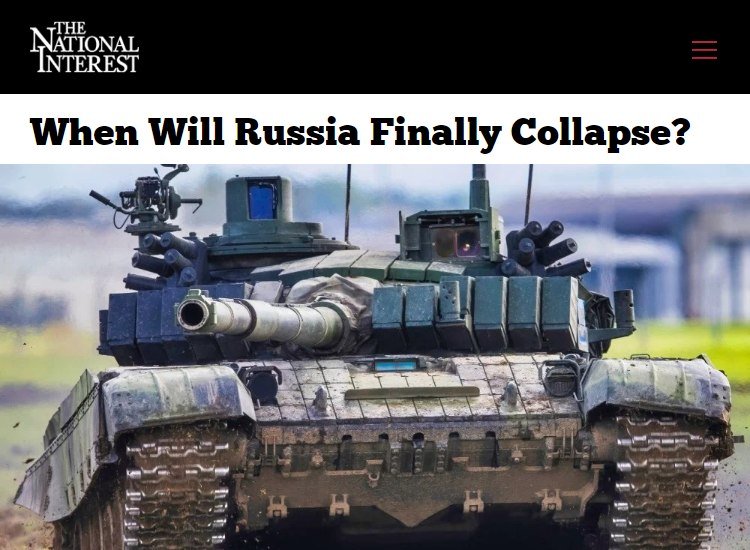
Russia’s genocidal war against Ukraine may become the spark that will make the collapse possible. The regime, the army and the economy have weakened, and there is no reason to expect that the situation in Moscow will improve in the near future.
When will Russia finally collapse? – Politicians and analysts are losing patience.
Predictions about the collapse of Russia turned out to be wrong.
Rather than weakening, Vladimir Putin’s empire appears to be growing stronger.
One critic of the disintegration argument put it this way: “Two years later, Russia looks alarmingly strong.”
If this is true, then it obviously makes sense to negotiate with the Kremlin now, before it becomes even more powerful and stable. This, of course, may be a bitter pill for Ukraine and its supporters to swallow, but what is the alternative?
When will Russia collapse?
The alternative is obvious. In reality, Russia is not getting structurally stronger and more stable, and almost all theories of system collapse lead us to expect something profoundly destabilizing to happen in Russia. But when? This is the problem. It may happen tomorrow, or it may happen in five years. In any case, the collapse is close, although perhaps not “in two years.”
The argument in favor of strengthening Russia is based on a peculiar interpretation of the available facts about the Putin regime, the war, the economy and the Russian population.
Putin may exude confidence – though why should we expect anything less from him or any other leader – but appearances can be deceiving, especially since Putin’s public persona is as often prone to ignorance as it is to self-confidence. He has arrested his liberal and right-wing critics, strengthened his security apparatus, and his propaganda machine remains as active as ever. Are these signs of strength?
Yes, for obvious reasons, and no, because all these measures would not be necessary if he did not feel threatened. From whom? On the part of important political and economic elites who are dissatisfied with the war and its impact on the Russian economy and armed forces. Prigozhyn’s attempted coup is a telling example. Its very occurrence indicated dissatisfaction in the army. More importantly, this attempt could not have been made without the knowledge – and blessing? of the special services.
So, yes, Putin survived the coup. But the very attempt means that his position was and remains shaky.
Putin’s weakness is Russia’s weakness
This is important because the weakness of Putin means the weakness of his regime, since he is its essential core. All authoritarian, totalitarian, fascist, and dictatorial systems are hypercentralized by definition. This can be their strength if the supreme leader is a Platonic philosopher king, but more often than not it is a fatal weakness. Supreme leaders resist changes and reforms.
Their central position encourages shifting of responsibilities, attempts to strengthen local power and cronyism. Most importantly, perhaps, they are prone to strategic mistakes, especially as they age, when they lose their ability to project invincibility, infallibility, and charisma.
Putin’s most significant blunder was pressuring Ukrainian President Viktor Yanukovych to withdraw from the Association Agreement with the European Union in late 2013, triggering the Revolution of Dignity that led to Yanukovych’s escape and then the launch of a full-scale invasion of Ukraine in February 2022.
Janusz Bugajski of the Jamestown Foundation argues that the war is disastrous for Russia: “Russian leaders are trying to convince Western leaders that Ukraine is losing the war in order to stop military aid to Kyiv. In fact, the war is disastrous for Russia. Although the Ukrainian counteroffensive in Donbass and Zaporizhzhia has been halted for the winter, after defeating Russian forces in Kyiv, Kharkiv and Kherson, the Russian army is disintegrating and its fleet has been pushed back from the western Black Sea.
In two years of fighting, Russia lost at least 315,000 killed or seriously wounded out of an estimated 360,000 ground troops that invaded Ukraine. It also suffered huge losses in equipment, including 2,200 out of 3,500 tanks and a third of armored vehicles. These are not just random problems. Together, they testify to the fundamental, structural destruction of the Russian armed forces.
The situation with the economy is no less alarming. The opposition Russian economist Vladimir Milov showed that the state invested huge funds in four sectors (munitions, railways, military security and engineering) directly related to the war, while reducing or only minimally increasing investment in the consumer goods sectors. Therefore, Putin’s claims that GDP is growing and inflation is low hide the reality that ordinary citizens are being sacrificed on the altar of militarism. As Milov notes, “Russians have become significantly poorer over the past five and especially over the past two years.”
Empirical evidence in favor of a strong Russia is weak
Jeffrey Sonnenfeld of Yale University and his colleagues have convincingly argued that the sanctions have worked and that “Russia is no longer an economic powerhouse and has banned the minimum reporting of transparent national income statistics required to maintain IMF membership. With an industrial power inferior to that of Chile, Putin’s Russia survives only by seizing assets. An increasingly state-dominated economy is destroying its own companies to support Putin’s war machine.”
Finally, we approach the Russian population. Yes, it is inactive, and yes, that makes him morally complicit in Putin’s crimes. But a significant minority, perhaps up to one in five, opposes the war and Putin’s fascist regime. These are mostly urban, educated professionals living in Moscow and St. Petersburg. Now they are scared. But as soon as the opportunity arises, and it will inevitably arise, they will declare themselves – as will all urban educated professionals around the world.
Thus, the empirical arguments in favor of a strong Russia are weak. At the same time, the theoretical case for collapse is strong because Russia is extremely vulnerable to the structural forces that typically lead to systemic collapse. It is important to remember that the structures are similar to tectonic plates. We can predict that earthquakes will inevitably occur where two plates meet, but we cannot say exactly when. And we can say which regions – or states – are more or less in danger and are increasingly facing the prospect of collapse.
What structural forces are persecuting Russia?
The aforementioned analysis identified them. Fragile mode is one of them. The pitiful state of the army is second. The sinking economy is the third. The protest potential of Russian educated urban elites is the fourth. We know from history that such states are prone to collapse or, at least, to massive popular protests and regime change. The Soviet Union and its Eastern European satellites in 1989-1991 immediately come to mind.
But also dozens of countries around the world – such as Argentina, Nicaragua, Egypt, Syria, Zimbabwe and Libya. Some states, such as Ayatollah Iran, weather the storms of constant upheaval and survive. Others, such as shahish Iran, do not survive. Apart from platitudes like “everything depends on the power of the state or the intelligence of the elite”, we cannot know what the exact result will be.
But we know that in most cases “contradictions” generated by structural forces come to the fore when “sparks” or “triggers” occur. These can be assassinations, earthquakes, fires, natural disasters – or wars, especially failed wars that undermine already weakened economies, armies, regimes and populations. It was World War I that destroyed the Habsburg, Ottoman, and Russian empires, and World War II that nearly destroyed the Soviet Union, especially after Joseph Stalin’s sweeping structural changes weakened the Soviet system and made it prone to collapse.
Russia’s genocidal war against Ukraine is probably just such a spark. The regime, the army and the economy have become weaker, and there is no reason to expect that the situation will improve in the near future. This means that the longer the war lasts, the more likely the structural forces will collide with each other, the more the contradictions will intensify, and the more likely the collapse of Russia will be. Contrary to popular belief, both in Russia and in the West, time is not on Putin’s side. He is not getting any younger, and his regime is not getting any stronger. Therefore, the West should refrain from negotiating with Putin until his country and regime are so weakened that they cannot be easily restored.
So, don’t fall for his forced bravado. The tune he hums is his swan song. As for when Putin’s Russia will meet its end, it may be sooner than you think. Indeed, consider holding your breath.
Alexander J. Motyl, The National Interest
Facebook





