

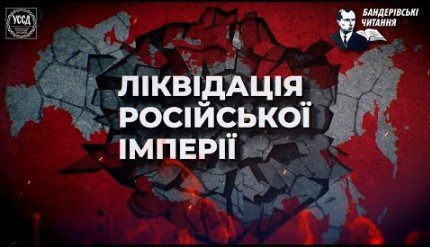
In light of these global trends and the massive war waged by Russia against Ukraine, the central issue becomes the liquidation of the Russian Empire, reducing the influence of its allies, and creating a new secure space in the territories of post-Russia.
Roman Bzhessky raised the first and urgent question immediately after the end of World War II, emphasizing the need to work on perceptions of the Russian Empire as a central problem: “Anyone who interprets the Russian Empire as a national entity, who, in fighting the regime, tries to preserve the dominant role of the Moscow people and wants to negotiate with them as the master of these expanses, increases the number of his enemies from 80 to 200 million and ensures the constant Moscow threat to the freedom of the nations of the Earth under any circumstances.”[1]
A pragmatic approach requires a fundamental change in the definitive apparatus from all those interested in creating a secure space, as numerous groups of Russian pseudo-liberals and pseudo-democrats who left the country remain supporters of the imperial course—not only regarding Ukraine but primarily in terms of the impossibility and unacceptability of dividing Russia into independent regions and independent national states of oppressed nation s. At the same time, the propaganda of liberal imperial circles reinforces the traditional fears of EU and US elites[2], which, since the collapse of the USSR, have been under the influence of Russian propaganda, which prophesied, if not a nuclear confrontation between former republics, then scenarios similar to the war in the former Yugoslavia.
It is illustrative that the recognition of Ukraine’s, Kazakhstan’s, and Belarus’s independence by the United States was conditioned on the renunciation of nuclear weapons. Such a requirement was set by the White House administration, which was caught off guard by the rise of independent states since it expected the signing of the Union Treaty[3]. Even before the facts of the emergence of a new geopolitical reality and the death of the USSR, the Russian Empire was perceived until the last moment as an integrity in which Moscow, as the imperial centre, should play a leading role.
The deconstruction of the Russian Empire should begin with a clear understanding that any Russian “opposition” or “government” can only make tactical concessions in its national policy to colonized territories or nations because such concessions were allowed by General Kornilov, Vladimir Lenin, or Boris Yeltsin. The more Ukrainian politicians and partners publicly speak about the unacceptability of the status quo for the Russian Empire and seek temporary or permanent allies among the colonized regions and nations, the more likely it is to expose agents of the Russian Empire in the West and approach the time when the idea of dividing Russia becomes a true formula for the victory of Ukraine and its allies.
Observing the West in the early years of the Cold War, the aforementioned Roman Bzhessky despairingly concluded that it was the utopian perception of the Russian white and red empires that led to terrible consequences for the entire world: “If the West freed itself from illusions and deception, if it overcame the force of inertia—understood that for the West, to save Western civilization, if there were no separatism of nations enslaved by Muscovites, it would have to be invented!”[4]
The second central issue is the support and development of independence movements and currents that do not recognize Moscow’s authority, call for abstaining from participating in the war against Ukraine, and consistently advocate for the full independence of regions and nations from the imperial centre and its interests.
Excessive expectations of the Ukrainian government from independent and regional movements constantly undermine dialogue with these groups, particularly due to factors such as: a) misunderstanding the state of elites and representatives of oppressed nations; b) a blatant unwillingness of state officials to involve representatives of oppressed nations in the Ukrainian Armed Forces; c) the absence of a strategy for working with independent group environments and the inconsistency of the positions of government authorities.
Effectively, the only tangible achievement of the Ukrainian parliament was the recognition of the government of the Chechen Republic of Ichkeria led by Ahmed Zakayev, as well as the adoption of a resolution recognizing the genocide of the Chechen people and the independence of the Chechen Republic of Ichkeria.
However, when it comes to a similar resolution on the recognition of the genocide of the Circassian people, submitted for consideration in May 2022 (the fourth document in a row since 2014), attempts to actualize this process face unclear obstacles. In December 2023, a resolution on the recognition of the genocide of the Ingush people was registered, and it is fervently hoped that its fate will be better than the resolutions on the recognition of the Circassian genocide.
The Ukrainian state cannot take on the resource provision of independent groups and consistently seeks to work only with some of them, thus designating them as leaders. Therefore, let’s outline urgent tasks that can be accomplished, relying entirely on our resources and the capabilities of allies:
Dissemination of information about independent movements and groups on all possible platforms, including primarily among the elites of the United States and Europe;
Continuous monitoring of the situation in the Russian Empire, spreading stories about the ethnically oppressed lower class[5] of millions of migrants from Central Asia and the oppressed state of colonized regions and nations;
Pressure on the authorities in Ukraine and the demand to recognize the historical genocides of nations enslaved by Russia;
Setting rational, practical tasks for independent and regional groups aimed at solving strategic issues, rather than the current work of individual structures on the brink of suicide;
Maximizing the expansion of the interaction base with representatives of oppressed nations and regionalist groups, as a conscious narrowing of the contact base will lead to a narrowing of perspectives and a reduction of opportunities;
Forming a view of Ukraine’s victory as a fact after which a regional leader will emerge, which will not only resist the Russian Empire to maintain its own sovereignty but will be a full-fledged centre of anti-colonial struggle against the Russian Empire and its allies.
Ukraine’s ability to formulate a genuine, rather than interim, image of Ukrainian victory must stem from an understanding of the method of war formulated by Carl von Clausewitz: “The purpose of war may be the defeat of the enemy, i.e., his political destruction or deprivation of the ability to resist, forcing him to sign any peace, or the purpose of war may be certain acquisitions near the borders of one’s state to keep them or use them as a guarantee during peace negotiations.”[6] Given the objective lack of resources and the slow awakening of European and American partners, we cannot rely on any interim result of victory that does not change the course of Russia.
Considering that war is only a part of political relations between countries, the question arises: how willing are Ukrainian political elites and civil society to accept the need to participate in the decolonization and de-imperialization of the Russian state? The creation of a special commission in the Verkhovna Rada can be welcomed; however, without real support from the Ministry of Foreign Affairs, it is challenging to achieve a full-fledged dialogue in all partner countries of Ukraine.
The question of redistributing Russia for Ukraine is a question of grand strategy, which, according to Edward Luttwak, takes place “at the lower, military levels, somehow reflecting in the broader context of international politics.”[7] Therefore, the goal of grand strategy is not only victory on the battlefield in real-time but also the work of the Ukrainian state on three basic levels:
- With expert environments in the EU and the USA regarding the image of future victory and a change in the perception of the Russian Empire as a constant, prompting the study of existing divisions and confrontations among various regional and national groups.
- With political and diplomatic environments, aiming to recognize the need to create real prerequisites to deprive the Russian Empire of the ability to sustain itself at the expense of colonized regions and nations, as well as to deprive it of resources as the main source for obtaining strategic and tactical weapons, bribing elites beyond Russia, and conducting special operations.
- Partnership with independent groups and representatives of oppressed nations, providing them with methodological assistance in formulating their future, where neither the imperial centre nor the Moscow nation can participate as the dominant force.
Ukraine can become a strategic player only if it takes on the burden of responsibility for the redistribution of Russia and can transform the discussion about the future of post-Russia into a full-fledged international process that will gain significance and strength with each month of the Russian-Ukrainian war and even after it.
[1] Bzhesky R. Russia Unmasked. Kyiv: Ukrainian Publishing Business, 2023. P. 64.
[2] URL: https://bit.ly/48jD9qi
[3] Zinchenko O. How Ukrainians Destroyed the Empire of Evil. Kharkiv: Vivat, 2024. P. 426.
[4] Bzhesky R. Russia Unmasked. P. 81.
[5] Juda B. Fragile Empire. How Russia Loved and Fell Out of Love with Vladimir Putin. Kyiv: Meduza, 2015. P. 196.
[6] Clausewitz. The Nature of War. Kharkiv: Vivat, 2018. P. 5.
[7] Hryniv I. The Art of Strategy. Kharkiv: Folio, 2023. P. 129.
Stanislav Fedorchuk, veteran, political scientist, head of the “Post-Russia” direction at the Ukrainian Strategic Initiative analytical centre of the Kyiv-Mohyla Academy






