

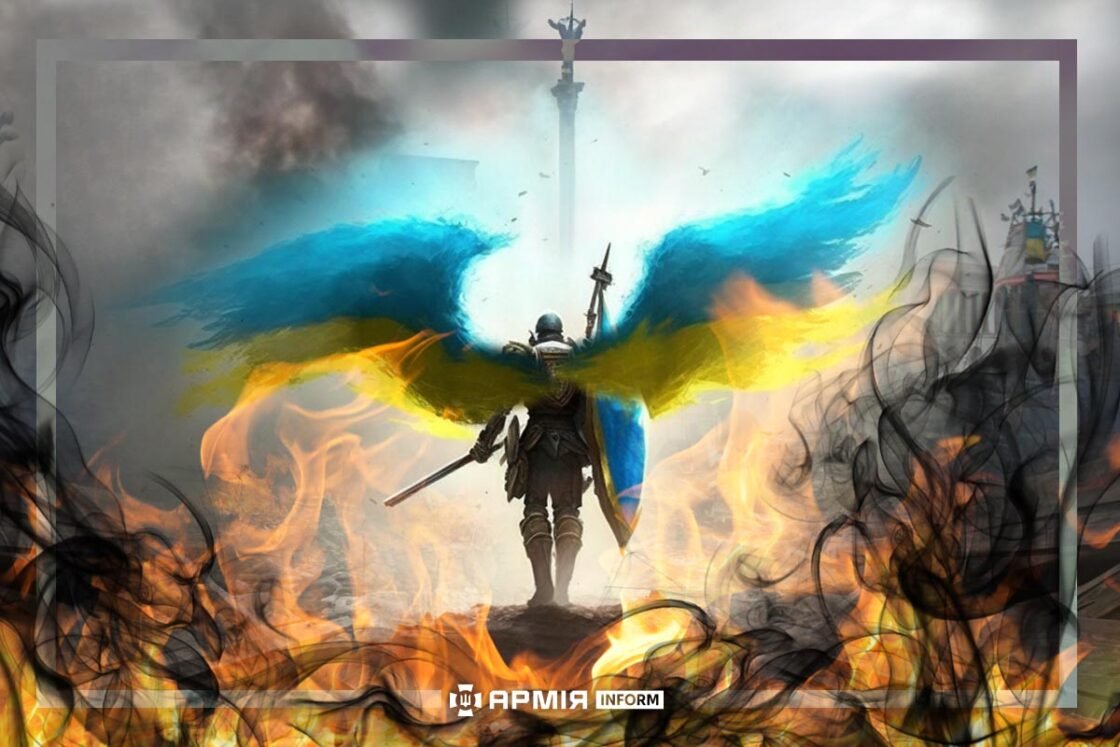
On February 18, 2014, when brutal murders of participants of the Revolution of Dignity began in Mariinsky Park in Kyiv near the parliamentary building, which turned into mass shootings on February 20, Putin began his Chekist operation to annex Crimea.
The Revolution of Dignity faced Russian military aggression and turned into a national liberation war of the Ukrainian nation against Russian imperialism.
Since the collapse of the Soviet Union, the former Soviet colonies, the so-called Union Republics, faced constant pressure from Russia, which called itself the sole heir of the Soviet Union and claimed the post-Soviet space as an exclusive zone of its interests.
Ukraine became one of the biggest objects of this aggression. Moreover, part of the world players considered Russia’s fears about Ukraine’s independence as an example to be justified. On the eve of the withdrawal from the Soviet Union, the President of the United States flew to Kyiv, demanding not to withdraw from the USSR.
Subsequently, Ukraine was forced to get rid of the world’s third-largest nuclear arsenal in exchange for paper guarantees.
From the first day of the Declaration of Independence, Ukraine faced pressure from the former metropolis. Energy, financial and economic, political blackmail continued unabated.
In 1992, the Supreme Soviet of the Russian Federation resorted to a brutal provocation, declaring invalid the decree of the Supreme Soviet of the USSR of 1954 on the inclusion of Crimea in Ukraine. At the same time, the adoption of the separatist Constitution and the introduction of the office of the President were inspired by the peninsula. Only the military weakness of Russia and the decisive actions of the central Ukrainian authorities stopped this coven in the bud.
In September 2003, Russia carried out a provocation around the Ukrainian island of Tuzla in the strategically important Kerch Strait, with which the Kremlin tried to test the reaction of the Ukrainian authorities and the international community to the attempt to seize Ukrainian territory.
Having seen the weak reaction of the world to the brutal destruction of Chechen independence and the aggression and annexation of part of the territory of Georgia in 2008, Putin began to plan an operation against Ukraine, the ultimate goal of which was to completely destroy the subjectivity of the Ukrainian state and the identity of the Ukrainian nation. Putin, taking advantage of the excess profits from the export of energy carriers to European countries, completely rearmed his army, and through his agency in Ukraine, maximally weakened the defence capabilities of the Ukrainian State, especially in Crimea.
The escape of the pro-Russian puppet President Yanukovych and a short period of anarchy in Ukraine in February 2014 allowed Russia to implement a quick operation to annex the Crimean peninsula, which was carefully prepared in advance. Moreover, the Russian authorities cynically denied the participation of their military in the events in Crimea (Putin cynically declared publicly that “they are not there”).
Since the beginning of the spring of 2014, the Russian authorities have organized an attempt to massively destabilize the situation in Ukraine. Russian agents, and even militants imported directly from Russia, tried to capture state authorities as part of the “Russian Spring” campaign, actually conducting the operation with the wrong hands and under the false slogans of “protecting the rights of Russian speakers” to prepare the ground for the alienation of these territories and the direct invasion of Russia. When the “Russian Spring” received active street opposition from Ukrainian citizens in all regions of Ukraine, including allegedly pro-Russian ones, in the South and East, the artificially organized rallies declined, and not a single local body of state power and local self-government supported the demands pushed by the Kremlin: such as the non-recognition of the Verkhovna Rada as a legitimate body, the creation of alternative authorities and their re-subordination to the power structures, and most importantly: the invitation of Russian troops to “protect the local population”, Russia managed to seize the city of Sloviansk in the Donetsk region in April 2014 with the help of its militants.
In response to the actions of the Ukrainian authorities regarding attempts to secure and protect the none delimited and none demarcated land border with Russia and the suppression of the terrorist takeover of Ukrainian cities and authorities by pro-Russian militants, Russia resorted to undisguised shelling of Ukrainian territory and openly introduced and deployed its troops in August 2014 in Donetsk and Luhansk regions.
The lack of an adequate reaction of the world to the brutal violation of the principles of the territorial integrity of the countries and the inviolability of borders prompted Russia to further aggressive intentions.
But at the first stage of the Russian-Ukrainian war, Russia tried to impose an unfavourable truce on Ukraine to constitutionally consolidate the so-called special status of the occupied regions, which provided that the nominally occupied territories would be part of Ukraine, which is obliged to fully finance them but in fact will be under the full control of Moscow. The Minsk Agreements pushed by Russia provided, in particular, exemption from punishment, persecution and discrimination of persons associated with the events that took place in certain areas of Donetsk and Luhansk regions (de facto amnesty and legalization of militants and Russian agents); the right to linguistic self-determination (in fact, strict denationalization and Russification of the occupied territories); participation of local self-government bodies in the appointment of heads of prosecutor’s offices and courts in certain districts of Donetsk and Luhansk regions (legalization of collaborators and occupiers in the government and law enforcement agencies); the Ukrainian authorities provide support for socio-economic development to certain districts of Donetsk and Luhansk regions; (paying for the occupation at the expense of Ukrainian taxpayers); promotion by the central authorities of cross-border cooperation in certain areas of the Donetsk and Luhansk regions with the regions of the Russian Federation; (the actual legalization of the separatism of these regions through direct ties with Moscow); creation of people’s militia units by decision of local councils for the purpose of maintaining public order in certain areas of Donetsk and Luhansk regions (legalization of militants).
Moscow legalized the status of its collaborators in the occupied territories and gained time to carry out ethnic cleansing (destroy any resistance), strict Russification and establish full control over the occupied territories and population. Carte blanche at the age of seven to erase any manifestations of Ukrainian statehood and reflash the population’s brains.
Having imposed the so-called Minsk Agreements and constantly insisting on its neutrality, Russia included the largest European countries, Germany and France, in the diplomatic game, excluding the USA from the context of the negotiations.
Russia has implemented its long-standing tactics of step-by-step aggression and tried to maintain its status in the international arena.
The lack of any real actions on the part of the guarantor countries of the Budapest Memorandum, and the active involvement of the European establishment in corruption ties related to obtaining surplus profits through the trade in energy carriers, made it possible for Russia to carefully prepare for the final phase of the liquidation of Ukrainian statehood.
The respite on the Ukrainian front allowed Russia to intervene more actively in the events in Syria and Libya, to strengthen its influence on the countries of Africa and South America, to drive out the troops, including the brigade commanders, through a fully-fledged conventional war with the use of all forces and means, aviation, missiles, and the fleet in Syria, to increase their geopolitical status.
Having destroyed any traces of Ukrainian statehood in the occupied territories, Russia mobilized its human potential and then buried it in the fierce battles of 2022-2024.
At the same time, Russia was conducting an active preparatory campaign inside Ukraine. In Ukraine, a powerful information fist of the so-called Medvedchuk channels was formed, pro-Russian forces returned to the parliament, Russian business felt free on the territory of the country, information and psychological operations of the enemy were carried out without any punishment and with the assistance of the authorities, such as the “Alpha Jazz Fest” in Lviv There was mass destruction due to the sabotage of weapons and ammunition warehouses.
Having prepared the ground, Putin launched a full-scale invasion in February 2022.
It was on the unpreparedness of Ukraine’s defense to repel a full-scale invasion, as well as on the presence of an extensive network of its own agents in Ukraine, that the Russian military-political leadership based its calculations in choosing the invasion plan.
The leadership of the Muscovite region, being captive to colonial stereotypes, underestimated all three components of war (according to Clausewitz): the state leadership, the army, and the people. In Moscow’s vision, the leadership had to flee or hide, the Armed Forces of Ukraine to disperse or go over to the side of the aggressor, and the people, if not to greet the “liberators” with flowers, then to sit in the outermost houses in fear.
On February 24, 2022, the world effectively put an end to Ukrainian statehood, openly evacuating even its diplomatic institutions from the territory of Ukraine.
Only the determined resistance of Ukrainians returned the Ukrainian issue to the world arena, and Ukraine began to receive real aid, including military aid, from the United States and European partners.
For two years, Ukraine has been waging a full-scale existential war, the largest since the Second World War in Europe, against the world leader of the axis of evil – Russia.
Having many times fewer resources, Ukraine won back a significant part of the territories. Unfortunately, the allies’ indecision allows Russia to overcome the sanctions partially. The missile monopoly, and portioned supply of weapons, when Russia is always ready for another expanded aid package, leads to a prolongation of the war and an increase in casualties.
The main problem for the Armed Forces was the lack of weapons and ammunition necessary for an offensive operation, the lack of parity in the air and the lost time associated with logistical delays in the supply of military aid by the Western allies, which allowed the Russians to strengthen defensive lines and expand minefields.
Despite significant failures in the implementation of the Kremlin’s plans, its strategic tasks remain unchanged – the destruction of the subjectivity of the Ukrainian state as an international state (the so-called neutral status), actual colonial dependence, further occupation of sovereign Ukrainian territories; rejection of Ukrainian identity, which is described as “Nazism”; undermining Ukraine’s internal subjectivity, destruction of industrial potential, destruction of infrastructure.
Russia’s aggression against Ukraine has terrible humanitarian consequences. The recorded facts of genocide are the terrible crimes of the aggressor against civilians, murders and tortures in the liberated towns and villages, in particular in Buch, Gostomel, Makarov and Borodyanka in the Kyiv region and Izyum in the Kharkiv region. Also, the occupiers take Ukrainian children en masse, taking them to the Russian Federation (up to 20,000 minors have been identified). This became the basis for opening a court case against Putin and other relevant Russian officials at the International Criminal Court in The Hague.
In June 2023, Russia committed another act of genocide and ecocide, blowing up the dam of the Zaporizhzhya hydroelectric power plant, and flooding vast areas near the river Dnipro. The number of victims on the occupied left bank of the Dnipro, where the occupiers prevented rescue operations, is still unknown.
According to the UN, up to 26 million people crossed the border mainly in the direction of the neighbouring states of the European Union. About 6.2 million of them did not return and remain abroad. Also, about 4.8 million people have become internally displaced within the country, according to government data (other estimates may be twice as many).
The nuclear terrorism manifested during the war (seizure and attempt to seize nuclear facilities on the territory of Ukraine), mass crimes against humanity, and ethnic cleansing have not yet received an appropriate response from the world.
Russia, grossly violating the fundamental principles of the UN and international law, cynically uses the right of veto of a permanent member of the UN Security Council, effectively destroying this institution and using the UN platform exclusively for carrying out its information and psychological operations, brutally propagandizing its aggression and spreading disinformation.
The Russian-Ukrainian war, and in parallel the actions of Moscow’s satellites – Iran and its proxy, North Korea – are rapidly pushing the world into the bosom of the third world war, destroying the world order, undermining the world economy, logistics and trade.
In 2023, Russia secured support in the supply of Iranian and North Korean-made missiles, artillery ammunition, and unmanned aerial systems.
Unfortunately, it turned out that the Western allies of Ukraine are not able to produce and provide as much artillery ammunition as North Korea alone, and do not have the political will and determination to provide missiles and unmanned aerial systems of medium range.
It should be recognized that the policy of pacifying the aggressor, suggesting proposals to appease the appetites of the aggressor by donating territories will only aggravate the situation.
Currently, Ukraine is actually single-handedly waging a war for those values that the Western world officially upholds. Only the determination of the latter, the end of the delay in helping Ukraine, will allow maintaining the world order.
Obviously, only Russia’s military defeat, further appropriate punishment and repentance, its denuclearization, and the realization of the right of enslaved nations to gain their independence will be a lasting guarantee of peace on the European continent.
Today, the fate of the world, without exaggeration, is being decided in Ukraine.






