

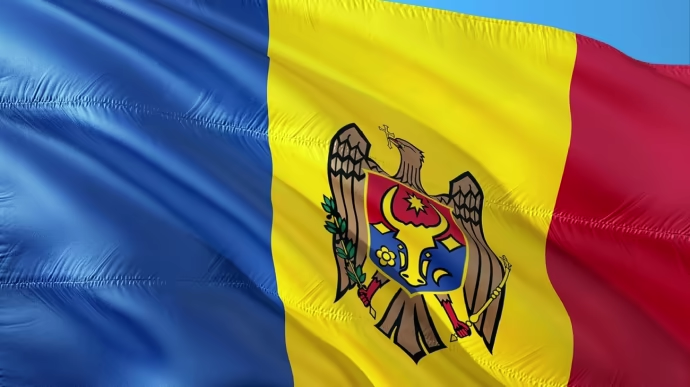
ISW believes that the Kremlin is trying to use pro-Russian actors in Moldova to destabilize Moldovan democracy and society.
Source: Institute for the Study of War ( ISW )
Details: In this way, Russia wants to prevent Moldova from joining the European Union or even to justify future hybrid or conventional operations against Moldova.
The Kremlin-connected governor of the pro-Russian autonomous region of Gagauzia, Yevgenia Hutsul, hinted that Romanian officials control the Moldovan government. It was the latest in a series of recent attempts by the Kremlin to question the sovereignty of Europe’s pro-Western governments.
Hutsul stated on 8 April during an interview on the Russian state TV channel “Pervy Kanal” that if Gagauzia begins the process of secession from Moldova, there will be a reaction not only from the Moldovan government in Chisinau but also from Bucharest (Romania), which, according to Hutsul, “controls” the Moldovan government, implying that Moldova is not a sovereign state.
Hutsul claimed that the Moldovan authorities could respond to the secession of Gagauzia with “loud, threatening statements” or send troops into Gagauzia.
She also stated that the unification of Moldova with Romania would be the “death” of Moldova, the Moldovan language and culture.
On 5 April Hutsul said that Gagauzia would “immediately” start the process of leaving Moldova if Moldova united with Romania.
Military analysts believe that Hutsul’s interview on Russian state television on 8 April is likely aimed at creating conditions to justify potential future Russian aggression against Moldova to a Russian-speaking and pro-Russian audience in Gagauzia, the pro-Russian separatist republic of Transnistria, and other pro-Russian regions of Europe and Central Asia, as well as in Russia itself. The Kremlin likely sees its efforts in Moldova as part of Russia’s broader existential geopolitical conflict with the West. Russia’s Ministry of Foreign Affairs (MFA) and foreign ministry officials recently hinted that Western countries are somehow driving the Armenian government’s national security policy, and said that Finland has “lost its independence in foreign policy decision-making” after joining NATO.
The Kremlin has previously made similar false claims that NATO controls Ukraine and uses Ukraine to threaten Russia to undermine Ukrainian sovereignty and justify Russia’s invasion of Ukraine. The Kremlin will likely continue to argue that the various target states are not fully sovereign to set the information conditions for Russian hybrid or conventional operations against them.
Olena Ivashkiv
Українська правда





