

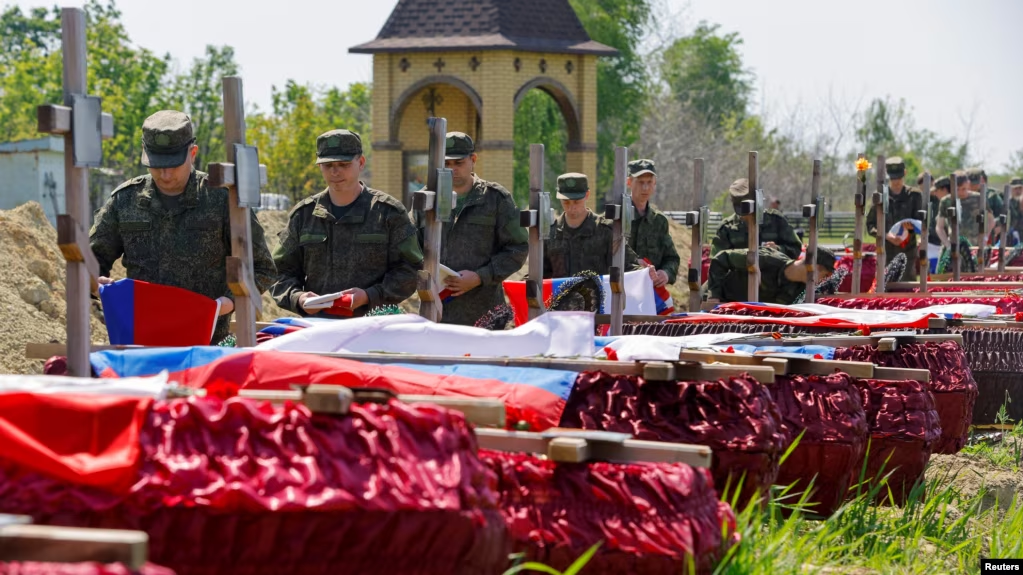
Soon after the start of Russia’s full-scale invasion of Ukraine, the editors of Kavkaz.Realii began monitoring reports about the losses of the Russian army in this war. Currently, the list of killed military personnel from the regions of southern Russia and the North Caucasus includes 8,000 people – excluding about 850 mercenaries buried in the Wagner PMC cemetery in Kuban.
This list passed the 1,000 mark on July 29, 2022, five months after the start of the war, and passed the 2,000 mark on January 10 2023, another five and a half months later. Then the flow of reports of those killed grew, and information about each subsequent thousand deaths began to accumulate in about three months: the 3,000th dead became known on April 11, the 4,000th on July 12, the 5,000th on October 16, 2023, the 6000th – January 16, 2024, about 7000th – March 18, 2024.
It took two and a half months to collect information about the eighth thousand killed, but this is not due to the real dynamics of losses but to the emergence of information about a significant number of previously killed. Thus, from the eighth thousand list in 2024, according to estimates, only 400–450 people died (the exact number is impossible to determine since the date of death is not always published).
Among the known dead are at least 617 mercenaries of the Wagner PMC, another 13 people who fought in unnamed PMCs, and at least 38 mercenaries of the Storm Z units of the Ministry of Defense. In total, at least 279 people were recruited from among the prisoners. It is also known about at least 649 killed mobilized and at least 484 so-called volunteers*. Collectively, they account for more than a quarter of all deaths. All these figures are significantly underestimated since the status of the killed military man is often not reported.
At least 610 of those killed were of officer rank. Including two killed generals, 28 colonels, 47 lieutenant colonels, 86 majors, 123 captains and a total of 299 senior lieutenants, lieutenants and junior lieutenants, another 25 people had an officer rank, which could not be clarified. These figures include police, justice FSIN officers and reserve officers.
There is still only one conscript among the dead – Andrei Shkolin from the Volgograd region, he served in the Belgorod region and died in the summer of 2023 as a result of mortar shelling from the Ukrainian side. In addition, conscript Kirill Korf, a native of the Irkutsk region and a resident of Sochi, who served on the landing ship Novorossiysk, is listed as missing. Novorossiysk was destroyed by a Ukrainian missile attack on the night of December 26, 2023.
Also, the number of known women killed in the war has not changed; there are two of them: Corporal Anastasia Savitskaya from Volgograd and lieutenant, military doctor Elena Sadkova from the Rostov region.
For the first time since the start of the full-scale invasion, the median age of those killed in war has increased by a year, now it is 34 years old. Of those killed by the editors, 10 were 18 years old, 19-year-olds – 44, 20-year-olds – 83. Those killed were 50–59 years old – 248 people, 60 years and older – 24 people, and the oldest was 69 years old.
In terms of regions of southern Russia and the North Caucasus, the deaths are distributed as follows:
- Krasnodar region – 1917 people;
- Volgograd region – 1207 people;
- Rostov region – 1156 people;
- Dagestan – 1056 people;
- Stavropol Territory – 711 people;
- North Ossetia – 527 people;
- Astrakhan region – 543 people;
- Chechnya – 270 people;
- Kabardino-Balkaria – 162 people;
- Kalmykia – 137 people;
- Adygea – 123 people;
- Karachay-Cherkessia – 112 people;
- Ingushetia – 79 people.
Proportional to the population of the region, the maximum number of known deaths is in North Ossetia, the minimum is in Ingushetia, and the share of deaths from North Ossetia in the population of the republic is more than five times higher than the corresponding share in Ingushetia. Also, the proportion of deaths in the population exceeds the average for the macro-region in the Astrakhan region, Kalmykia, Volgograd region, Krasnodar region and Dagestan.
It should be noted that these data are not only deliberately lower than the real number of those killed in the war but may not reflect the real regional proportions, since the availability of information on losses is influenced by factors such as the willingness of administrations to report the dead, the presence or absence of volunteers keeping burial records, policies of local publications and telegram channels.
According to the Caucasian Knot, as of June 1, 2024, authorities and government organizations in the southern and North Caucasus regions officially confirmed the deaths of only 4,102 people.
A comparison of information from the “Caucasian Knot” and information from the Kavkaz.Realii website allows us to assess the “level of information,” that is, the share of military personnel whose deaths were in one way or another officially confirmed in the total number of dead known from all sources. The average “level of awareness” for all regions of southern Russia and the North Caucasus is 51%, that is, slightly more than half. The lowest values are in the Krasnodar Territory and Rostov Region (21% and 38%, respectively), and the highest are in Kabardino-Balkaria and Dagestan (89% and 86%).
* “Volunteers” in reports of military deaths can refer to both fighters from units that are not part of the Ministry of Defence and those who entered into a contract with the Ministry of Defence to participate in the war in Ukraine after the start of a full-scale invasion.
- In assessing the losses of the Russian army in Ukraine, the Kremlin limits itself to the word “ significant ” – the exact number of killed soldiers is unknown. The Russian Ministry of Defence published information about losses on March 2, 2022, when 498 people were reported killed, and on March 25, 2022, 1,351 were reported dead. Defence Minister Sergei Shoigu stated on September 21, 2022, that the losses amounted to 5,937 people.
- According to the roll-call count of the BBC Russian Service and Mediazona, as of May 31, 2024, 54,763 Russian military personnel are known to have died in Ukraine.
- The monitoring, conducted by the Kavkaz.Realii website does not allow us to establish the real scale of losses. First, the authorities are reluctant to report deaths and prevent the collection and compilation of such information. Secondly, relatives of the deceased do not always use social networks or declare themselves by other means in the information space. Third, available reports often do not allow the identification of the person killed with a sufficient degree of accuracy. Fourthly, not all bodies were removed from the combat zone and identified.
- Essentially, monitoring provides information not so much about losses as such, but about their structure, dynamics and representation in the public field. The website Kavkaz.Realii told how officials, government organizations and censored media talk about those killed in the war.






