

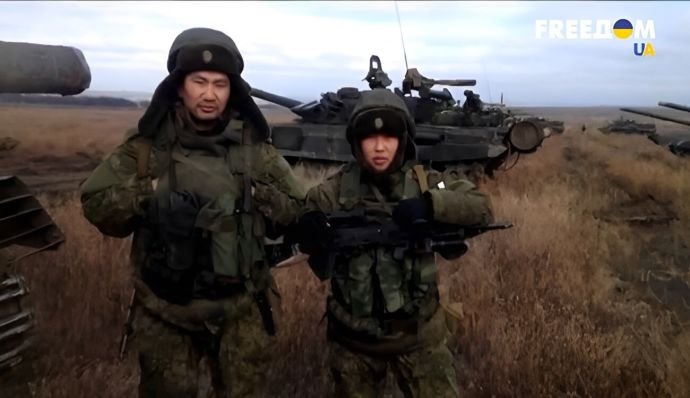
In Russia’s war against Ukraine, representatives of almost all indigenous people of the Federation die. Judging by the statistics of the distribution of losses, which is kept by the publication “Mediazon”, a significant number of the dead Russian soldiers come from Siberia and the Far East – in particular, from places of compact residence of representatives of small nations, reports FREEDOM.
Representatives of 47 indigenous minority nations inhabit Russia. These are ethnic groups that number less than 50,000 people. And every year their number is decreasing. The reasons are thoughtless and violent assimilation, underfunding of national programmes, and the eviction of small nations from their territories.
After the start of the full-scale invasion of the Russian Federation into Ukraine, one of the most important factors was the mobilization and large-scale losses of the Russian army in Russia’s war against Ukraine. After all, it is the representatives of indigenous people who are primarily sent to the front. For example, according to the 2021 census, there were 2,730 Telengits in the country. In 2022, 26 people called from Kosh-Agach, which is one of the places where the Telangites live compactly. Of them, 24 are representatives of a small nation.
“We hoped that they would return at least someone. The boys were still in Novosibirsk then. But no, everyone ended up going to war. Verbally they said that, well, the error occurred simply because of a system failure. But someone should be responsible for this mistake! There are only a few of us! In my opinion, the Telangites should not have been taken away at all! Here almost 90% are mobilized Telengites, – commented Azzat Tondoyev, a resident of Kosh-Agach, in the commentary Sibir. Realities.
The standard of living in the national republics of the Federation is much lower than in the centre. The Kremlin also uses this to send as many men from these regions as possible to Russia’s war against Ukraine. Judging by official data, earnings in the North and the Far East of Russia are higher than the national average. But this is the “average hospital temperature”. And they get it by summing up the colossal incomes of top officials and managers of energy and mining companies with the poor salaries of ordinary workers.
“Either you will work as a security guard, or if you are lucky, at a liquor store and receive 40,000 rubles a month, or welcome to the army of the Russian Federation. Globally, it seems to me that the question here is why these regions found themselves in such a difficult situation, because, after all, it seems to me that the policy of the centre is aimed at reducing these regions to poverty, so that later anything can be done with them.” — said Oleksandra Harmazhapova, head of the “Free Buryatia” foundation.
Moscow systematically violates the rights of small ethnic groups enshrined in Russian legislation. The Kremlin banned the activities of organizations involved in the protection of indigenous nations. Objective monitoring of the situation is difficult, as representatives of international environmental and human rights organizations are not allowed to enter the country. However, this prevents Russia from using representatives of small nations of the Federation for propaganda.
“At international events, for example, at the UN in New York, representatives of indigenous nations from all over the world discuss the problems facing their nations. The Russians receive a detailed briefing before each appearance on the podium from a representative of the Ministry of Foreign Affairs (who is very similar to a representative of the FSB) and they say that it is necessary to lift the sanctions,” said Dmytro Berezhkov, a representative of the International Committee of the Indigenous Nations of Russia, in a comment on Siberia. Realities.
Representatives of the small nations of Russia united in the Anti-Imperial Block of Nations. On 21 and 22 July, the organization held its first congress in Lithuania. The goal of the activity is the struggle for the right of self-determination of all nationalities and nations guaranteed by international pacts. The members of the Anti-Imperial Block of Nations are confident that the victory of Ukraine and the complete collapse of the Russian Federation will give them a chance to realize these tasks.






