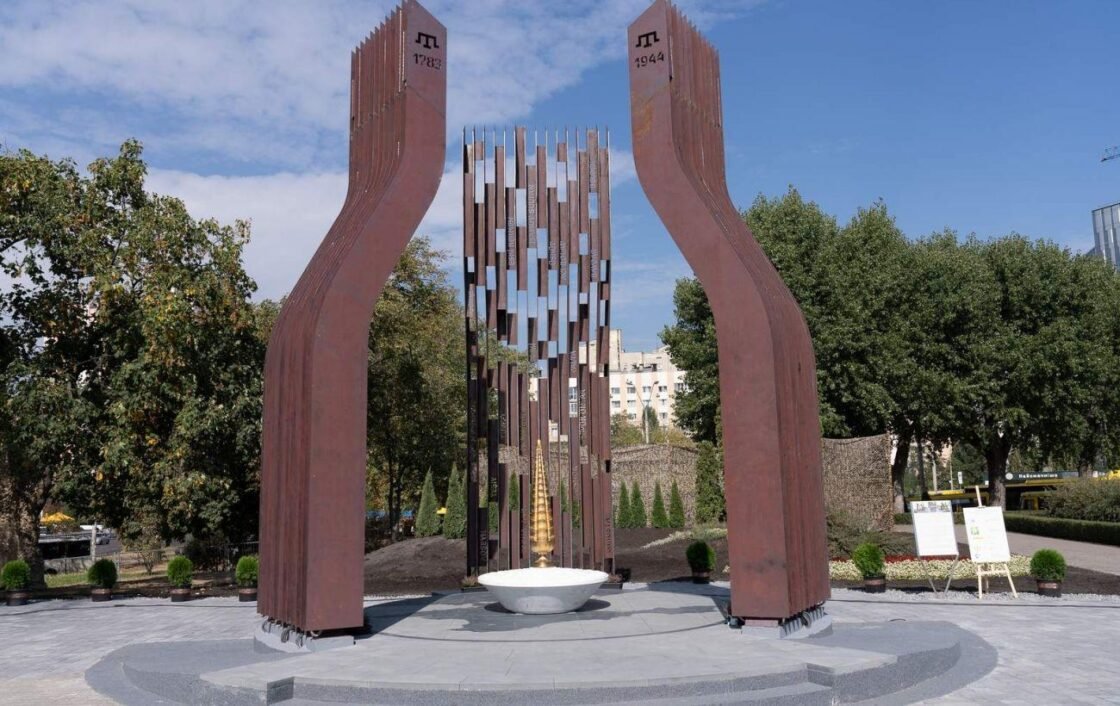
One of the darkest chapters in Crimean history unfolded in 1944, when the entire Crimean Tatar population was forcibly deported from their homeland to remote regions of Central Asia. This tragic event wiped out almost half of the population and left unhealed trauma not just on the survivors, but also on the next generations. By the time of the deportation, however, the Crimean Tatars were already a minority in Crimea, making up only 20–25% of the population – the result of decades of systematic repression and waves of forced emigration.
Thus, the 1944 deportation was not an isolated event, but the tragic culmination of a long history of persecution that began with the annexation of Crimea by the Russian Empire in 1783. Before the annexation, Crimean Tatars comprised about 90% of the peninsula’s population, forming the dominant majority in a land where no Russians lived.
However, 1783 marked a turning point – the beginning of what historians often refer to as “the dark century” for the Crimean Tatar people. Russia’s rule over Crimea stands as one of the most destructive periods in the region’s history, leaving scars that have never fully healed. The imperial and later Soviet regimes sought to erase or rewrite the peninsula’s rich, thousand-year history to create a narrative that Crimea had always been Russian. From the very beginning, Crimean Tatars were seen as the main obstacle to achieving this goal, an obstacle that had to be removed by any means necessary. As a result, Crimean Tatars became the target of persecution, displacement, and cultural erasure. Alongside repressive measures, they were systematically deprived of their land and property, much of which was handed over to Russian generals and nobles.
There were cases when entire villages were displaced, with Russian soldiers forcibly removing their residents. In 1799, for example, authorities surrounded twelve villages in the Baydar Valley and forced the local Crimean Tatar population to abandon their homes. The land was reassigned to Count Mikhail Mordvinov, who shamelessly justified the act by declaring, “When Crimea belongs to Russia, in my view, it’s not necessary to call Russian land ‘Tatar land.’” This episode was not an exception, but part of a broader colonial strategy aimed at removing the indigenous population to make way for Russian settlers.
Each family tells its own escape story, with different methods, routes, and destinations, but they are all united by one common factor: they fled from Russian oppression. For many, the decision to leave was not made willingly, it was instead a matter of survival. Remaining in Crimea often meant facing certain death or enduring oppression. This continuous exodus reshaped the demographic landscape of Crimea long before the Soviet deportation delivered its final, devastating blow.
Kerem, a Crimean Tatar now residing in Turkey, recalls that his ancestors fled Crimea shortly after its first annexation by the Russian Empire. According to vivid stories passed down by his great-grandmother, Haşime, their escape was dramatic and filled with danger. The entire family fled on horseback, with the Russian army in pursuit. Every gallop was a desperate bid for survival and freedom. During their flight, tragedy happened – Haşime’s uncle fell from his horse. Despite the shock and grief that shook the family, they had no choice but to leave him behind. Stopping to help him would have meant capture for them all. With heavy hearts, they continued, and his loss became a sorrowful chapter in their family’s history. After a dangerous journey, the family reached Shumen, now part of Bulgaria, where they found temporary safety. But their quest for a better life did not end there. Eventually, they moved once more, this time settling in Eskişehir, Turkey. Today, Eskişehir is home to one of the largest Crimean Tatar communities. Around 200,000 Crimean Tatars live there, and the region is home to 29 Crimean Tatar villages, each a testament to the resilience and enduring spirit of a people whose history has been shaped by both hardship and hope.
In 1853, Russia launched an attack on the Ottoman Empire, marking the beginning of the Crimean War, a conflict that turned the Crimean Peninsula into the epicenter of military hostilities. Fearing that the Crimean Tatars might support the Ottomans, with whom they shared deep historical, cultural, and religious ties, the Russian authorities began to view the indigenous population as a potential threat. In response to these suspicions, Tsar Alexander II ordered their expulsion, reportedly stating that it was necessary to “rid the peninsula of this harmful evil people.”
One of many personal stories from this period was shared by a Crimean Tatar named Yener, born and living in Romania. His grandfather, Elmi Amet, was told this account by his grandmother, Burmambet Esma, born in 1888. According to her, Elmi Amet’s grandfather fled Crimea between 1853 and 1855, during the height of the Crimean War. He was just 12 years old when he left his homeland, completely alone, with no parents or siblings. As the story goes, his parents had likely been killed by Russian forces. In a desperate bid for survival, he escaped by sea, clinging to a single piece of wooden cork attached to a ship crossing the Black Sea.
He eventually reached the shores of the Dobruja region, then part of the Ottoman Empire, now modern-day Romania. As a lone child in a foreign land, he was soon taken into custody by local authorities. But in a remarkable turn of events, while sheltering in a barn between sacks of grain, he discovered his sister, who had also fled Crimea under similar tragic circumstances. Since then, Yener’s ancestors have continued to live in Romania, alongside many other Crimean Tatars who held on to the hope that one day they would return to their homeland. Yener himself has never been to Crimea. And now, with the Russian occupation of the peninsula that began in 2014, that hope feels more distant than ever.
This period was particularly catastrophic for Crimea and its indigenous people. For the first time in history, the number of Crimean Tatars living in exile exceeded those who remained in their ancestral homeland. Many villages and mosques were abandoned, and Crimea lost countless individuals who had carried and preserved its rich cultural heritage.
The Ottoman-Russian War of 1877–1878 triggered yet another wave of Crimean Tatar emigration, as intensified Russian repression made life in their homeland unbearable. It was during this period that Yiğit’s ancestors fled Crimea via two different routes, escaping the looming threat of persecution and leaving everything behind. Yiğit Taymaz notes that had his family not left Crimea during those years, they might not have survived the 1944 Soviet genocide against the Crimean Tatars. Their journey first took them from Crimea to Turkmenistan – a difficult and uncertain migration across vast distances, marked by hardship, fear, and the struggle to survive in unfamiliar lands. Like many other Crimean Tatars, they had to rebuild their lives from scratch, holding onto their language, faith, and traditions even in exile. After spending some time in Turkmenistan, the family eventually decided to continue their journey to Turkey. Upon arrival, Crimean Tatar families were resettled in various cities based on the professions they had held back in Crimea. Yiğit’s great-grandfather had been both a farmer and a baker. In his new home in Polatlı, Ankara Province, he played a significant role in developing the local bakery tradition, preserving and sharing the cultural legacy of his people in a new land.
Today, Yiğit represents the fourth generation of his family to live in exile. Despite the challenges they faced, his family continues to remember their roots, cherishing their culture and language. Yiğit sometimes meets Crimean Tatars who have come to Turkey from Crimea in the past decade. As he explains, the oppression is ongoing, and their only hope is for Crimea to return to Ukraine and to be free once again.
There are countless stories like this, stories that are often reduced to mere statistics. But behind those numbers are real people, each with their own unique experiences of loss, separation, and survival. These are the stories of families torn apart, of individuals who were forced to flee their homes, leaving behind everything they knew and loved. The trauma of exile and the longing to return to their homeland is a reality that continues to echo through generations.
Today, Crimean Tatars are once again being forced to flee their homeland due to relentless repression and persecution. Since 2014, Russia has been carrying out the same form of deportation, as seen in the stories mentioned, creating living conditions so unbearable that the people of Crimea have no choice but to either leave or endure further suffering. We are witnessing a new wave of Russian colonization on the peninsula – one that threatens to erase the very identity of the Crimean Tatar people. This time, however, the world must not turn a blind eye to this unfolding tragedy. The global community must stand with the Crimean Tatars, ensuring their voices are heard and their rights protected.
Lia Motrechko