

There is a lot of talk about the future collapse of Russia and the liberation of the enslaved peoples in Ukraine, because this is the desired and most optimal scenario for us to end the war. Moscow’s loss of the imperial “sting” is the main guarantee of security in the region, the rest are compromises that do not exclude relapses of aggression against us or some Eastern European or Asian state that once belonged to the Soviet sphere of influence.
In Russia itself, both at the official and popular levels, theories about the empire’s collapse are usually joked about sarcastically. However, today there is reason to believe that recently the Kremlin has begun to take such a threat seriously.
In early November, the magazine “Gosudarstvo” published an article by an official from Putin’s administration, Alexander Kharychev, entitled “Who We Are,” in which he outlined the main threats to Russia and ways to overcome them.
The author of the article calls the number one threat “civil war, the division of people, the loss of opportunities to fight for their continued existence.”
There is an irony in this: about ten years ago, Kremlin spokesmen were talking about a civil war in Ukraine when it came to armed confrontation in Donbas, and today they have started talking about the likelihood of such a scenario within Russia.
Clearly, Kharychev’s warning is not mere curiosity but part of a coordinated, centralised policy. Kharychev himself is a man from the orbit of Sergei Kiriyenko, a politician from the Yeltsin era, who has gone through a typical path from a young reformer to an imperialist. Kiriyenko is responsible for domestic policy in the Putin administration (including the occupied Ukrainian territories), and Kharychev, who is a chemical weapons officer by education, has been involved in elections as a political strategist for many years, first at the regional and later at the federal level.
Alexander Kharychev speaks rather abstractly about the possibility of civil war, saying that if Russia has experienced major upheavals twice in the past (the Troubles of the 17th century and the Revolution of 1917), then this risk cannot be ignored today. Here, of course, he is being sly.
Ideological articles from Russian officials are not uncommon, but so far, none of them have outlined the likelihood of civil war as the number one threat. Since the beginning of zero, Putin and all his spokesmen have methodically intimidated the population with the “predatory plans of the West” that intend to capture, subjugate and dismember Russia, and all the mobilization fervor has been thrown into preventing the implementation of these “insidious plans.”
Internal conflict is a phenomenon of a completely different kind, and Kharychev is talking specifically about contradictions within the country, which, according to his definition, can be of an interethnic, religious, property, and intergenerational nature.
The interethnic conflict is put in the first place not by chance. This topic constantly “sparks” inside Russia. Its latest, most large-scale manifestation is the raids of security forces in Yekaterinburg, as a result of which ethnic Azerbaijanis suffered. This conflict could be a response to Baku’s firm position on the shooting down of an Azerbaijani plane by Russia.
Since 2020, the activities of the far-right organisation “Russian Community” have been gaining momentum in the Russian Federation. On the one hand, it fulfills orders from the authorities to popularize the so-called SVO, and on the other, it systematically incites interethnic hostility, organising unauthorized anti-immigration raids in various cities, which are often accompanied by violence.
Xenophobia of ethnic Russians towards their “compatriots” from the republics of the Caucasus, the Volga region, and Siberia is consistently high. For Moscow or St. Petersburg, it has long been the norm to write in real estate rental advertisements that an apartment will be rented only to a Russian (Slavic) family. In the national republics, contradictions are becoming increasingly acute. “Maidans” and armed uprisings do not break out there. But this does not mean the complete absence of anti-colonial struggle.
In 2023, the Yakut film “Aita” premiered. A kind of “Twin Peaks” in the interior of the northern republic. However, there is one “but”: at the centre of the plot is the suspicion of a Russian policeman in the murder and rape of a Yakut girl. And although the suspicions turn out to be in vain, the film is so filled with connotations of the indigenous people’s rejection of the Zayd that Roskomnadzor banned its distribution. The film, by the way, collected $ 184 thousand at the box office (with a budget of $ 28 thousand) as “containing destructive information that contradicts the principles of Russian unity.”
Yakut cinema (“Aita” is far from the only film shot on indigenous material in the republic) is just one of the markers of the presence of hints of emancipation among the enslaved peoples. Today, almost every republic has its own popular rapper or blogger who speaks in its native language. Some of them cooperate with the authorities, some do not and emigrate in protest.
In emigration, the lives of nations enslaved by Russia are also becoming increasingly visible. In contrast to the “good Russians” from Russia’s democratic opposition, representatives of indigenous nations are trying to create their own platform in PACE.
Just as in the late 1980s, different republics of the USSR had varying degrees of readiness to leave the USSR, so in modern Russia, indigenous peoples have varying degrees of assimilation and readiness to leave the empire.
Today, the republics of the North Caucasus, primarily Chechnya and Dagestan, have a significantly different way of life compared to the rest of Russia. There, Russian laws are often inferior to Sharia, to which the federal centre prefers to turn a blind eye. If the collapse of Russia begins, then, without a doubt, it will begin from this region, and the more loyal and assimilated Udmurtia and Chuvashia will “wake up” later and accept the new order of things, as was once the case in the Soviet republics of Central Asia.
After all, if we talk about the likelihood of a civil war in Russia, then it is worth taking into account the Ukrainian factor. We have founded the University of Free Peoples, which works with the potential anti-colonial elite of the indigenous peoples of Russia. Kyiv recognised the independence of Ichkeria and the genocide of the Circassian people. Bill No. 11402 is under consideration in the Verkhovna Rada.
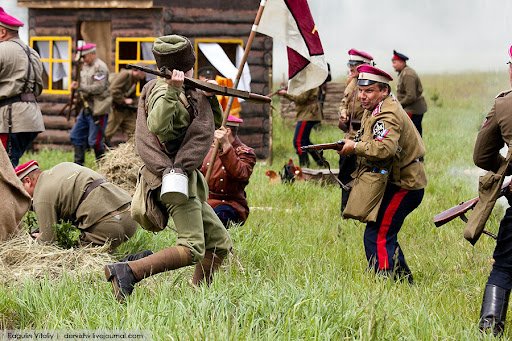
Against the background of all the above factors, Russia has begun to talk about the threat of civil war. In the context of information confrontation, this is a positive development for us. The Civil War is a major narrative in Russian culture. In modern Russia, the events of 1917–1922 are interpreted as a great tragedy, “brother against brother,” where Vasily Chapaev and Admiral Kolchak appear to be equally tragic figures. Unlike World War II, the Civil War at one time covered the entire territory of modern Russia from Vladivostok to St. Petersburg. That is why it is feared.
Kharychev proposes to counter the threat of civil war with “active patriotism” – a typical imperial construct, in which indigenous peoples are given the role of younger brothers (instead of gingerbread, Putin even declared 2026 the year of the indigenous peoples of the Russian Federation). Colonizers traditionally do not understand the enslaved: if the metropolis sees its own demise in the coming upheavals, then the colonies see a chance for freedom.
Among other challenges that Kharychev mentions in his article is depopulation. Demographic problems in Russia have reached such a level that it was decided to keep statistics on birth and death rates secret there. According to the 2020–2021 census, population growth was mostly observed in republics where Muslims predominate. It is unlikely that calls to nurture a family and have at least three children in a family (Kharychev himself has only two) are addressed to Russian citizens who practice Islam. The regions where ethnic Russians make up the majority are in a real demographic pit. The authorities are trying to reach them with rhetoric about traditional values, avoiding mentioning the main enemies of family life in this country: alcohol and domestic violence.
Kharychev also considers transhumanism, the transition of people to the virtual world, and the transformation of a person into a subject of consumption, to be enemies of Russian society. The Kremlin exploits the fear inherent in many modern people of the rapid development of technology, artificial intelligence, etc. In this matter, the great ally of the Russian authorities remains the church, which fosters various kinds of ignorance in its believers (which we observe among the most zealous parishioners of the UOC-MP). But this intimidation also has completely utilitarian goals. To overcome “depopulation”, Kharychev suggests focusing on “service” and “creative labour” and, at the same time, removing the word “services” from circulation. This is not just a game of linguistics. Services are an important category of the market economy. Replacing them with service means promoting gratuitous, altruistic activity. Against the backdrop of the deepening economic crisis in Russia, the fight against the consumer society becomes useful.
All this was done by Soviet ideologists at one time. And, as we know, they lost.
People who were told about plans for world imperialism and “peace in the world” wanted to buy imported jeans more than anything else. Today, Kharychev can announce as many laws as he wants about patriotic education in schools, and their adoption will not reduce the desire of Russian teenagers to have the latest iPhone.
The fight against the virtual world is also not just a beautiful figure of speech. By this, Kremlin ideologues mean further tightening of censorship on the Internet, the rejection of certain services and social networks, and the movement towards the “cheburnet” (a purely Russian Internet closed from the world).
As a result, a rather gloomy perspective emerges from Alexander Kharychev’s article: we need to consume less and serve more for the public good, give birth to as many children as possible, otherwise there will be a civil war. And in such conditions, and also on the principles of “Russian philosophy”, the “man of the future” should be born: without the Internet and the service sector, but with a rich inner world.
Konstantin Vozdvyzhensky






