Russia is trying to solve its main problem of 2026 — the shortage of manpower — not only with money and pressure on its own regions, but also through the systematic recruitment of foreigners. It is not that foreigners will become the basis of the Russian army. But if even 5–10% of the plan of more than 400,000 contract soldiers are citizens of other countries, this already shows a dangerous trend. The Kremlin has begun to globalise its mobilisation.
The logic here is simple and very cynical. Moscow is trying to make the war as invisible as possible for the population of large cities. The political stability of the regime is more important than real losses. That is why the main burden of the war is borne by the Russian province, national republics, migrants, prisoners, and now also foreigners from Africa and Asia. This is a classic imperial model: the centre lives relatively peacefully, and the outskirts and foreigners pay for the war.
Another thing is especially telling. The state, which for years has built a xenophobic ideology about “purity” and the fight against migrants, today actively uses foreigners as assault infantry. This is the real price of Russian propaganda. When there is a need for meat for the front, all ideological constructs disappear. Because, for the Kremlin system, they are not allies. They are expendable material.
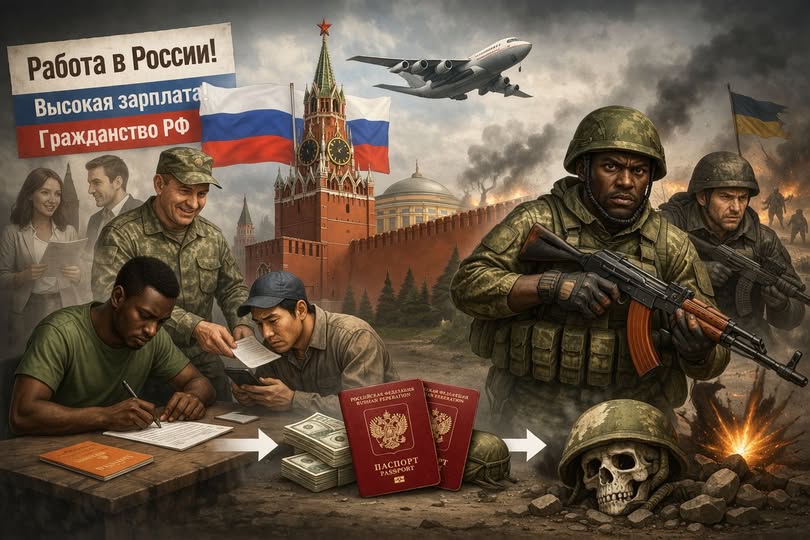
The recruitment schemes are as dirty as possible. People are lured by promises of work, training, legalisation, or quick acquisition of Russian citizenship. Documents are often taken away. After a short training, such “volunteers” find themselves in the most dangerous areas of the front. In fact, we are talking about using socially vulnerable people as a disposable resource of war.
As for the role of China or other major powers of the Global South, there is no need to look for formal permissions here. The Kremlin benefits more from the lack of a strong reaction than from support. Russia works where there is no political price for such actions. Where economic interests, energy, or military contracts weigh more than the fate of individual citizens, recruitment networks are given space to operate.
The situation with India demonstrates this well. Despite public statements about the return of its citizens, the process has been delayed. The reason is simple – large powers always act pragmatically. Cheap energy sources, military-technical cooperation and geopolitical calculations often affect the speed and rigidity of decisions. This is real policy, not diplomatic declarations.
What can and should Ukraine do in this situation?
First of all, we need to shift this topic from a military to a criminal one. The world should see not just “foreigners in the Russian army,” but signs of deception, coercion, and actual elements of human trafficking.
The second is to systematically work with the governments of countries of origin regarding the facts of their citizens who have died, been captured, and disappeared.
The third is to conduct active information work in these countries: to show the reality of Russian contracts without embellishment.
Fourth, seek sanctions against intermediaries, recruitment structures, and pseudo-employment agencies that operate as tools of the Russian military machine.
The main thing that is important to understand. If Russia starts searching en masse for people around the world, this is not a sign of strength. It is a sign that its own mobilisation resource is becoming politically dangerous for the Kremlin. That is why Moscow is trying to buy other people’s blood so as not to pay too dearly for its own.
To put it bluntly, Russia is creating a global war market where poverty is exchanged for death.
And this is another indicator that, for the Kremlin, this war has long ceased to be a question of territory. It is a question of the survival of a regime that is ready to continue it at any cost. Even if this price is paid by citizens of other states.
Viktor Yagun
Facebook