In the context of the current vicissitudes in relations with Poland, Slovakia, and previously—and quite possibly again in the future—with Hungary, it is worth taking a closer look at the issue of enslaved nations in modern Russia. Let us also add the fact that in the recent presidential elections in Romania, pro-Russian populist forces came very close to victory.
No matter which scenario unfolds next—be it a “freezing” of the war with uncertain prospects, or a Ukrainian victory followed by a deep weakening or even disintegration of the Russian Federation—Ukraine will face a new historical challenge. This will no longer be just about security, but also about solidifying its new regional status and shaping a new role in Central and Eastern Europe and the Black Sea region.
It is unlikely that all of our closest Western neighbours are equally interested in Ukraine emerging from this war as a charismatic regional power. Each state has its own vision of national interests and its own geopolitical calculations. However, reality may turn out differently than expected just a few years ago. Instead of being weakened and turned into a source of cheap resources, Ukraine has gained a chance to become significantly stronger, more technologically advanced, more influential, and a desirable partner for the world’s leading nations. Naturally, not everyone is pleased with such a scenario.
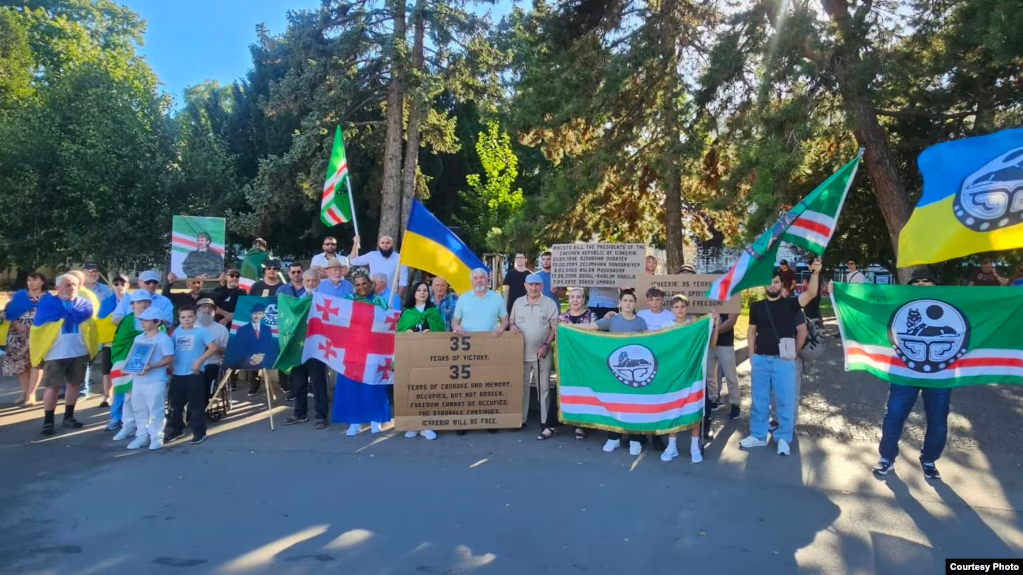
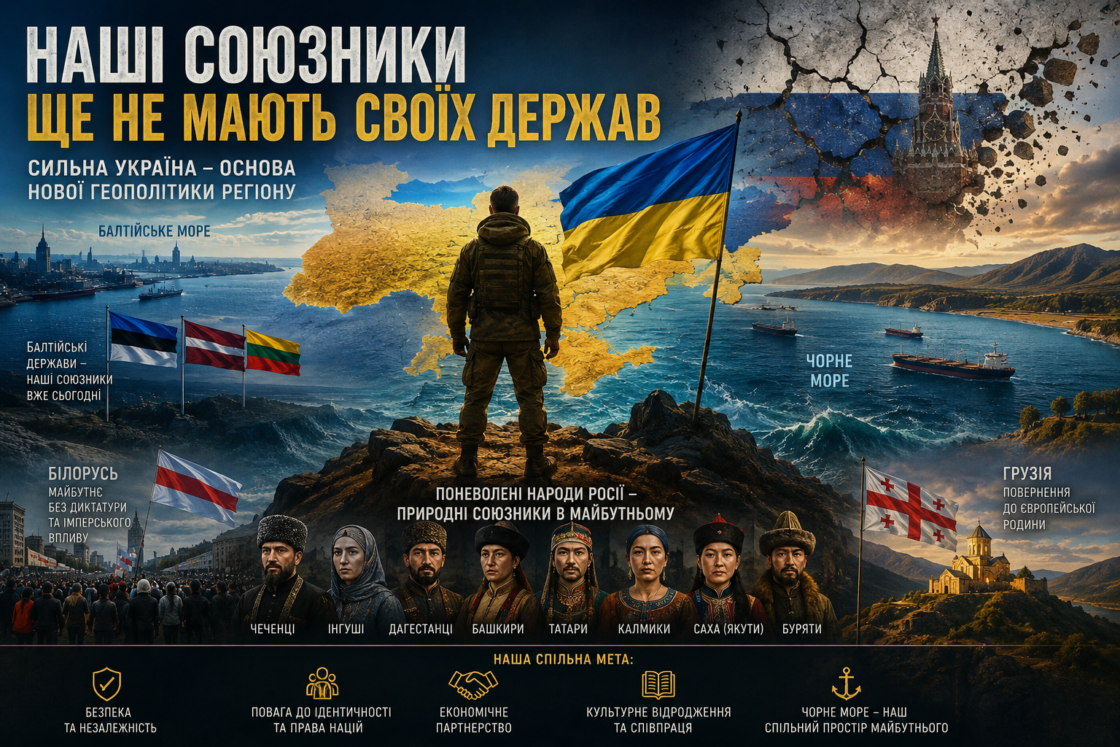
It is precisely in this context that we should discuss the enslaved nations of modern Russia. The logic is quite simple: Ukraine needs reliable, natural allies who would be objectively interested in the existence of a strong and successful Ukrainian state. Alongside the Baltic states, such potential allies could be the peoples of the North Caucasus and other nations of the Russian Federation striving to preserve their identity and the right to their own political future.
For many of them, a strong Ukraine could become one of the key factors in shaping a new system of security and cooperation in the region in the event of a fundamental transformation of Russia. These are not merely theoretical reflections. I arrived at this conclusion after numerous observations and conversations with representatives of national liberation movements of various nations.
If we look at the map, it becomes obvious that Ukraine’s two main pillars of support could be the Baltic and Black Seas, with the Black Sea direction holding particular strategic significance. In this context, it is appropriate to recall Yuriy Lypa’s work The Black Sea Doctrine, which contains many ideas that remain relevant today.
Therefore, when speaking of the enslaved nations in Russia that have preserved their identity, we should view this issue not through the prism of post-Soviet stereotypes and prejudices, but from the perspective of the future security architecture in our region. No matter how strong Ukraine becomes, it will still need reliable allies with whom it can jointly build a stable, secure, and competitive space.
In this context, future changes in Belarus and Georgia’s return to fully sovereign development without Russian influence are also crucial. These are components of a single, broader geopolitical process that is only beginning to take shape.