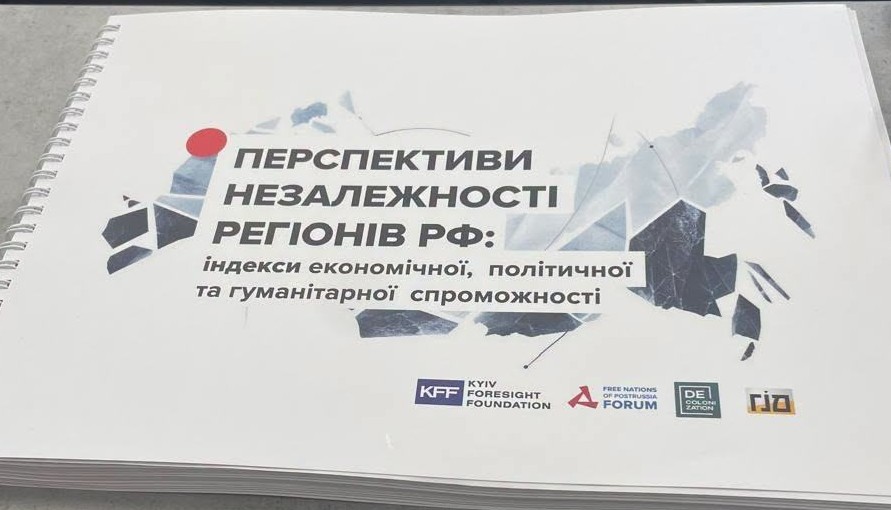
A presentation of the expert study “Prospects for the Independence of Russian Regions: Indices of Economic, Political, and Humanitarian Capacity” was held in Kyiv at the Kyiv-Mohyla Academy.
At the beginning of the presentation, Valery Pekar, chairman of the board of the public organisation “Decolonisation,” emphasised: “Moscow constantly uses arguments about the economic, humanitarian, political, and other inefficiencies of its own regions to justify its colonial policies.”
In his opinion, the main problem when discussing decolonisation in the Russian Federation is the lack of reliable data. “The subject hasn’t been studied,” adds Valery Pekar, recalling that UN Resolution 1514 of December 14, 1960, explicitly states that insufficient economic or political readiness cannot be used as a reason to postpone independence.
Kyiv Foresight Foundation founder and Doctor of Economics Andriy Dligach summarises the presentation’s main idea simply: “Our goal is to prove that the insolvency of Russia’s regions is not a natural fact, but a constructed reality. A region can receive more from the centre than it earns. But not because it’s poor, but because the rent from the sale of its natural resources was first pumped to Moscow,” the economist explains.
The authors don’t trust official Russian statistics. Therefore, they based their analysis on hard-to-refute indicators and honestly identified areas where the estimates are questionable.
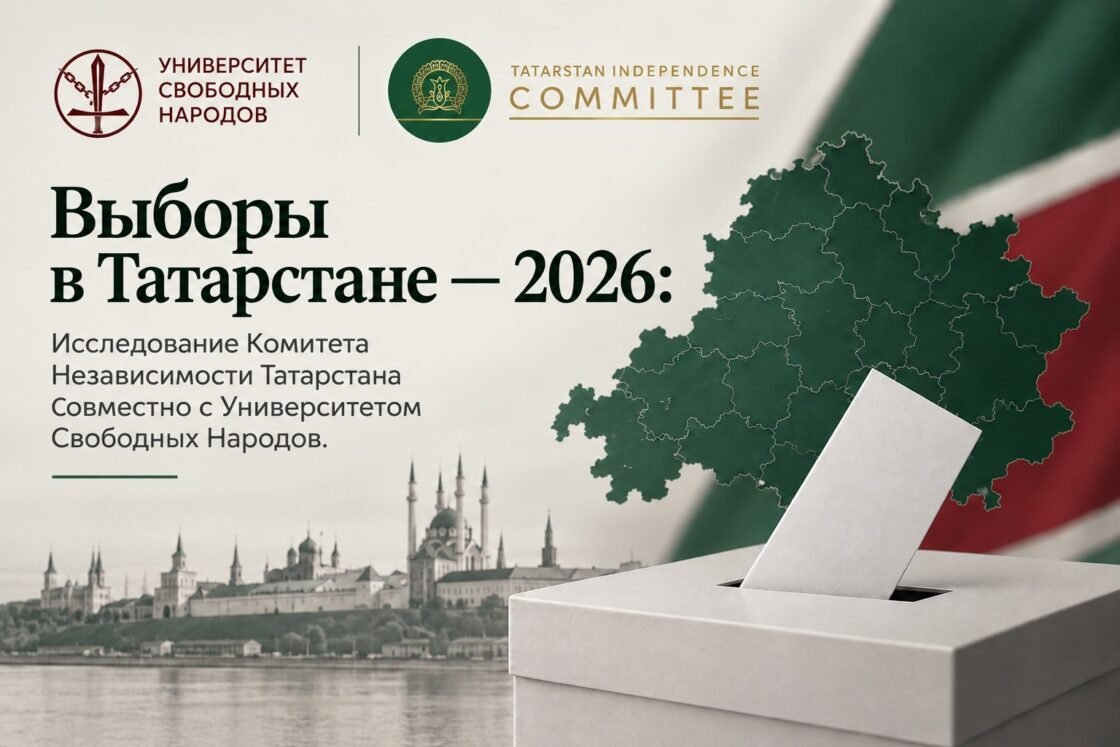
Ten regions were selected for the first wave of the study: Ingria, Kuban, Oirat-Kalmykia, Tatarstan, Bashkortostan, the Urals, Komi, Siberia, Sakha-Yakutia, and Buryatia. They were deliberately diverse: large and small, northern and southern, ethnic and Russian-speaking, with high and low levels of protest sentiment. The logic was clear: identify the extremes. Then all the other unexplored regions would fall somewhere within.
Some of the regions studied are existing national republics. Others are “synthetic,” assembled from several regions based on historical or cultural principles.
A team of researchers calculated three indices of regional well-being: economic, humanitarian, and political. They concluded that Dligach calls one of the most important.
“As soon as the federal centre disappears, it turns out that all ten of these regions can exist independently as independent and economically stable countries,” he says. At least eight of the ten territorial entities, according to the authors, are capable of quickly transitioning to independence. The reason is the same rent on natural resources.
“The rent extracted from the regions significantly exceeds the subsidies they receive from the centre,” explains Dligach. He adds that the companies exploiting the outlying regions’ natural resources are primarily registered in Moscow and St. Petersburg, meaning they pay the bulk of their taxes there.
Dligach divides the regions of the Russian Federation into three groups.
Quasi-autonomy. Kuban is an example. “It’s a strong region that’s only formally a recipient. But in reality, too much is being pumped out of it,” says the economist. Cut off the connection to the centre, and it becomes a state with a budget surplus.
“They are economically self-sufficient,” adds Dligach.
Resource colonies. Siberia is an example. They are self-sufficient, but their entire economy is geared toward sharing resources. “If Siberia gains independence, it will essentially be a closed system,” explains Dligach. The problem of an independent Siberia will be the lack of ice-free seas with access to the World Ocean and its dependence on the transit of goods. Such regions require a separate “transition programme” and new markets. “And each of these resource colonies risks becoming a new metropolis,” warns the economist.
Administrative protectorates. The most heavily subsidised regions. An example is Kalmykia. Here, the local economy was deliberately destroyed to make the territory dependent.
To summarise, researchers see the highest political capacity in Tatarstan, Bashkortostan, Buryatia, and the Sakha Republic (Yakutia). The Urals and Siberia experienced only brief episodes of statehood. The Siberian one lasted less than nine months during the wars of independence in the former Russian Empire.
Valery Pekar reduces his part of the research to a simple image.
“The main imperial bonds are money and fear. I don’t think anyone would argue with me on this point. Other bonds, like shared identity, ideology, and a career as an official, no longer work.”
When money dwindles, the first bond breaks. Pekar recalls 1991: “The republics fled Moscow, and Moscow fled the republics.”
Fear is also waning. For example, the shortage of jet fuel means the Kremlin is physically unable to redeploy security forces quickly from region to region. Pekar recalls the protests in Bashkir Baymak in early 2024: there weren’t enough local security forces to suppress the protests, so reinforcements had to be brought in from other regions.
At the same time, Pekar doesn’t idealise the future of the post-Russian space. “Some states will embark on the path to democracy. Others will become democratic republics. Still others may turn into dictatorships,” the researcher believes. He points out that even after 35 years of independence, Ukraine is still called a hybrid democracy.
The moderator of the meeting, international lawyer and board member of the NGO “Decolonisation,” Taras Byk, examines imperial myths. The authors divided Russian propaganda into four sections, each with its own response.
First: the myth of the voluntary incorporation of Russia’s current “outskirts.” “Bashkortostan, for example, came under the control of the Grand Duchy of Moscow in 1557, and then its rights began to be revoked,” the moderator says.
The conquest of Buryatia and Yakutia lasted for decades, with uprisings and epidemics. The Kalmyk Khanate remained sovereign until the Russians arrived. And in the 18th century, approximately 170,000 Kalmyks simply fled the new empire.
Second: the myth of Moscow’s civilizational mission. Allegedly, the “outskirts” contained only “deer and swamps,” while “civilization came from the centre.” The authors support this with facts: the Kalmyks had codified law since 1640 and their own written language; networks of Buddhist monasteries operated in Buryatia and Kalmykia; and the Kazan Khanate converted to Islam before the Christianisation of Rus’.
Third: the myth of lack of identity. The Kremlin not only repeats it, but destroys this identity itself—it continues to restrict the right to speak one’s native language and practice one’s religion.
Fourth: the myth of subsidies. “Russia collects almost all the rent from the regions. And then, out of pure generosity, hands over a few pennies,” explains Taras Byk.
They propose countering this in three ways: international diplomacy, information, and politics. The latter has a concrete dimension—the adoption by the Verkhovna Rada of Bill No. 11402 on support for national movements of colonial peoples of the Russian Federation. It was registered back in the summer of 2024 and signed by over 80 deputies. However, the document has yet to reach the floor of the parliament.
“There is still no political will to adopt this bill,” the international lawyer states.
Oleh Magaletsky, founder of the Forum of Free Peoples of Post Russia, embraces the symbolism of the event’s location: “The Kyiv-Mohyla Academy is an institution whose graduates helped build the Muscovite Empire,” he says. He believes it’s appropriate to lay the foundations for the empire’s dismantling at Mohyla Academy.
Magaletsky insists: this isn’t a dream about Russia disintegrating on its own. It’s a blueprint. In the modern world, cognitive warfare is paramount. “And only when cognitive methods fail to gain an advantage does the aggressor resort to kinetic methods of influence,” the public figure explains.
For every Kremlin horror story—from nuclear weapons to chaos—a risk-mitigating roadmap is needed, Magaletsky believes. “The overall risks of Moscow’s dismantling are far less than the risk of leaving this terrorist state as a single, indivisible entity.”
He uses the years 1989–1991 as an example. Not all post-Soviet countries became democracies: along with Estonia and Lithuania, there are Turkmenistan and Tajikistan. But none of them pose a threat to their neighbours.
Moderator Taras Byk returns to the main stage.
“Our Western partners kept telling us: ‘You’re speaking emotionally, you’re traumatised by the war. Give us the facts about the Russian Federation,'” he recalls. He points to the brochures: “This study provides those facts.”
Even more important, adds Taras Byk, is that the talk of colonisation should not come from Ukrainians. “Let the people themselves speak: we want to be independent.”
Member of Parliament Maria Mezentseva joins the online discussion. She promises to use the research results to work on a resolution for PACE, an assembly that unites 46 states. She also cites a figure she finds interesting. “According to a survey of young people in Russia, 57% are ready to stage a real protest,” Mezentseva says. “Not just write something in the comments, but actually take to the streets.”
The participants in the discussion also agreed that new states must have at least basic security structures in order to be able to protect themselves from attempts to draw them into a new empire.
Alexander Kurylenko