Fears of the development of separatism in Russia have a real basis. The signal for the possible start of the process of secession in the regions is not only the political situation that has developed in the Russian Federation today, but also the economic indicators of the development of the Russian state.
In previous materials, the general features of the development of Ural separatism were considered in the context of the analysis of the totality of risks of secession activation among national minorities living in the region, and among the Russian population of the Urals. In particular, the peculiarities of Udmurt , Mari, and Chuvash separatism were considered separately .
In this material, the subject of the study is the assessment of the potential for the development of separatism in the territory of the Khanty-Mansia Autonomous District as a component of the secession process in the Urals.
general information
Yugra, also known as the Khanty-Mansiysk Autonomous District, is one of the subjects of the Russian Federation, which is part of the Tyumen Oblast and the Ural Federal District. In fact, this region of the Russian Federation is one of the economically self-sufficient donor regions. The largest oil production enterprises of both Russia and the world as a whole are concentrated on its territory.
It should be noted that Ugra ranks third in the ranking of the socio-economic situation of Russian regions and second in the scale of the economy in the Russian Federation.
The economy of the autonomous district has priority sectors of extraction of hydrocarbon raw materials, energy, construction, development of transport infrastructure and other industries are also developing in the autonomous district.
According to the information of the Department of Economic Development of Ugra, in the sectoral structure of industry, accordingly, the dominant position is occupied by the oil and gas production industry, the share of which is 81.7%, the electric power industry – 6.1%, and manufacturing – 12.2%. Oil and gas production on the territory of KhMAO is carried out by 51 enterprises, 33 of which are part of vertically integrated oil companies, 18 are independent companies.
For 9 large vertically integrated oil companies: PJSC “NK Rosneft”, JSC “Surgutnaftogaz”, PJSC “LUKOIL”, JSC NGK “Slavneft”, PJSC “Gazprom Nafta”, “Salim Petroleum Development NV”, JSC NK “Rosneft”, OJSC “Tomskneft” VNK, OJSC ANK “Bashneft” – the volume of oil production was 99% of the total production in the district.
6 oil refineries and 9 gas processing enterprises operate on the territory of the autonomous district. The leader in the volume of production of light petroleum products is Surgut Gas Condensate Stabilization Plant named after V. S. Chernomyrdin LLC “Gazprom Processing”.
The stability of the electric power complex is ensured by: OJSC “Surgutska GRES-1”, OJSC “Surgutska GRES-2”, OJSC “Nizhnyovartivska GRES” and “Nyaganska GRES”, with a total installed capacity of more than 12.1 GW. According to the results of 2016, the power system of Ugra produced a record 92.6 billion kilowatt-hours. Production complexes have been created in Ugra, which allow the production of woodworking products, with the exception of pulp and paper production.
The administrative center is the city of Khanty-Mansiysk.
The ethnohoronym of the territory is Yugorchane, Yugorchanin, Yugorchanka.
Khanty, Mansi, Russian, Ukrainian, Bashkir, Kalmyk, Chuvash, Mari, Nogai and others live on the territory of the district.
As for the Khanty, it is worth noting that this nationality is one of the small Finno-Hungarian ethnic communities, which is divided into two groups: Finno-Permian and Hungarian. In the Hungarian language group, two subgroups are distinguished: the Danube Uygurs, which include Hungarians, and the Ob Uygrians, which include the Khanty and Mansi. According to the All-Russian population census of 2010, the total number of the Khanty ethnic group is 30,943 people. Of these, 19,068 people live in Ugra, i.e. 61.6% of the total population of all khanates; in Yamal — 9,489 people, i.e. 30.7% of all – Khanty, and 718 people live in Tomsk Oblast — 2.3% of the total population. A total of 14,134 men and 16,809 women. 9,584 people, i.e. 30.9%, speak the native Khanty language, and 21,359 people, i.e. 69% of the total population, no longer speak it. The term χănti literally means “people who have successfully settled or attached to one territory” in the Khanty language. In addition to the above, there is another common popular version of the origin of the word Khanty. This term may also come from the Khanty noun χătneχu — “man”.
The Mansi are a people living in the northwestern part of Siberia on the left bank of the Ob River and its tributaries. According to the 2010 census, the total number of Mansi people was 12,269 people, until now the number of those who speak the national language is less than 1,000. The ethnonym “Mansi” is formed from the self-name of the people, derived from the ancient generic name mos, mons (people). In the old scientific literature, the people were called Voguls, Vogulichs. As an official name, the ethnonym “Mansi” was adopted in Soviet times. Mansi belong to the family of Finno-Ugric peoples. The Hungarian branch of them consists of Mansi, Khanty and Hungarians. In the Mansi language, there are four adverbs, or dialect groups (northern, eastern, western, southern), of which only the northern and eastern have survived. The northern group of Mansi lives in the basin of the Northern Sosva River with the tributary of the Lyapin River, in the upper reaches of the Lozva and Pelim rivers. The eastern group is the Konda River and its tributaries. Currently, in connection with the industrial development of Ugra, the life of the Mansi people has also changed. A large part of the population lives in cities and has modern professions.
Historical features of development
1. Occupation of the territory of the Khanty and Mansi
In 1579, at the invitation of the Stroganov family, a detachment of the Cossack chieftain Yermak Tymofiyovych arrived in their possession in the town of Orly (the territory of the modern Perm region). Merchants hired Cossacks to protect their lands from the attacks of the Ostyaks and Voguls, who are actually known today as Khanty and Mansi. In the XV-XVI centuries. these two peoples were subordinated to the Siberian Khanate, which at that time occupied the territory from the Yenisei to the modern Sverdlovsk region. The Mansi originally lived in the Urals, but in the 11th–14th centuries, Russians and Komi pushed this people further east.
According to one version, the idea of a campaign for the Stone Belt belonged to the Cossacks, who were attracted by the treasures of the Siberian Khanate. According to another, the expedition was organized by the Stroganovs, who were interested in the preventive protection of their possessions from raids and the capture of new lands. The campaign began without the knowledge of the then Tsar Ivan IV the Terrible. The merchants provided Yermak’s people with weapons and everything necessary, and also reinforced the Cossack army with three hundred of their soldiers.
Reproduction of Surikov’s painting “The Conquest of Siberia”
In 1581, a detachment of 840 people on 80 plows went on a campaign – first along the Kama, then up its tributaries to the Tagil Pass in the Ural Mountains. Yermak’s detachment visited the territories of the modern Sverdlovsk, Tyumen and Omsk regions and the Khanty-Mansi Autonomous District. The Cossacks were opposed by a large (up to 15,000 people) army of the Siberian Khan Kuchum. A detachment of Moscow invaders captured rich booty, conquering new territories and taxing their population with an annual tribute – yasak (which was collected mainly with fur). Yermak’s success was facilitated by tactics, the use of firearms (the Khan’s units also had them, but in small quantities) and the ability to negotiate with the local population (not all Siberian peoples supported Kuchum). In October 1582, Muscovites captured the capital of the khanate, Kashlyk.
After that, the occupation of Siberia began. After the first expedition, there were new ones, and in the next 13 years, the state of Khan Kuchum ceased to exist, and his territories were occupied by Muscovites and became part of Muscovy. The local population undertook to pay yasak, perform labor duties in the construction of fortresses, roads and pit chases. The Moscow occupiers moved further east to seize new territories by force of arms.
2. Colonization of the region and Russification
The first Russian settlement on the territory of the modern Khanty-Mansiysk Autonomous District — Berezovsky Ostrog — was founded even before the final defeat of the Siberian Khanate, in 1593. A year later, the Muscovites founded the fortress city of Surgut, now the largest city of KhMAO. The current capital of the district — Khanty-Mansiysk — has been known since 1582 as the town of the Ostia prince Samar, who was killed in battle with Yermak’s wife. At the turn of the 1620s and 1630s, the village of Samarovsky Yam was founded in its place, the main population of which was made up of Yamshchik. Merchants and peasants followed the Cossacks to the new lands. Already by the end of the 17th century, the Russian invaders on the territory of the former Siberian Khanate outnumbered the indigenous peoples. In the same century, there were several uprisings of Voguls and Ostyaks, but all of them were suppressed.
On December 29, 1708, provinces were established in Russia by decree of Peter I. The lands of the future autonomous district became part of the largest of them, the Siberian District. In 1782, Catherine II divided it into 3 viceroyalties: Irkutsk, Kolyvanske and Tobolsk. Paul I turned this administrative unit into Tobolsk province.
From the middle of the 18th century, the region became a place of exile. Oleksandr Menshikov served his sentence in Berezov from 1727 until his death in 1729, in the 1730s the Dolgoruky family was exiled here, and in 1742 — an associate of Peter I, Count Andrii Osterman. Later, some Decembrists were exiled in these places.
The first mention of Megion, a large city of KhMAO, dates back to 1810. In 1909, Nizhnyvartivsk was founded. From the second half of the 19th century, the growth of the turnover of local fairs and the rapid development of river transport began. In 1859, only 7 steamships traveled on the Ob and Irtysh rivers, in 1904 – 107, in 1913 – 220. At the beginning of the 20th century, a telegraph was laid in the main settlements of the region. At the same time, economic growth was seriously restrained by low population density. According to the 1897 census, only 29,158 people lived in Bereziv and Surgut districts (their territory roughly coincides with the modern Khanty-Mansiysk and neighboring Yamalo-Nenets autonomous districts). Most of them were engaged in fishing, hunting, gathering mushrooms and berries. There was some industry — mainly fish canneries.
3. The period of Soviet occupation
After the February Revolution, Soviets of Workers’, Soldiers’, and Peasants’ Deputies appeared in the territory of the Tobolsk Province in parallel with the local authorities of the Provisional Government. In April 1918, the Bolsheviks renamed the province Tyumensk and moved the provincial capital to Tyumen. In June of the same year, power in the region passed to the Provisional Siberian Government, and in November to Kolchak. At this time, the Khanty and Mansi generally maintained neutrality. The civil war in these places ended in 1920. But at the beginning of 1921, the largest anti-Bolshevik uprising, known as the West Siberian uprising, engulfed the Tyumen province, among other regions. In the spring, Surgut, Bereziv and Samarovo rose. By that time, 100,000 people, tired of the policy of military communism and food distribution, had taken up arms. They fought for freedom of speech, assembly, union and trade, for the right to independently dispose of the land and the products of one’s labor. The main slogan of the rebels is “For councils without communists.” The story of their heroic struggle continued until the end of 1922, when it was drowned in blood by the Bolsheviks.
In 1923, a new administrative reform followed. The former provinces were replaced by the gigantic Ural region with its center in Yekaterinburg (soon renamed to Sverdlovsk). The Soviet authorities started a policy of indigenization. Under Stalin, so-called native districts were formed in the places of residence of the few nationalities of the North. They were governed by native Councils and native district executive committees (so-called TuzRIKs).
In 1930, the Ostyako-Vogul National District was created as part of the Ural Region. In 1931, a language reform took place, the Khanty and Mansi switched to the Latin alphabet, which was later replaced by the Cyrillic alphabet with the use of additional symbols. On June 11, 1932, the Committee of the North under the Presidium of the Central Central Committee made a decision on the indigenization of the administrative apparatus. Now representatives of local peoples had to make up at least 75% of the students of the Samarovsk Council Party School.
As a next step, the Bolsheviks renamed the Ostyak and Vogul peoples Khanty and Mansi. In 1940, the district was transformed from national to autonomous and renamed Khanty-Mansiysk. The capital of the region also changed its name.
According to Serhiy Yermolov, in December 1931, the Kazym uprising began in the north of the region. Khanty and Nenets participated in it, dissatisfied with collectivization, removal of deer and the general destruction of the traditional way of life. Although the number of rebels was only 150 people, the confrontation lasted more than two years. For the most part of this period, there were no military actions, but all kinds of popular rallies and negotiations with the authorities. The hot phase of the uprising occurred at the turn of 1933-34. Then they grabbed, beat and strangled five Soviet workers with ropes. In addition, three OGPU employees were killed in the shootout. The Khanty officially lost three, although they themselves speak of 20-30 killed, including women and children. As a result, the authorities arrested 88 participants of the uprising. Some were soon released”
During the 1930s and 1940s, the Soviet authorities regularly transferred the district from one oblast to another, until in 1944 they stopped at Tyumensk. The situation changed dramatically after, on June 23, 1960, the team of drilling master Semen Urusov found oil in the area of the village of Shaim.
As a result, the region experienced an economic boom. In 1959-89, the population increased more than tenfold — from 124,000 to 1.2 million people. During this period, 10 of the 16 cities of KhMAO were founded. The population of Surgut increased by 41 times during these years, and that of Nizhnyvartivska by 105 times. In 1988, out of 569 million tons of oil produced in the country (the peak of the Soviet fuel industry), the Khanty-Mansiysk Autonomous District accounted for 335 million tons. It was here that the “cursed oil needle” and the crown of the “energy superpower” appeared.
4. As part of the Russian Federation
In the 1990s, clan feuds and mafia wars typical of the Russian Federation took place in KhMAO. Yuganskneftegaz, one of the main “daughters” of Mykhailo Khodorkovsky’s business empire, worked in Neftuyhansk. On June 26, 1998, the mayor of the city, Volodymyr Petukhov, was shot dead on his way to work. Later, Khodorkovsky’s colleagues Oleksiy Pichugin and Leonid Nevzlin were found guilty of organizing this murder.
After the creation of federal districts, KhMAO became part of the Ural Federal District. In 2005, the name of the region changed slightly: by the decision of the president, it was called “Khanty-Mansia Autonomous District – Ugra”.
The GRP of the region in 2015 was 2.918 trillion rubles (or 1.795 million per capita). In the “Rating of the Socio-Economic Situation of Regions – 2015” compiled by “RIA-News”, Ugra is inferior only to Moscow and St. Petersburg. The large cities of the district are regularly included in various lists of the most comfortable and wealthy in the Russian Federation. The infrastructure of the region has been significantly updated in recent years.
The population of the subject of the Russian Federation is 1.626 million. KhMAO is a region with one of the highest birth rates among Russians. The birth rate among the Khanty and Mansi is even higher, but representatives of indigenous peoples make up a small part of the population of the district. But despite this, threats of the development of separatism and radicalism also arose in the Khanty-Mansiysk Autonomous District.
Sources of separatism and radicalism
1. Interethnic conflicts
According to Serhii Yermolov, a huge number of migrants are arriving in KhMAO. Figures from the article of Oleksiy Starostin of the Department of Geology of the Ural State Mining University in “Nezavisimoya Gazeta”: from 1989 to 2010, the number of people from Central Asia in the Urals increased by 1.7 times, from Azerbaijan – by 2.1 times, and from the North Caucasus – 2.4 times. The total share of the Muslim population of the Ur Federal District also increased by almost 100,000 people — to 1.134 million. In KhMAO, the share of Muslims increased from 12.54% to 15.92%. At the same time, the number of Tatars and Bashkirs in the region is falling. People who profess radical currents of Islam come to the autonomous district.
In the first half of 2013 alone, 26,000 migrants arrived in Surgut alone. During the same period, crime in the city increased by 50%, and the number of robberies increased by 9 times.
In April 2014, the Center for the Study of National Conflicts (CSC) and the federal information agency “Club of Regions” released the report “The Grapes of Wrath”, dedicated to inter-ethnic tensions in the subjects of the Russian Federation in the period from September 2013 to March 2014. More than 80 experts divided Russian regions into 5 groups: from “very high tension” (it was noted in Moscow, St. Petersburg, Stavropol Territory, Tatarstan and Dagestan) to “very low tension”. The Khanty-Mansiysk Autonomous District is among the regions with high tension.” According to the report, it involves “repeated organized mass non-violent conflict actions; cases of ethnically motivated violence; political activism with the exploitation of ethnic themes”.
Experts called Siberia and the Far East “the most peaceful territories in terms of interethnic relations” (although they noted the risk of the spread of radical Islam among newcomers). But Ugra, as well as neighboring YANAO and Tyumen Oblast, were classified as a risk zone, mainly due to the large influx of foreign migrants. Experts called the Chechen diaspora a particularly strong diaspora in the district.
The situation in the district is the opposite of that in most regions of the country. There is no consolidation of society in the region, there is an increase in the level of inter-ethnic tension and nationalist sentiments. In 2015-2016, a number of fierce inter-ethnic clashes and high-profile crimes took place in KhMAO with the participation of immigrants from the Caucasus – Chechens, Dagestanis, Azerbaijanis.
Vasyl Romanitsa, the head of the Ministry of Internal Affairs of Russia for Ugra, reports that in 2015, despite the decrease in the general level of crime and the outflow of migrants from the region, the number of particularly serious crimes committed by them increased. In some municipalities, the indicator immediately jumped by 2-2.5 times. Deputy Prime Minister Ihor Kholmanskyi said about the growth of ethnic crime in the entire Ural Federal District.
According to the FST report that was leaked to some media on February 25, 2016, the Khanty-Mansi Autonomous Okrug ranks second after Moscow in the level of inter-ethnic tensions. Analysts of the department note that the region is on the verge of a social explosion caused by inter-ethnic conflicts; dozens of people in KhMAO were recruited by the “Islamic State”, whose emissaries work even in regional universities.
In September 2015, a native of Tajikistan was sentenced to 8 years for a series of rapes and robberies. And 2013 was marked by a whole series of events with a unique Russian flavor: mass fights, shootouts, massacres. In some conflicts, half a thousand people took part, and Russian nationalists constantly write about a convoy of hundreds of cars with Azerbaijanis armed to the teeth.
It is especially necessary to remember the story of the “Noy” cafe: on the night of February 23-24, 2013, four Caucasians brutally beat and raped two young girls in a cafe in Khanty-Mansiysk. The torture lasted the whole night. As a result, in 2014, the Russian court presided over by Lyudmila Blashkova handed down the following verdict: to the head of the local Chechen-Ingush diaspora, Sultan Israilov (during the trial, he constantly tried to call Kadyrov) — 4 years on probation, the Yurtaev brothers — on 5 years on probation. Only the owner of the cafe, the Azerbaijani Vyvadi Narimanov, who took one of the victims to his home and continued to rape him there, received a real term of 4.5 years. While the trial was going on, the “Noy” cafe burned down. After restoration, it was renamed “Paradise”.
For some time, signatures for the resignation of the governor of Yugra, Nataliya Komarova, were collected on Сґапге.org.
“A wave of violence by Caucasians and migrants has covered the Khanty-Mansiysk Autonomous District,” say the authors of the appeal. “The region is choking on ethnic crime. In 2013, the number of crimes committed by people from the North Caucasian regions increased by more than 40%. And these are only official data. In addition, up to 200,000 migrants come to the autonomous district every year. 2013 became a record year for massive ethnic fights.”
Another high-profile story related to a mass fight between Caucasians and local residents happened in February 2015 in Naftuyhansk. According to witnesses, about twenty people participated in the fight. The Caucasian side of the conflict shot from injuries; the police, according to their custom, investigate a “domestic conflict”.
At the same time, the authorities of the region persecute members of Russian nationalist organizations, while Governor Komarova once gave 280 apartments in new buildings to natives of Chechnya. It is noteworthy that about 30,000 indigenous residents of the district still live in barracks without heating and water supply. There is also a persistent rumor about Komarova that she is married to a Chechen.
2. Growing influence of Islamist organizations
According to Russian experts, the influence of Hizbut-Tahrir and other similar organizations among Muslims living in the region, especially migrants, is recorded in KhMAO despite the fact that Islamic extremists are regularly detained. Experts call the national government policy “unclear”:
“Measures to normalize the situation carried out by local authorities and law enforcement agencies demonstrate extremely low efficiency, most of the adopted measures are of a hardware nature and are not related to direct work with the population. The situation is further complicated by the fact that the crisis in the field of international relations is not recognized by the regional authorities. The combination of low efficiency of the work of responsible officials, the interweaving of inter-ethnic and inter-confessional enmity, and the aggravation of socio-economic contradictions caused an explosive situation in the region.”
On February 18, 2016, two members of the “ISIL” cell were convicted. They were found guilty of taking four hostages (including a child), attempting to kill two policemen, and attempting to blow up a mosque in the city of Pit-Yah. As a result, Rizvan Agashirinov and Abdula Magomedaliyev were sentenced to 16 and 20 years in prison, and four more Islamists from this group are wanted internationally.
In November 2015, the Surgut city court arrested 22-year-old wrestlers Islama Zubayraev and Denys Tolstov in absentia – in 2013, the young people gave up sports and went to Syria to fight on the side of the Islamists.
3. Conflict between indigenous peoples and oil companies
The second part of the expert report “The Grapes of Wrath” reports on unresolved conflicts between indigenous peoples and oil companies, as well as on the criminal distribution of property between ethnic mafias. For example, in April-September 2014, attempts of forceful raiding were registered.
In general, the experts’ conclusions are disappointing: everything is bad and the situation will worsen, and the authorities are unable to solve the situation. If earlier the wealth of the region served as a restraining factor, then with the growth of socio-economic problems, hatred is increasingly spilling out.
As tr.rkrp-rpk.ru reports with reference to Herman Sodulayev, earlier the head of the reindeer husbandry, Semen Aypin, refused the LUKOIL – Western Siberia company to develop a deposit on the land of his ancestral land. His son, Oleksandr Aypin, said: “If oil is found on the plots, we will be swept away from this territory, and we will have nowhere else to keep deer. We have already changed places five times. We have nowhere to go.” The family even hired a lawyer to defend their interests. They were supported by the vice-speaker of the Duma of the Autonomous District, Veremiy Aypin. The surname is well-known among the Khanty people, about a hundred people bear it.
According to R. Sodulaev, in such situations, “Lukoil” usually pushes the necessary decision through the administration, after which the Khanty are literally swept off their lands. The first alarm bell has already rung.
Previously, oil companies were bought back from indigenous peoples with appropriate compensation. Local residents write that even one hundred thousand rubles for land for the development of an oil field was considered an unreasonably high cost by the company. Now this system does not work. The Aypins asked for five million rubles for half of their land, where they agree to allow oil production. And the second half of the land was outlined with a red line. On that territory, according to them, there is a pine forest, which they did not want to give away, because deer eat pine trees. Other khanates also supported the conflict surrounding the Aypin family and the issue of land. They noted that the Khanty have the right to self-determination. And they decided to raise the ruba issue at the UN World Conference on the Rights of Indigenous Peoples.
Such a position of the khanates caused growing discontent among radical groups of Russian nationalists. According to the blogger akravchuk, Russian nationalists do not understand that to what extent they measure others, the same measure will be measured to them. The principles of separatism that they proclaim can spread to “unplanned” territories and peoples. And it will be difficult to explain to the Khants why if Moscow is for Muscovites, then the ancestral land of the Khants is not for the Khants, but also for Muscovites. Or to explain to the Mansi, Khakas, Evenks and Yukagyrs what Russia is doing on their land. If earlier the Russians built schools, hospitals, taught and treated, helped people’s creativity, now they take oil, gas, wood, diamonds, fur, under the guise of the common good.
According to the blogger, in the economic sphere in the interests of the indigenous peoples of the North, for two and a half decades, measures have been actively taken to develop traditional economic activities with the creation of territories of traditional nature use, the establishment of special regimes of nature use, the allocation of budget allocations to support folk industries, the privatization of enterprises in the North – in first of all, taking into account the interests of indigenous peoples. But in general, the Khanty and Mansi live much worse than the so-called non-native population.
4. Russian radical nationalist organizations
According to Serhii Yermolov, in response to the increase in crime by people from the Caucasus, Russian radical-nationalist organizations have become more active. As an example, the activity of the sports organization “Sovist”, which unites a thousand people, is given. One of its main goals is the fight against the illegal trade in alcohol, which is crushed by Caucasians in the region. “Conscience” is attributed to the burning of shops and clashes with Caucasians in 2013-14. In 2015, four people were sentenced for one of them – three were immediately amnestied in honor of the 70th anniversary of the victory, another was sent to a settlement colony for one and a half years. The organization itself claims that its representatives did not attack anyone, but started a fight and suffered themselves.
After that, a group of Dagestanis went to finish off the members of “Conscience” in the hospital, which is confirmed by the camera recordings. Nevertheless, the police who arrived did not arrest anyone, the identities of some of the attackers have not been established, and two more were punished with only 3 months of restriction of freedom. Sovista claims that the attack was organized by Vagif Abdullayev, a four-time world kickboxing champion and head of the Surgut Dagestan diaspora.
At the moment, “Sovist” is officially disbanded, and its members continue their activities. The head of the organization, Ruslan Ayupov, is wanted on charges of extortion and is hiding in Belarus. His associates call the case fabricated. They blame the head of the Surgut UMVS Oleksandr Yerokhov, who has a share in the illegal alcohol business, for all their wanderings. The conflict continues on several fronts at once. Former members of “Conscience” are holding protests demanding Yerokhov’s resignation.
Against the background of the persecution of the members of “Conscience”, pro-government pocket organizations of nationalists, including those who support militants in Donbas, became active. Under the pressure of the FSB, in September 2015, the leader of “Conscience” was forced to announce that his wards were fully joining the “NSD” – the most inadequate public movement in Russia, led by mentally ill member of the State Duma Yevgeny Fedorov, which inflates the topic of “Masonic conspiracy” in Russian Federation A number of propagandist mass media in Russia also call the members of “Conscience” sect supporters of the so-called “Dead Water” public security concept, who fan the topic of the so-called “world conspiracy” of the Rothschilds and Rockefellers and take anti-Semitic positions. Moreover, under pressure of the Russian special services, part of the activists of “Conscience”
For a long time, the far-right Opir movement, namely its branch in the autonomous district, has been promoting the topic of countering ethnic criminal groups. Later, most of the members of this organization were also used by the FSB to support Donbas separatism and Russian fascism on the territory of Ukraine.
5. Administrative separatism
According to the information of the blogger general-ivanoff, the governor of Khanty-Mansiysk JSC Nataliya Komarova and her team are rewriting history, emphasizing that “the Uyghurians live on land with almost a thousand-year history.” Ugra “is not an appendage of the south, but a self-sufficient region with its own traditions, memorable dates and heroes.” The new nine-volume book on Ugrian history has already been practically written, and new, ideologically correct textbooks should appear in schools starting in 2018, according to the plan.
It was announced that in 2018 KhMAO will solemnly and monumentally celebrate the 825th anniversary of the founding of the first Yugor principalities (the Khanty and Mansi early state entities that were located on the territories of the Northern Urals and the coast of the Arctic Ocean from the Yugorsky Shar strait to the mouth of the Taz River).
Based on this date, the ideologues of Natalia Komarova’s government are developing the concept of “independence and faith in one’s own strength.” By the 825th anniversary of the existence of Ugra, the authorities of the region ordered historians to complete 9 volumes of its history, publish school textbooks, and hold another international film festival “Spirit of Fire” under the auspices of this date.
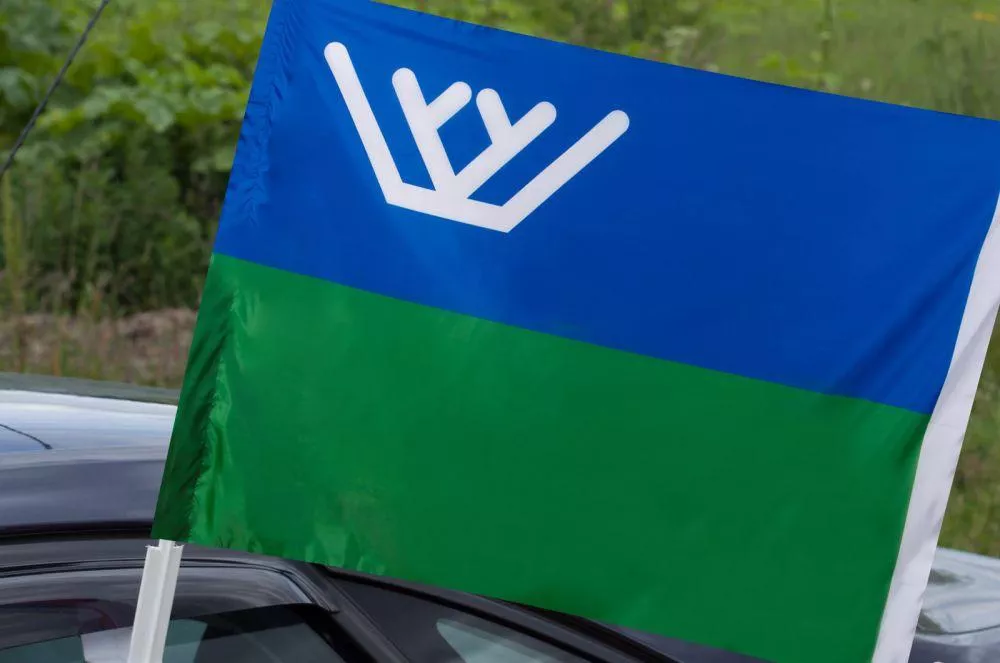
“825 years — the date is certainly not the roundest. But there were no other options. While we wait for the anniversary, the term of office of the government will expire. It has been decided now, from all available platforms, to start forming the opinion that Ugra has its own great history, and the governor defends independence and self-reliance of the region. In the near future, state symbols of the district will also be revised,” comments an interlocutor of “Ura.Ru” from the close circle of the governor.
According to the blogger, representatives of the 31,500-strong Khanty and 12,500-strong Mansi ethnic groups have absolutely nothing to do with it.
“All questions to Nataliya Volodymyrivna Komarova, a native of the Pskov region, or rather to her roof. Let me remind you: she was pushed into the governorship by the Sobyanians (that’s right, Serhiy Semenovich Sobyanin is half Mansi) with the consent of the Medvedevs, from the latter she is sensitively supervised by Arkady Volodymyrovych Dvorkovich , and the real master of Ugra is the president of PJSC “LUKOIL”, Baku native Vagit Yusufovych Alekperov, – notes blogger general-ivanoff. – The direct creators and PR people of the new concept are far from the autochthonous Ugrian ethnic groups. It is enough to name the political scientist, sociologist, poet, musician Ilya Arkadiyovych Verkhovsky, a citizen of Israel, the director of the “Ugra-society” center of the Ugra State University, the moderator of the “Expert Club of Ugra” (under the auspices of the Surkov Foundation for the Development of Civil Society),ex-director of the department of public relations of the KhMAO administration”.
Comment
It should be noted that the Khanty-Mansia Autonomous District is one of the most exclusive regions both from the point of view of analyzing the political process and the development of the socio-economic situation, and from the point of view of researching potential separatist threats on the territory of the Russian Federation.
Summing up the analysis of the phenomena of separatism and radicalism in the Khanty-Mansiysk Autonomous District, it should be noted that the basis for their potential development can be:
1. Inter-ethnic and inter-confessional conflicts as a result of the uncontrolled flow of migrants from the North Caucasian national republics of the Russian Federation and the countries of Central Asia;
2. Activity of cells of Islamist extremist and terrorist organizations (“ISIL”, “Hizbut-Tahrir”);
3. The development of the conflict between the management of the oil companies and the indigenous population, as a result of which representatives of the Khanty and Mansi will live off their own lands;
4. Activities of Russian nationalist organizations, which leads to the growth of inter-ethnic tensions in the region;
5. Latent forms of administrative separatism, expressed in the activities of the team of governor Natalia Komarova.
The main basis for the development of radical extremist and separatist tendencies in the Khanty-Mansiysk Autonomous District is the growing influence of criminalized Caucasian diasporas. Recently, they have been actively displacing the Russian-speaking population, as well as entering into conflicts with Asian migrants. Thus, a characteristic feature of the region is the presence of a high proportion of conflicts between natives of the North Caucasus, who perceive the territory of the district as “traditionally theirs”, and immigrants from Central Asian countries, whose number in KhMAO shows growing trends.
A separate factor of destabilization of the situation in the region can be the process of clashing interests of oil companies and the indigenous population. The root of the problem is the development of new deposits in territories with a traditional way of life. With absolute certainty, the conflict will intensify as the explored natural resources are exhausted.
It is unlikely that the manifestation of inter-ethnic tensions in KhMAO will show downward trends. No decrease in migrant quotas has been recorded in the region, and an effective platform for solving international issues with the participation of diasporas and civil society institutions has not been created. The existing structures, which are pocket organizations of regional authorities and the FSB, are designed to demonstrate facade stability in front of the federal center.
Despite the wealth of the region, the multinational composition of KhMAO, the situation can really look threatening in the perspective of 3-5 years. Falling oil prices and the general socio-economic crisis in Russia do not allow the regional authorities and the Russian special services, as it was before, to level social risks with the resource potential of the region.
As a result of the ineffective national policy of the federal center, the number of regular mass violent acts is likely to increase in the near future in the Khanty-Mansiysk Autonomous District; murders on national soil; interethnic conflicts; political activity with the exploitation of ethnic themes.
The Russian authorities, using the potential of the 2nd Service of the FSB of the Russian Federation, actually minimize the activity of the nationalist organizations “Conscience” and “Opir” and redirect their activities to support Russian fascism and illegal armed formations of Donbas separatists on the territory of Ukraine. In their place, conspiratorial sects and groups from the category of “local madmen” such as the “KOB” and “NSD” movements are actively moving forward, which do not oppose the growth of ethnic gangs in KhMAO, but only worsen the already difficult situation. Nevertheless, the potential of nationalist groups not connected to the Russian authorities and those that have not tarnished themselves by participating in hostilities on the side of the DPR and LPR militants is still great. In the event of an aggravation of the situation in the region and the Russian Federation as a whole, part of the asset from this environment is potentially ready to come out of the underground and intensify its activities. At the moment, this is opposed by representatives of the 2nd Service of the FSB for the protection of the constitutional order and the fight against terrorism. However, the incident with a nationalist attack on the FSB Office in the Khabarovsk Territory demonstrated the insecurity of this structure and the presence of growing cracks in Russia’s national security system itself. This incident once again emphasized that in the coming years, the process of destruction of the very structure, it would seem, is still one of the most influential and closed special services of the aggressor country, which actually rests on the foundation of Putin’s regime in Russia, may begin. At the moment, this is opposed by representatives of the 2nd Service of the FSB for the protection of the constitutional order and the fight against terrorism. However, the incident with a nationalist attack on the FSB Office in the Khabarovsk Territory demonstrated the insecurity of this structure and the presence of growing cracks in Russia’s national security system itself. This incident once again emphasized that in the coming years, the process of destruction of the very structure, it would seem, is still one of the most influential and closed special services of the aggressor country, which actually rests on the foundation of Putin’s regime in Russia, may begin. At the moment, this is opposed by representatives of the 2nd Service of the FSB for the protection of the constitutional order and the fight against terrorism. However, the incident with a nationalist attack on the FSB Office in the Khabarovsk Territory demonstrated the insecurity of this structure and the presence of growing cracks in Russia’s national security system itself. This incident once again emphasized that in the coming years, the process of destruction of the very structure, it would seem, is still one of the most influential and closed special services of the aggressor country, which actually rests on the foundation of Putin’s regime in Russia, may begin.
It is noteworthy that in KhMAO, unlike other regions of the Urals, the separatism of the Khanty and Mansi ethnic groups is not the main factor for the development of the secession process. At the moment, the activities of the nationalist groups of the indigenous peoples of the region are as limited as possible. On the contrary, the administrative type of separatism in the region has greater potential for development. Despite the fact that Natalia Komarova’s team implements a “cautious policy” in matters of regionalism and the development of international relations, the manifestation of separatist tendencies appears even against the background of preparations for the celebration of the 825th anniversary of the founding of the first Ugrian principalities. Such a policy of the regional authorities causes growing criticism from radical groups of Russian nationalists. Nevertheless, the administrative type of separatism is an ideal environment for the potential development of secession in the future. The advantage of the administrative separatists of KhMAO is the presence of an economic base, and not purely ideological doctrines of the development of the region or an international factor. If the Khanty-Mansiysk Autonomous District leaves the Russian Federation, the region has significant economic potential for further development in Russia. We are talking about the presence of oil companies, large deposits of oil and other minerals in the region, which in the future can ensure the economic independence of this territory.
More news about events in Ukraine and the world at Depo.ua
Olexandr Nykonorov