

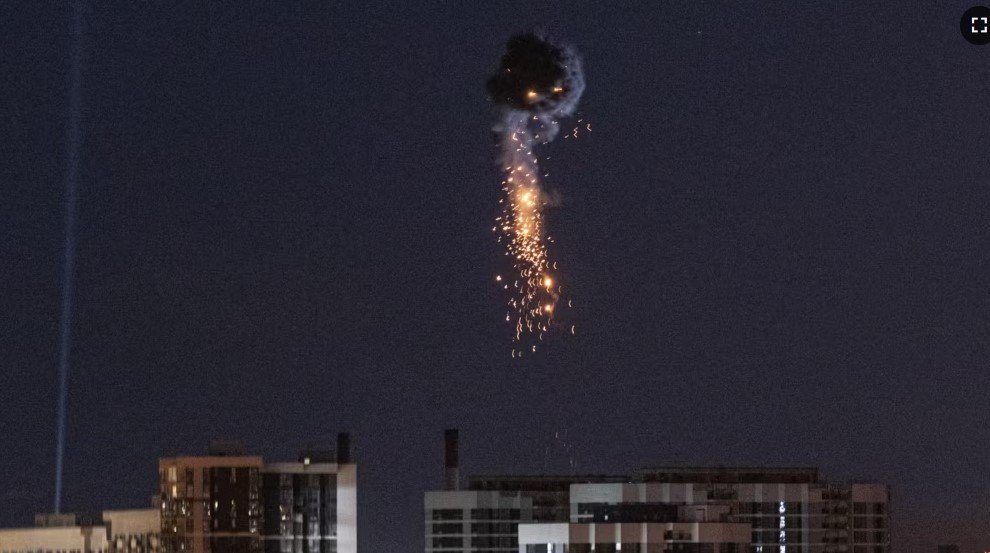
Assumptions have been confirmed that Iranian drones are planned to be assembled in the Tatarstan city of Yelabuga, which Moscow uses to attack Ukraine.
Information leaked to the media earlier that in the special economic zone “Alabuga”, it is near the second most important city of Tatarstan, Naberezhnye Chelny, where KAMAZ trucks are assembled, but with Chinese components, they are setting up the production of Iranian-made UAVs Shahed-131 and Shahed- 136 . Russia labels them as Geranium-1 and Geranium-2.
It immediately became known that Putin ordered the creation in a number of subjects of the Russian Federation, including Tatarstan, Bashkortostan and other regions of the Volga region, a network of centers to support the design, testing, production and preparation for certification of drones.
And the coordinator of strategic communications at the US National Security Council, John Kirby , provided new information about the intensification of cooperation between Russia and Iran in the military sphere.
He noted that as of May this year, Russia has received hundreds of unmanned aerial vehicles and the necessary equipment for their production from Iran. A representative of the US National Security Council described the scheme of how Iranian drones are delivered to the country.
Kirby expressed particular concern about Moscow’s intention to begin production of Iranian drones. According to him, the project is planned to be implemented in the Alabuga special economic zone in Tatarstan.
“We have information that Russia itself will receive the necessary materials for the construction of an Iranian drone production plant. This facility can be fully commissioned early next year,” he said and presented satellite photographs of the Alabuga special economic zone, where produced Iranian drones.
A quite reasonable question arises: why was Tatarstan chosen for these purposes? I think there are several reasons for this.
First. Ideological. Invariably bind Tatarstan with blood. For the same purposes, Moscow actively contributed to the creation of the so-called national volunteer battalions from the inhabitants of the republic of the Russian Federation in order to give the war an international face and character. That not only the “Russian world” is fighting against Ukraine, but also representatives of other nations. This was given special emphasis. At the very beginning of the war, Putin literally stated the following: “I am a Lak, I am a Dagestan, I am a Chechen, Ingush, Russian, Tatar, Jew, Mordvin, Ossetian.” That is, he is such an integrator of all in his own person, in his person everything is melted into one mass, which Putin decided to throw into the furnace of war.
Tatarstan, like the Caucasus, has always been viewed by Moscow as a zone of increased danger, potential separatism, where ideas of national sovereignty and political identity have always been alive and strong. The vertical of power now and then fluctuated in the republics. Therefore, Putinism defiantly and systematically destroyed their subjectivity through the displacement of the language, the elimination of national education, the defeat of the intelligentsia, the falsification of history, pursued an intensified policy of Russification and clericalization, created pressure on society by intimidating all dissidents with the help of law enforcement agencies, introduced the actual regime of state terror, in particular in the North Caucasus.
“An act of humiliating surrender.” American experts reacted to the amendments to the Constitution of Tatarstan
But all these draconian methods still failed to “finally solve the national question.” Putin acted under Eichmann’s regime in the Third Reich, who was in charge of the “Jewish question.” Eichmann was then caught and tried.
As long as the historical memory of the people is alive, then it is possible to collect its political subjectivity anew, to rebuild it. Sovereignty is a phenomenon too profound, I would say, metaphysical, to be banned with a single stroke of the pen.
Sovereignty is the will to freedom and it cannot be silenced, either legally or administratively.
The second reason is geographical. Tatarstan is located in the depths of the territory of the Russian Federation. And, perhaps, according to the planners, Ukrainian drones will not reach these lands. Too far. Naberezhnye Chelny will be transferred to a paramilitary position, surrounded by missile defense and air defense systems, stuffed with agents and spies. Rather, this process has already started.
However, there is no guarantee of security. We remember how half a year ago the Engels strategic aviation airfield in the Saratov region was attacked twice in one month using a drone. Long-range strategic bombers Tu-160 and Tu-95 MS were damaged. They participated in launching missile strikes on the territory of Ukraine. The Saratov region is the south of the Volga region, by the way.
Now the Ukrainian armed forces are even better equipped than at the end of last year. Western partners are helping Kyiv with modern means of defense, including equipment for delivering damaging elements.
The third reason is infrastructure. Tatarstan is known for its powerful industrial potential. In “Alabuga” before the war, the production branches of many leading automotive and technological giants were located. The same Ford, for example. A proper base has been created there, that is, there is no need to build a lot from scratch.
There is an engineering school. Plus, specialists working in the Tatarstan design bureaus and employees of the Kazan aviation and helicopter plants, if necessary, can be attracted or seconded to work. That is, it is easy to add up the production and engineering chain. Moreover, all of them are under the hood of counterintelligence officers from the FSB and there is no need to once again rebuild this control activity.
And finally, the fourth reason. Co-optation. It has been operating in Kazan for more than fifteen yearsIranian Consulate General. During this time, Tehran was able to establish close cooperation with Tatarstan in many areas: humanitarian, economic, technical, business. Including in the oil industry. Tatneft has been working in Iran for a long time, implementing a number of joint projects. There are a considerable number of specialists in Iranian studies and connoisseurs of the Persian language on the basis of universities and research centers.
All this together creates a projection of painless integration of the two systems through cooperation in the military-industrial sphere.
Naturally, the republic and its people do not benefit from this, but only lose. Their rulers draw them against their will into a criminal war on the side of the aggressor. In relation to Tatarstan, Moscow is the same aggressor. She seized the lands of the peoples of the Volga region and planted their own rules, pursuing a targeted policy of ethnocide. And here he wants to use them as an instrument of his imperial expansion.






