The crisis created by Russia, has an artificial and contrived origin, and the reasons for invading are frankly invented. Therefore, most countries understand full well, that Russia’s prime goal of this war – is the annihilation of the Ukrainian state and nation as such.
The countries that share a common border with Russia especially felt the tension from Russia’s behaviour. Almost every country that has a common border with Russia has its own history of wars, conflict, territorial pretensions and occupation of territories. At one time or another Russia stole territory from Finland, Estonia, Germany, Moldova, Georgia, Ukraine and Japan. The case of country mentioned last is the focus of the article.
In fact, Russia occupied Belarus, whose regime rests on its ‘bayonets’ and support. The only friendly relations it has is with China, which Moscow frankly fears. Even more so, according to a bilateral agreement, Russia transfers border areas to China, due to the peculiarities of the current border, the river Amur, the course of which changes not Russia’s favour. Russia also has disputes over the shelf of the Arctic Ocean with Norway, Canada and the USA.
Let us return to Japan.
Japan – is the third largest economy of the world, according to its GDP level and volume of export. It is a world leader in car exports, the development of robotics and the number of nuclear power station it has. Japan is also an influential member of key international organisations, especially the G7 countries, IMF, OECD (Organisation for economic co-operation and development). Also, Japan remains an important participant in world trade and is a major international investor.
Despite Japan’s influence in the international arena, Russia stubbornly ignores the problem of its occupation of Japan’s Northern Territories.
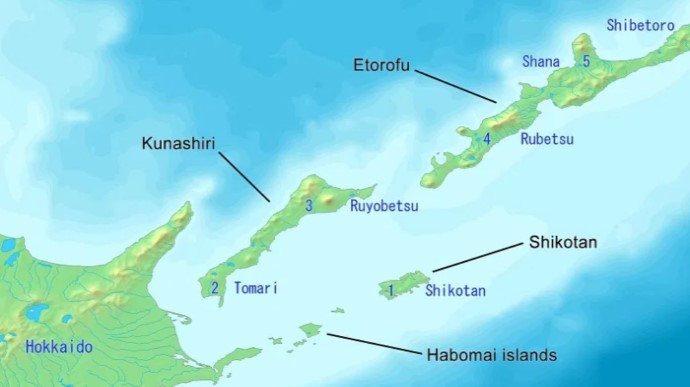
The origin of the struggle for Japanese Northern territories goes back to the 19th century, when the countries signed the Shimoda Treaty, according to which the islands Kunashir, Iturup, Shikotan, the Habomai group of islands and South Sakhalin were recognised as Japanese, and the Kuril Islands and Northern Sakhalin as Russian. The border between the two states ran between the islands of Arup and Iturup.
Then the situation changed with kaleidoscopic speed.
– 1875 – signing of the St. Petersburg exchange agreement. Japan received all the Kuril Islands for the transfer of South Sakhalin to Russia.
– 1905 – signing of the Portsmouth Treaty following the results of the Russo-Japanese wars. Japan received the South Sakhalin territory.
– 1945 – the USSR occupied South Sakhalin and all the Kuril Islands.
– 1946 – the unilateral inclusion of Kunashir, Iturup, Shikotan, the Habomai group of islands and South Sakhalin to the USSR, the deportation of the Japanese population to Hokkaido.
– 1956 – signing of the Soviet-Japanese declaration. The USSR promised to return the islands of Shikotan and Habomai from the South Kurils to Japan after signing the peace treaty, but the treaty was not signed.
To legitimize the occupation, the Russians even resorted to replacing scientific concepts and geographical names, declaring the Japanese Northern Territories as islands of the Kuril ridge or the Southern Kurils. Although in fact, the occupied territories are the geological continuation of the northern Japanese islands of Hokkaido.
Why is Japan important to Ukraine? In my opinion it is obvious that Ukraine should become a promoter in the group of countries, whose territories are occupied by the Russian Federation. Moreover, perhaps even the initiator of creating an international organisation out of these countries. The main goal of uniting these countries is to return these territories, to pay compensation and restore the sovereignty and territorial integrity of the countries, that were subjected to Moscow’s aggression. This would add strength and international weight in the matter of returning the occupied territories. With a country like Japan, such a community would have more powerful standing.
It is also worth considering the historical aspect of Ukrainian-Japanese contacts. At this point I will quote a well-known Ukrainian researcher of the Ukrainian Liberation Movement Mykola Posivnych: “At the beginning of the 1930s, the leader of the OUN Yevhen Konovalets, in resolving Ukraine’s problems, paid particular attention to events which took place in the Far East. It was there that he saw an opportunity to embody the “legion” concept of creating a regular Ukrainian army. Contacts with the Japanese were established in Warsaw, thanks to the former military minister of the UNR (Ukrainian People’s Republic), Major-General Volodymyr Salskyi and editor of the Parisian magazine “Tryzub” (Trident) Ilarion Kosenko. And in Istanbul – Olexandr Shulgin together with Volodymyr Murskyi through a military attache Lieutenant-Colonel Hara. An appeal about a Ukrainian matter in the Far East and Siberia was prepared by T. Olesnyuk and sent via Colonel Yanagita. Colonel Yevhen Konovalets managed to convince the Japanese General Staff that Ukraine has exceptional political-strategic and economic significance in the context of solving the Far East problem. The Ukrainian Nationalist leaders tried to influence German politics regarding issues in Eastern Europe through Japan and Italy”.
More details about the contacts between the OUN and Japanese government factors can be found in this link:
https://ukranationalism.com/history/3096-formuvania-zovnishnoi-polityky-oun-1929-1939.htm
Japan is one of the first countries in the world to condemn Russian aggression in Ukraine. On 28 February 2022, the Director of the Department of Foreign Affairs of Japan, Hideki Uyama stated: “The Northern Territories are occupied, and we believe this is against international law, just as the attack of the Russian army in Ukraine”.
In turn, the Verkhovna Rada of Ukraine in its Resolution of 7 February 2022 declares its support for Japan’s position regarding its Northern Territories. Ukraine acknowledges that these territories still remain under the occupation of the Russian Federation and calls on the international community to continue to take all possible measures for the contractual and legal registration of the status of the Northern Territories of Japan.
The existence of common interests in the de-occupation of their own territories make Japan and Ukraine natural allies. And that is why the task of Ukrainian diplomats and officials is to give this process an organic characteristic and different degrees of formalization to the level of creating an international organisation. Such a union of states that suffered losses because of Russian imperial activities would become a powerful voice in global, international politics and one more compelling argument for the division of Russia into peace-loving, demilitarized countries, which would not be a threat to any of its neighbours.