

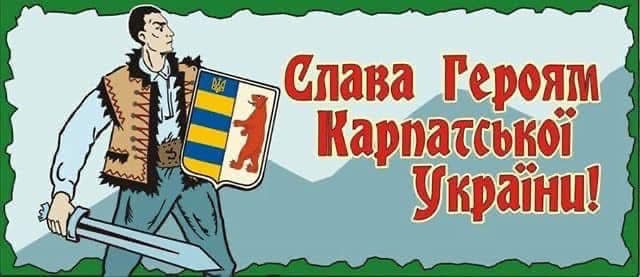
In the 20th century alone, Ukrainians rose up in the liberation struggle five times and proclaimed the creation of a Ukrainian state, until they finally achieved this on 24 August 24 1991.
One of the most striking stages of the struggle for the independence and unity of Ukrainian lands was the proclamation 86 years ago, on 15 March 1939, by the Sejm (the highest legislative body) of Carpathian Ukraine of the independence of the region, the adoption of the Constitution, which introduced the state language – Ukrainian, the blue-yellow flag and the national anthem “Ukraine is not dead yet.” Avgustyn Voloshyn was elected president.
Carpathian Ukraine, separated from the main part of Ukraine by the Carpathians, has been occupied by foreign invaders – the Hungarians since the decline of Kyivan Rus’ in the 13th century. Despite more than seven centuries of harsh colonization and denationalization, the Ukrainians of Transcarpathia have preserved their identity, language, traditions, and unity with other Ukrainian territories.
Already in 1919, during the proclamation of the Act of Union of the Ukrainian People’s Republic and the Western Ukrainian People’s Republic, representatives of the Ukrainian national liberation forces of Transcarpathia declared the unification of Carpathian Ukraine with the Ukrainian People’s Republic and the Western Ukrainian People’s Republic in a single Ukrainian state. They took part in the conclusion of the Act of Union in Kyiv on 22 January 1919.
The unjust Versailles system, introduced by the victorious countries of World War I, did not support the aspirations of Ukrainians to live in a single, independent, united Ukrainian state. Carpathian Ukraine was given to Czechoslovakia as an autonomous region.
Therefore, only during the collapse of Czechoslovakia in March 1939 did the Ukrainians of Transcarpathia proclaim the creation of an independent Carpathian Ukraine.
Authorities and a government were formed. The armed forces of Carpathian Ukraine called the “Carpathian Sich”, were established, as well as the police. Judicial bodies were formed.
Ukrainians from all corners of the ethnic lands had high hopes for this state formation. They hoped that it would become a centre that would allow them to eventually restore the Ukrainian state.
Voloshyn’s government carried out measures aimed at building the state. In particular, the work of industry, transport and trade was being adjusted. The Ukrainisation of the state administration, the education system and publishing was being carried out. Cultural and artistic life was especially activated. Writers such as Oleg Olzhych and Ulas Samchuk came to Khust. The New Stage Theatre began to operate here.
Faced with the threat of aggression from Hitler’s ally, Hungary, thousands of Ukrainians from all corners of the ethnic lands set out to defend Carpathian Ukraine.
Immediately after the declaration of independence of Carpathian Ukraine, Hungary launched military aggression.
The well-prepared Hungarian General Staff military operation to seize the region was carried out with lightning speed. The Hungarians were helped by Polish military groups, carrying out various sabotage operations. The “Carpathian Sich” was unable to effectively resist the well-armed Hungarian army. The Carpathian Expeditionary Corps of Hungary (40 thousand Honveds – Homeland Defence), which was ten times larger than the number of the “Carpathian Sich” troops, during 15-22 March 1939, occupied not only 4 regions of the region with the Hungarian ethnic group but also occupied the territory of all of Transcarpathia. During the fighting, from 5 to 6 thousand Transcarpathian Sich soldiers died.
The Hungarian army’s invasion of Carpathian Ukraine took place with the consent of Adolf Hitler and Poland. The day before the invasion, the Polish Foreign Minister announced that he supported Hungary in its actions aimed at “returning Transcarpathia.”
The Poles encouraged the purge of Ukrainians under the guise of liberation from the communist element, called for lightning de-Ukrainization and the banning of the concept of “Ukrainian.” The Hungarian occupiers, together with the Poles, committed mass crimes against prisoners of war, viewing the defenders of Carpathian Ukraine, the Sichkovs, exclusively as bandits and terrorists.
The prisoners were shot without investigation or trial, the wounded were finished off by throwing them into the Tisza River with their hands tied with barbed wire. Some of the prisoners were handed over to the Polish police at the border with Poland and jointly destroyed.
On 18 March, most of the lands of Carpathian Ukraine were occupied by Hungarian troops. However, in the mountainous areas, units of the “Carpathian Sich” continued to fight against the occupiers until the end of May 1939.
On 7 July 1939, the Hungarians finally annexed Carpathian Ukraine.
This annexation was accompanied by brutal terror against Ukrainians. Thousands of members of the “Carpathian Sich” were either shot or sent to concentration camps and prisons. Ukrainian organizations, including “Prosvita”, were destroyed.
Hungary still has not apologized for its terrible crimes and illegal occupation of Transcarpathia in 1939-1944. Neither has its accomplice in war crimes, Poland.
The occupation of Carpathian Ukraine by the Kingdom of Hungary lasted from March 1939 to October 1944.
The heroic defence of Carpathian Ukraine by Ukrainians from many corners of the ethnic lands grew into a struggle for Independence during World War II under the leadership of the Organization of Ukrainian Nationalists (many of whose members died fighting for Transcarpathia) and the Ukrainian Insurgent Army.
Here, the nationalists tried to put their Military Doctrine into practice, focusing primarily on their own forces.
The author of the “Military Doctrine of Ukrainian Nationalists” and the chief of staff of the “Carpathian Sich”, Colonel Mykhailo Kolodzinsky “Kum”, died here.
The future commander of the Ukrainian Insurgent Army, General Roman Shukhevych, gained military experience here.
With the beginning of the Russian-Ukrainian war, the volunteer unit “Carpathian Sich” was revived, which continues to fight for an independent and united Ukraine in the Ukrainian Donbas as the 49th separate rifle battalion “Carpathian Sich” named after Oleg Kutsyn within the Armed Forces of Ukraine.







