

On 31 October 1943 two detachments of Azerbaijanis together with a detachment of Ukrainian insurgents attacked a hundred German aviators who had come to rob villagers. In the battle, the Nazis were defeated, about 50 German Luftwaffe soldiers died.
Four Azerbaijanis and one Ukrainian died from the UPA . Another Caucasian was injured. The dead were buried in Tochevyky, the Caucasians were buried according to the Muslim rite, without coffins.
The circumstances of the battle are described in detail in the underground newspaper “News of the Ukrainian Information Service” (1 April, 1944):
“…In the morning, a hundred Germans came to the nearby village of Tochivk(a), Ostryzka district, to go for a walk as was their wild custom. After our departments were informed, the Germans had time to go for a walk, and after robbing the population, left. However, soon they wanted to go for a walk in the same village again. At this time, Landwirt himself arrived with a hundred well-dressed and armed young pilots. But here they were not so lucky. They had not yet matured to properly “mismanage” near the peasant property when our company and two Azerbaijanis attacked them and forced them to flee. Brave Azerbaijanis, seeing a hated enemy in front of them, went to battle with great zeal and with their heroism added courage to some of our young fighters who were in battle for the first time.
That walk was costly: 50 lay dead, several were wounded, and twenty German “heroes” escaped. Landwirt also got here. The population joyfully cheered the insurgent units, rejoicing in friendly relations and the joint struggle of the Azerbaijani and Ukrainian units against the German invader.”
Read also: The monastery became a shelter for the UPA troop: the 80th anniversary of the battle in Novy Zagorov

On the eve of the battle, the night of 29-30 October 29-30, this detachment of Azerbaijanis, stationed in Zdolbunov , transferred to the UPA as part of 160 people with full uniforms and weapons. They were fighters of the 805th Battalion of the Azerbaijan Legion.
Before that, Azerbaijanis fought as part of the German army in the North Caucasus, in particular near Malgobek (Ingushetia). There, their battalion suffered heavy losses and was redeployed first to Poland.
There it was replenished with new volunteers from among the captured Red Army soldiers, and then – in Western Ukraine – in the Zdolbunov district.
From the UPA leaflet:
AZERBAIJANS !
Only with the joint efforts of all enslaved nations can we defeat the imperialist predators of Moscow and Berlin and build independent states in the Caucasus and Asia.
We urge you to increase the ranks of your national divisions under the Ukrainian Insurgent Army!”
Read also: Date of creation of UPA – 14 October : how the holiday tradition was formed

In Volyn, insurgents from the UPA militia of the Zdolbuniv region under the command of Boyko -Chornota held talks with the Azerbaijani legionnaires. The Bandera followers persuaded them to join and fight against the Nazis.
The first initiator of the legionnaires’ escape from the Germans was an officer of the 805th battalion, nicknamed Chavli . Azerbaijanis joining the UPA was organized by legionnaires I. Nasrullayev , A. Kuliyev , T. Kambarov , G. Adygezalov , A. Makhmudov and A. Aslanov .
As noted by historian Oleg Stetsyshyn in the book “Banderivsky International”, even American intelligence reported on the Azerbaijani legionnaires joining the UPA.
Documentary evidence of this was discovered by the Georgian historian Giorgii Mamulia . This is a report on Azerbaijani military formations of the US Department of Military Intelligence, compiled after the war.
It stated that in 1943, one company commander with four officers and 70 volunteers and one company commander with two propagandists and 95 volunteers defected to the Ukrainian national partisans from the Azerbaijan Legion.
Read also: Organizer of the UPA departments in Volyn: what is known about Yuri Stelmashchuk

In general, Azerbaijanis were the largest ethnic group in the Ukrainian Insurgent Army. Lithuanians, Georgians, Armenians, Jews, Tatars, Uzbeks, Italians and representatives of other nationalities also fought in it.
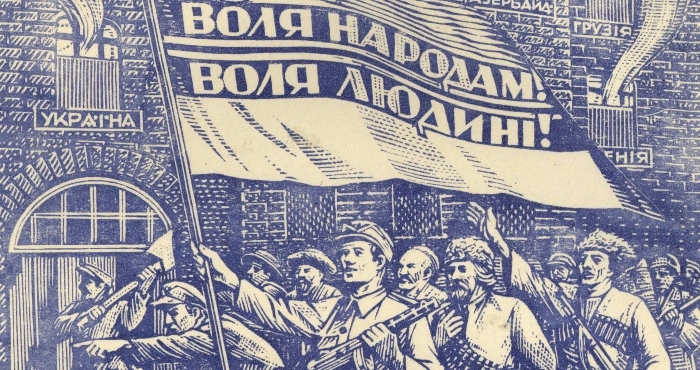
In November 1943, the leadership of the OUN convened the first Conference of Enslaved Peoples of Eastern Europe and Asia in the village of Buderazhi in Volyn. It was attended by 39 delegates representing 13 nationalities. The largest were the Azerbaijani and Georgian delegations – six people each.
Read also: The State Archive of the SBU stores the files of Lithuanians who were loyal to Volyn

The conference developed a number of political and practical organizational resolutions aimed at spreading the joint struggle of the enslaved nations of the USSR and also adopted an appeal to all the nations of Eastern Europe and Asia, in which the political situation of the enslaved nations, the tasks facing them, and prospects were comprehensively clarified as a joint struggle.
LESYA BONDARUK
Note: for a quick information search please subscribe to our Telegram channel “Freedom for Nations!” https://t.me/ABN_Freedom_for_Nations
Also, read the Facebook materials of the ABN page and the group
Our site: https://abn.org.uaen/
Район. Історія





