

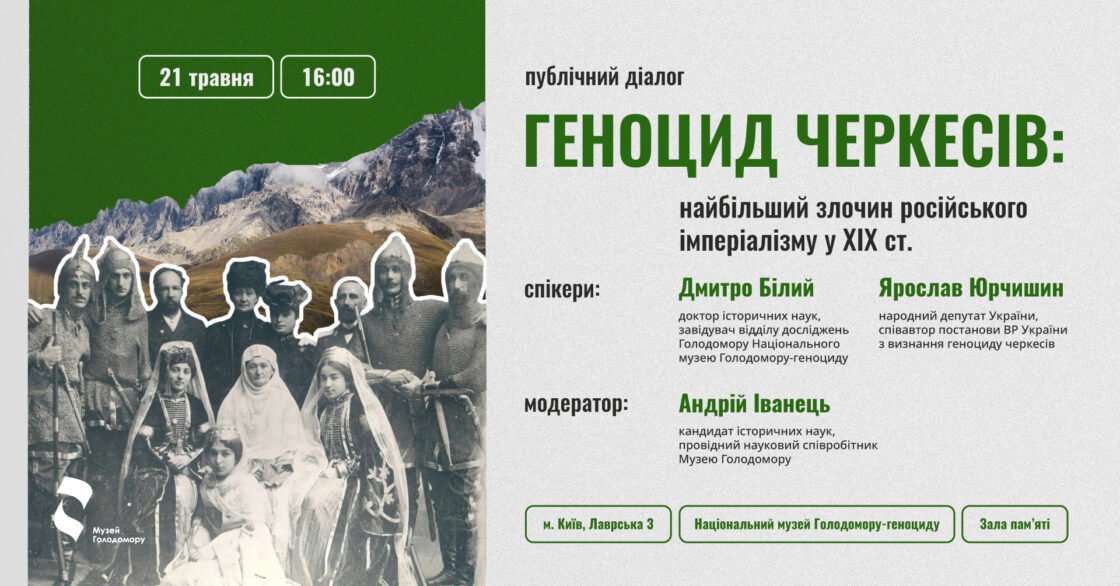
On 21 May, the Holodomor Museum will host a public dialogue “Circassian Genocide: The Greatest Crime of Russian Imperialism in the 19th Century.”
By colonizing and seizing new territories, the Russian Empire purposefully exterminated people in these territories and even entire nations. Thus, in the 19th century, the desire to seize the lands of the North Caucasus led to a long Russian-Caucasian war. When the resistance of the Caucasian highlanders could not be overcome in an open military confrontation, Russia began to “cleanse the Caucasus of enemy nations.” 21 May became the date of the genocide of the Circassian people when in 1865, Circassian soldiers who entered the last doomed battle with Russian troops and died in Krasnaya Polyana near Sochi were killed.
To date, only one state – Georgia – has recognized the extermination of the Circassians as genocide. Ukraine is also considering this possibility: the Verkhovna Rada has registered a draft “Resolution on recognition of the genocide of the Circassian people committed by the Russian Empire.”
Our speakers will talk more about the crime and its recognition:
Dmytro Bily, Doctor of Historical Sciences, Head of the Holodomor research department of the National Museum of the Holodomor-Genocide;
Yaroslav Yurchyshyn, National Deputy of Ukraine, co-author of the resolution of the Verkhovna Rada of Ukraine on the recognition of the genocide of the Circassian people.
Moderator:
Andrii Ivanets, Candidate of Historical Sciences, leading researcher of the National Museum of the Holodomor-Genocide.
Andrii Ivanets, Candidate of Historical Sciences, leading researcher of the National Museum of the Holodomor-Genocide.
“Now, when Ukraine is waging a war with the Russian invaders, we should know that the Russian genocidal policy has not changed and will not change until the people adequately fight back,” says Dmytro Bely. Ukrainians have their own experience of the Holodomor – the genocide of 1932-1933. But we understand that all the nations that the Muscovite Empire, the Russian Empire, the USSR, and the modern Russian Federation tried to subjugate have this experience. The names of Russian state entities change, but their main weapon against other nations remains unchanged, and this weapon is genocide. Our response to this is to support the people who have suffered genocide and fight with them to stop this terrible empire of evil.”
When: Tuesday, 21 May, at 4:00 p.m.
Where: Memorial Hall of the Holodomor Museum (Kyiv, 3 Lavrska St.)
Where: Memorial Hall of the Holodomor Museum (Kyiv, 3 Lavrska St.)
Entry is free with prior registration: http://surl.li/tnggs
Facebook 





