

On 20 January 2024, Russian dictator Vladimir Putin congratulated the residents of Novgorod on the 80th anniversary of the liberation of Novgorod from the German-fascist occupiers (although there were no Italian military units in Novgorod during World War II, only the Spanish “Blue Division”).
Then the dictator simply said that “the liberation of our ancient capital from the Nazis became an event of great symbolic and ethical significance because there (they say) a thousand-year-old Russian statehood was born.”
A lover of parallel history spoke about the thousand-year-old Moscow statehood in a staged over two-hour interview with Tucker Carlson. The number of historical blunders, outright lies and distortions in this interview, in which the pseudo-historical evidence that there was no Ukraine, that it does not exist, and cannot exist, is staggering and should become the subject of analysis by psychologists and psychiatrists.
So, is it possible to talk about the liberation of Novgorod by those who destroyed this component of the ancient Ukrainian statehood of Rus with its centre in Kyiv?
The Moscow principality never had any relation to either the Novgorod land or the Novgorod Republic (since 1136). On the contrary, Moscow occupied Novgorod as a result of two bloody wars of conquest as part of the allied army of the Golden Horde, destroyed the unique age-old form of democracy, and later, during the time of Ivan the Terrible carried out a bloody massacre of Novgorodians in 1570.
The conquest and occupation of Novgorod by Moscow had a much bloodier and more tragic character than the almost three-year occupation and stay on the front line during World War II.
Therefore, before the conquest in 1478, Novgorod had no relation, neither to the Moscow ulus of the Golden Horde nor to any other form of Moscow statehood.
The mention of the founding of Novgorod in the first Sophia Chronicle in 859 is considered by scholars to be a later compilation. This date is not confirmed either by the results of archaeological research or by data from Scandinavian sources or other annals of ancient Ukrainian statehood.
According to the same Novgorod chronicle, the “town” was founded by Volodymyr Yaroslavovich in 1044, that is, two centuries later.
During the civil war between the descendants of Dmitry Donsky, who were arguing for the Moscow throne, one of the contenders for the throne, Dmitry Shemyaka, moved his family after his defeat and found refuge in Novgorod.
The heir to the throne (his cousin) Vasily II the Dark, an ally and vassal of the Kazan Khanate, used this situation as a reason for aggression in Novgorod.
In January 1456, the Muscovite army together with the Tatars began a campaign on Novgorod.
Having besieged Novgorod and threatened the city with a brutal ultimatum: “There should be no bell for the watchman, no leading official, but we will hold the whole state”, the joint Tatar-Moscow army defeated the Novgorodians. This was the first serious defeat of the Novgorod Republic in the entire history of its existence.
The imperial historian Karamzin describes those events as follows: “A terrible devastation began… they destroyed everything with fire and sword. Muscovites showed indescribable indignation. With hard-heartedness, the Kholmsky governor, having captured the prisoners from Novgorod, ordered them to cut off their noses and lips and send them, crippled, to Novgorod.
The Novgorod gathering decided to ask for a humiliating peace. The Yazhelbytsk peace agreement was signed between Novgorod and Moscow.
According to the treaty, the Republic of Novgorod significantly reduced its rights. Novgorod was deprived of the right of external communication and legislative rights, the Grand Duke of Moscow became the highest judicial authority, and the Novgorod ancient seal and the seal of officials were replaced by the seal of the Grand Duke of Moscow. In addition, the republic undertook to pay Moscow a huge contribution of 10 thousand rubles.
However, Moscow did not stop there, constantly increasing the pressure on the Novgorod Republic. Trying to resist the Moscow expansion, the Novgorod boyars led by Marta Boretskaya advocated an alliance with the Grand Duchy of Lithuania in the fight against the Moscow prince Ivan III.
The envoy of the Polish king and Grand Duke of Lithuania Casimir IV, Ukrainian prince Mykhailo Olelkovich arrived in Novgorod. Also, Novgorod decided to establish church ties not with Moscow-dependent Metropolitan Philip I, but with Metropolitan of Kyiv and All Russia Grigory II Bolgarinovych.
The set of actions caused a disturbance in the Moscow Grand Duke’s court and dissension among pro-Moscow Novgorod boyars.
Initially, Prince Ivan III of Moscow tried to influence the Novgorod region through the metropolitan under his control, who accused the Novgorodians of “treason” and demanded that the “Latin state” be renounced. The actions of the Novgorodians were declared “treason to Orthodoxy” by Moscow.
In March 1471, the Novgorod governor Mykhailo Olelkovich left Novgorod for his reign in Kyiv. At this time, the Grand Duke of Moscow decided to organize an attack on Novgorod under the guise of a religious crusade.
For Moscow, the most secular form of government, “devilish”, “a bottomless bucket of evil stinkers and nameless peasants” was unacceptable.
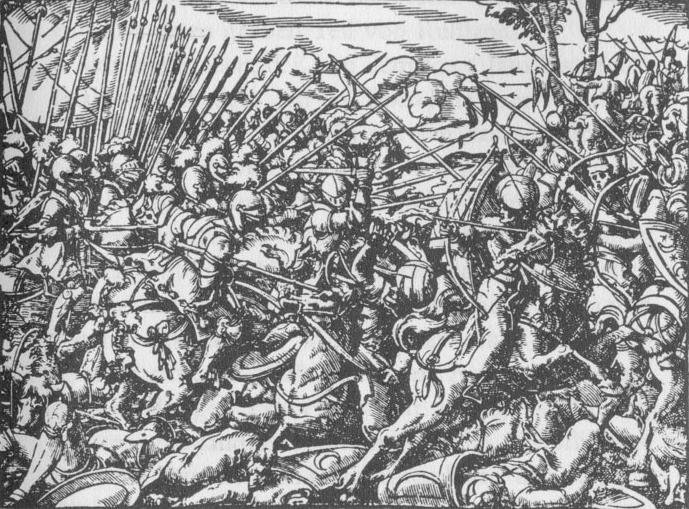
The combined Muscovite-Tatar army defeated the Novgorodians on the banks of the Sheloni River on July 14, 1471. Muscovites captured many noble citizens of Novgorod, including officials Dmytro Boretskyi and Kozma Grigoryovych, boyars Vasyl Seleznyov, Kyprian Arzubov and others.
Grand Duke Ivan III of Moscow executed 6 leaders of the struggle of the Novgorod Republic against the Grand Duchy of Moscow. After a series of defeats, on 11 August 1471, the capitulation was signed in the village of Korostyhn between the Grand Prince of Moscow Ivan III and the Novgorod Republic, after which the Novgorod region lost its independence. According to the Peace of Korostyna, the Novgorod Republic admitted its defeat and undertook to break off relations with the Grand Duchy of Lithuania and to pay a huge tribute of 15,500 rubles to Grand Duke Ivan III of Moscow. By order of the Moscow tsar, defensive structures in the Novgorod fortresses of Demyan and Rusa were demolished.
One hundred years later, Ivan the Terrible committed one of the most terrible massacres.
In December 1569, Ivan the Terrible, suspecting the citizens of Novgorod of complicity in the “conspiracy” of Prince Volodymyr Andreyovich Starytsky, who had recently been killed by his order, and at the same time intending to surrender to the Polish king Sigismund II Augustus, marched with a large army of oprichniks (opponents) against Novgorod.
The reason for this was a denunciation filed by some vagabond.
Having set out for Novgorod in the fall of 1569, the oprichniks staged mass murders and robberies in Tver, Klin, Torzhek and other cities: 1,505 people were killed, mainly imprisoned Lithuanian and Tatar prisoners, as well as residents of Pskov and Novgorod who had been evicted from their homes, ambushed by the oprichniks on the way from Moscow. In December 1569, Malyuta Skuratov personally strangled Metropolitan Philip, who refused to bless the Muscovites’ march to Novgorod, in the Tver Otroch Monastery.
On 2 January 1570, advanced units led by V.G. Zyuzin approached Novgorod and surrounded the city with outposts, sealed the treasury in monasteries, churches and private houses, arrested and put monks, priests and prominent Novgorodians “on the right side”. On 6 January Ivan the Terrible himself appeared near the city.
On 8 January during a meeting of the opponent army with the Novgorod clergy on the Great Bridge over Volkhov, the tsar accused Archbishop Pimen of treason. The latter was arrested and put in prison.
In Novgorod, thousands of townspeople, including women and children, were executed with the use of various tortures. An accurate count of the victims was carried out only in the early days, when Ivan the Terrible deliberately destroyed the local nobility and nobles, holding a trial in the “Rurik settlement” (211 landowners and 137 members of their families, 45 cantors and nobles, and as many members of their families were killed). Among the killed were: the main nobles of Novgorod K. Rumyantsev and A. Bessonov, the boyar V. D. Danilov, who was in charge of cannon affairs, as well as the most prominent boyar F. Syrkiv, who previously participated in the compilation of the “Great Chetyi-Minay” and built his at the expense of several churches (he was first immersed in the icy water of Volkhov, and then boiled alive in a cauldron). After that, the tsar began to visit Novgorod monasteries, taking away all their property, and oprichniks attacked the Novgorod post (which had remained untouched until then), killing many Novgorodians. From the church of St. Sofia Vasilovsky, the gate was removed and transported to the then “capital of oprichnina (the opponents)” Oleksandrov sloboda (village).
The executions continued until February 15. Numerous townspeople, including women and children, were executed with various tortures. According to the Russian story about the defeat of Novgorod, Ivan ordered to douse the Novgorodians with an incendiary mixture and then throw them, burnt and still alive, into Volkhov; others were dragged behind a sledge before drowning. After various abuses, priests and monks were beaten to death with sticks and thrown into the river. Babies tied to their mothers were thrown into the water from a great height. Contemporaries report that Volkhov was surrounded by corpses; living traditions about it were preserved even in the 19th century. The Novgorod chronicler says that there were days when the number of those killed reached fifteen thousand; and days when Muscovites killed 500-600 people each were considered lucky.
Any mention of a self-governing people’s republic was erased and covered in blood.
But several centuries passed and the story of the massacre and occupation was brutally rewritten in the Kremlin and turned into lies about a thousand-year statehood.







