

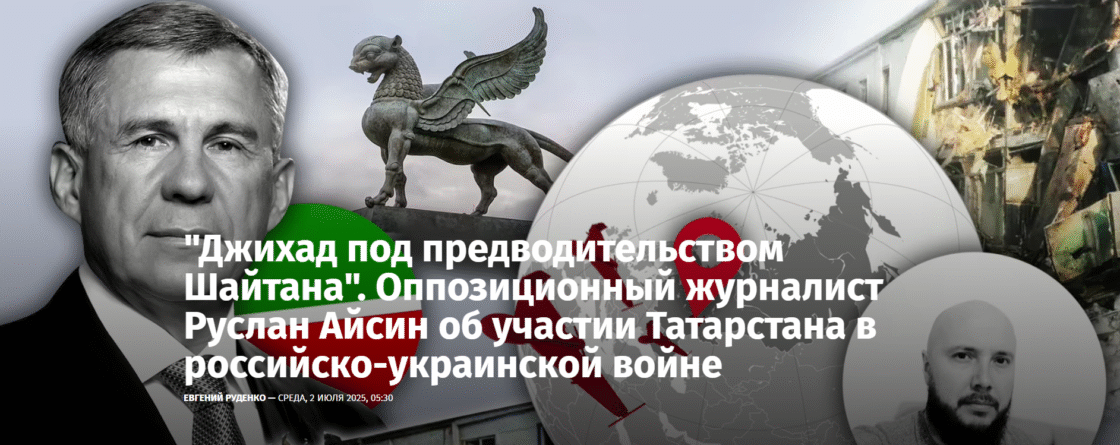
The media started talking about Tatarstan’s active involvement in the attack on Ukraine in February 2023. A few months before the first “Shahedi” began to be gathered in Yelabuz, the Armed Forces of Ukraine defeated the volunteer battalion “Alga” near Uhledar, which was created in Kazan.
After the critical losses in Vugledar, the commander of the Alga unit, Timur Abdurakhmanov, a resident of Moscow and a native of Dagestan, was lucky enough to be on vacation. In an interview with Russian media in July 2023, Abdurakhmanov, with the call sign “Shaitan”, promised to “finish off the evil” that “his grandfathers did not finish off.”
A few months later, during the liberation of Andriyivka by the Third Assault Brigade, Shaitan was lucky for the second time – he was captured by the Ukrainians, who did not “finish him off.” The seriously wounded battalion commander was taken out from under “friendly fire,” and his life was saved.
In an interview with Yuri Butusov, the prisoner recalled how a Ukrainian soldier shared his last bottle of water with him. “Now he is my blood brother,” Abdurakhmanov barely held back tears. “I swear by Allah Almighty, I am telling you the truth. Whether Russia will accept it or not is their business.”
According to the calculations of the media project Idel.Realii, Tatarstan is among the leaders in terms of losses in the Russian occupation war in Ukraine. Researchers were able to verify 5,351 Tatarstanians who were killed by the fighters of the Armed Forces of Ukraine. This is the second position after Bashkortostan (6,016 liquidated people) among the peoples of the Volga region.
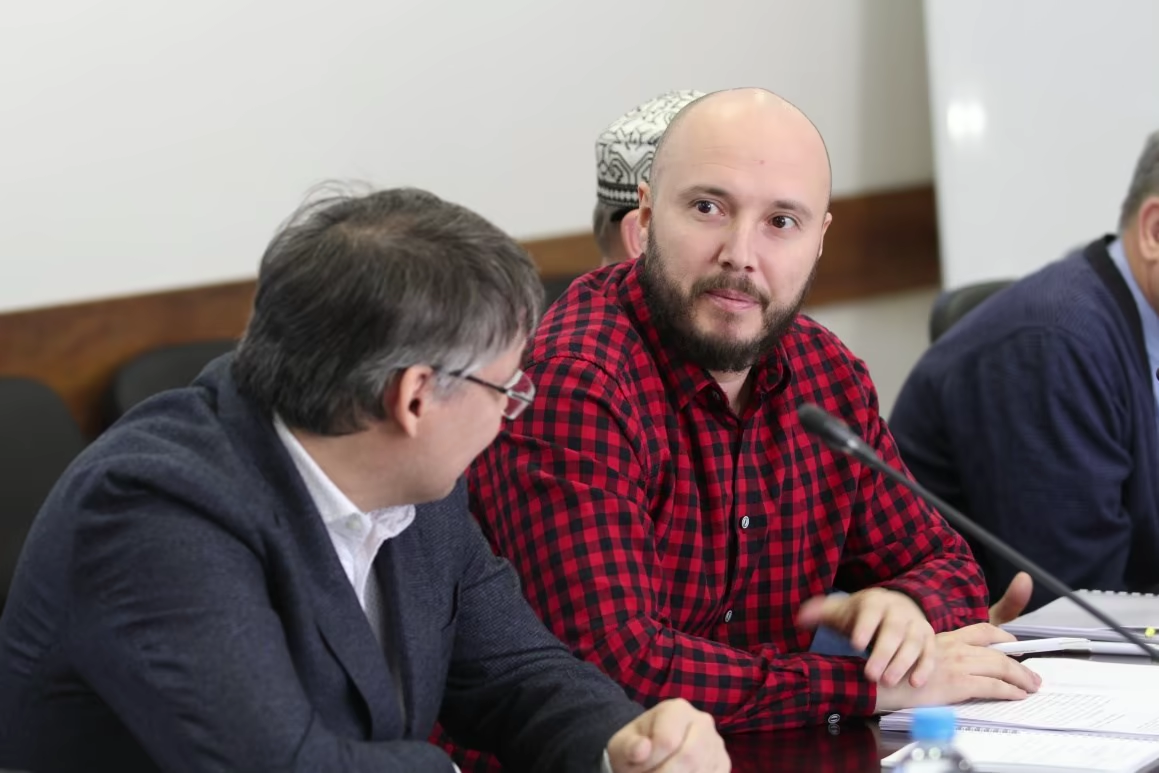
“I think this number should be multiplied by three, four,” says Ruslan Aisin, 45, a publicist and political scientist who was arrested in absentia in Kazan for “rehabilitating Nazism” and “evading the duties of a foreign agent.”
In an interview with UP, Ruslan talks about the Tatarstan factor in this war and the place of the “Tatar clan” in Russian politics. About Yelabuga, the Russian Orthodox Church in Kazan, and hopes for a confederation of Turkic peoples.
Next is direct speech.
Sophisticated clan
Tatarstan is among the leaders in terms of losses. There is a nuance here: the republic is one of the richest among Russian regions, so there is not a huge number of people willing to fight there.
Officials are luring people from depressed regions with some of the largest incentives in the Russian Federation – over three million rubles, which is about $35,000. To provide the Kremlin with a report, “volunteers” are enrolled in battalions such as “Alga”, given temporary registration, and are recorded in statistics as Tatarstan residents.
For the Kremlin, the main thing is the report. We called a thousand poor people a month – good. Now this is the main KPI by which the Kremlin evaluates the efficiency and loyalty of governors and heads of republics.
Rustam Minnikhanov is as much a political heavyweight as Ramzan Kadyrov. The similarity between the political regimes in Tatarstan and Chechnya is that power did not pass to someone appointed by Moscow. This transition, of course, was agreed upon with the Kremlin, but power was passed down through inheritance. In the case of Kadyrov, within the same family, from Akhmat to Ramzan. And in Tatarstan, within the same clan, from Mintimer Shaimiev to Minnikhanov.
In Chechnya, representatives of one clan rule for 25–27 years, and in Tatarstan for a total of 35. Nowhere else in Russia is this the case. These clans are stable, but the degree of their dependence on the Kremlin is quite high, because everyone is connected by common projects, a common political destiny.
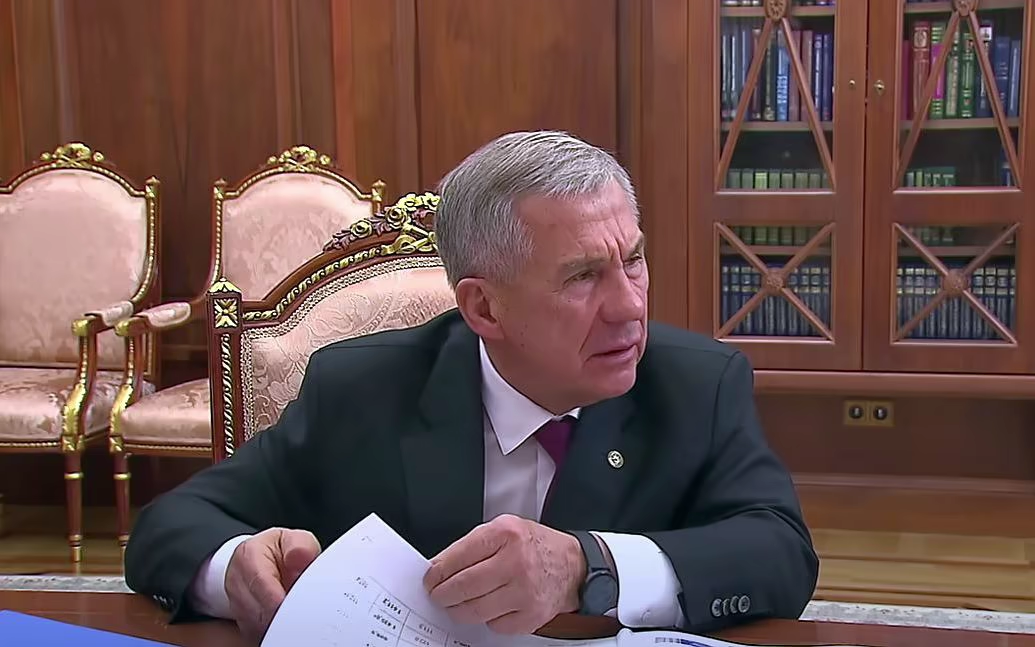
Moscow demands a more serious involvement in the criminal war. Through the Kadyrov and Minnikhanov clans, the Kremlin also solves additional tasks. For example, it restrains national feelings, the so-called “separatist sentiments.”
Also, they are tasked with building Moscow’s relations with the Islamic world. And in the case of the head of Tatarstan, with the wider Turkic world, through which the Putin system circumvents sanctions. Tatarstan is working in this direction with Kazakhstan, Kyrgyzstan, and, to a lesser extent, Uzbekistan and Turkmenistan, one way or another.
The so-called “Tatar clan” of Minnikhanov has its people in the Russian government. Marat Khusnullin, for example, and people in smaller ministerial posts. The “Kadyrov clan” also promotes its people, but it is also based on a force aspect, which the “Tatar clan” does not have. This clan is more sophisticated, intricate, and economically dense than Kadyrov’s.
Minnikhanov and Kadyrov, to some extent, form a tandem. They are friends, their villas and islands are located in the Emirates. They are neighbours there. And it is not a fact that in the event of the fall of the Putin regime, chaos and catharsis, these people will continue to serve Moscow. I am inclined to believe that the two of them can take advantage of the situation and perhaps take someone else with them.
Fears
I don’t believe that the majority supports the war in Tatarstan. I think there are about 30% of real volunteers. In the first wave, few people imagined what war was. Few people understood that the Ukrainians were putting up a serious fight back.
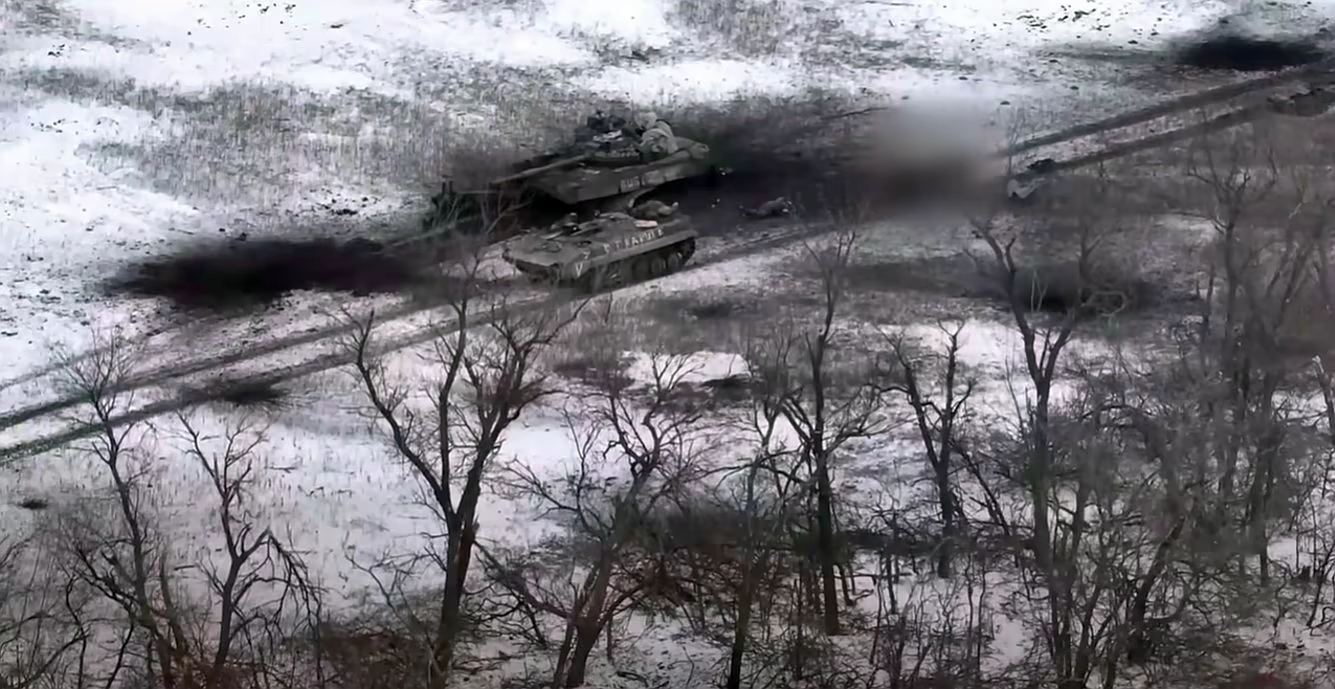
Everyone was told about an easy path, a blitzkrieg. But they (the “Alga” battalion – UP) were immediately defeated. The corpses, the remains of many of the dead, were received by their relatives a year or even more later. After they made a fuss, they began to board up the thresholds.
By the way, that commander with the call sign “Shaitan” (Timur Abdurakhmanov from the “Alga” unit – UP) is not an ethnic Tatar, although his surname is Muslim (Abdurakhmanov calls himself a Lezgin – UP). It was a great dissonance to see the mufti of Tatarstan blessing all this (the invasion of Ukraine – UP), while a man with the call sign “Shaitan” was standing next to him.
This is proof of what a vile public this is. They don’t even reflect on how all this looks from the outside. They are sent to fight, telling them that this is a jihad. But these people are led into battle by Shaitan – Satan.
Sociology during war is an extremely uncertain thing. Tatarstan people are intimidated; they are in a psychologically difficult state due to high losses at the front. The general atmosphere of depression has reduced political activity, protest sentiments in the republic to practically nothing. All who could resist have either been arrested or left. Others are silent because they cannot challenge the system.
Nobody publicly speaks out against the war. But in informal conversations, the attitude towards it is rather negative. In addition to the fact that Tatarstan has suffered great losses, people see that Putin has taken advantage of this war to put pressure on the republic, on other nations.
Muslims in Russia were already “internal enemies,” and now this trend is only intensifying. Moreover, Russian society generally supports the pressure on Muslims, considering them foreigners, not their own.
With this war, Moscow is also solving a very important problem for itself – it is deliberately depleting the population of the national republics. The Kremlin is really afraid that in the event of a crisis, the system will start to collapse again, as in 1917 or 1990–1991. Moscow wants there to be no martyrs in the regions if a revolutionary situation arises.
Moreover, all this helps the Kremlin to strengthen the ideology of the “Russian world” within the regions. Now this is happening openly – they are abolishing everything national and religious, everything that is different from Orthodoxy.
The recent conflict between Alauddinov (commander of “Akhmat” – UP) and the Orthodox abbot is indicative (meaning the speech of a priest from the Russian Orthodox Church, after which Alauddinov called him “a moron in a cassock” – UP). Muslims are openly told that they cannot gather for prayer because they “will go and slaughter Muscovites if they receive an order”. Muslims are called a threat because they are mobile, organized, and ideologically strict. Moscow is not satisfied with this and is very scared.
“Orthodox land”
About ten years ago, there was an Orthodox Metropolitan Anastasius in Tatarstan – absolutely loyal, integrated into the Tatarstan vertical. A known homosexual (some priests spoke about this and reported it to the media – UP).
Anastasia’s obedience to the Minnikhanov clan did not please Moscow. It organized a series of provocations with the burning of churches, blaming them, naturally, on Wahhabi Muslims. Immediately, instead of Anastasia, Metropolitan Feofan was sent. This is a “GRUShnik” who was a special envoy in Palestine.
When he came to Kazan, he immediately started saying that this was an Orthodox land. He began to pursue an aggressive policy, could not stand Covid and died in 2020. But this policy of the ROC in Tatarstan continued.
When the construction of the Orthodox Cathedral of the Mother of God was completed in the centre of Kazan (destroyed in 1932, restored in 2016–2021 – UP), the local authorities wanted to somehow “balance” it. They proposed building a mosque so that the cathedral would not dominate in an architectural and ideological sense. But Patriarch Kirill Gundyaev did not allow this idea to be implemented.
Practically everything the Orthodox Church wants is done in Tatarstan. Anything that is not done causes a wild outcry from Moscow. Accordingly, Muslims are being driven out.
The Tatarstan government is trying to maintain a balance on this issue, but not out of great love for the people, but because they understand perfectly well that they could lose political resources and power.
In Tatarstan, with a population of four million, there are many Russians – 40%. Most of them are, after all, immigrants. After the capture of Kazan (in 1552 – UP), the Tatars were forbidden to settle near it and along the banks of the rivers. And the immigrants were given great, fertile lands and very advantageous places from a logistical point of view.
But gradually the Tatars regained theirs, because they are more viable (viable – UP) , organized. And all these areas that were inhabited by these immigrants gradually shrank. These people entropize (deviations in the social behaviour of a group of people – UP), do not give birth, get drunk, etc.
The Russian Orthodox Church is very worried about the fact that Tatarstan is growing in numbers. There is a human migration – Tatars are coming to the republic from other regions and countries, and migrant workers who are co-religionists are coming. All this is very worrying for the Kremlin.
Remove Naberezhnye Chelny from the radar
Previously, no one could have imagined that drones would start flying to Tatarstan, which is located two thousand kilometres from Ukraine. This is causing concern in the republic, and in addition, they are afraid of sabotage there.
Adding to the nervousness among ordinary people is the fact that the agglomeration, which includes Naberezhnye Chelny and its satellite city of Yelabuga, has been populated in huge numbers by representatives of the special services. They are increasing pressure on the people, stopping the “talkers in the ranks.”
It should be taken into account that Naberezhnye Chelny has always been considered a fairly free city. People from all over the USSR, including Ukrainians, came there. A peculiar mentality developed there. The Tatar national movement was once based in Naberezhnye Chelny, because the people there are more passionate and stronger in the sense of protest, and have greater potential.
Naberezhnye Chelny is much more serious than Yelabuga in an industrial and logistical sense. It seems to me that Yelabuga is being specially highlighted (in the media – UP) to overshadow Naberezhnye Chelny, as if to remove it from the radar.
Production (of drones and other military products – UP) is set on a grand scale in Tatarstan. As you know, citizens from other countries were invited to Yelabuga, Cameroon, for example. But huge problems arose with them. These people turned out to be not entirely disciplined, and crime also appeared – all these drug cases and so on. Everything happened in a boogie-woogie mode, which, of course, did not suit the Efesbesh public.
I do not exclude that these workers could be replaced by North Koreans. They are expanding their production line there; there are already several modifications of drones. North Koreans are more compliant, obedient, and responsible than Africans.
Turan
75% of all resources and income Tatarstan gives to Moscow. There were studies: in the 1990s, Tatarstan residents could live better than the residents of Kuwait. The republic has not only oil, but also industry, a scientific base, and convenient logistics. One can only imagine how Tatarstan could live without Moscow’s participation.
But I am not a supporter of talking about Tatarstan only as a piece of land, where only 23-24% of all Tatars, who are scattered across the vast territory of Eurasia, live. In fact, Tatars are a large people, the second largest in Russia, the heir to the Golden Horde, and so on. The Tatar project is much more significant than just Tatarstan. Tatarstan is a piece of the puzzle, and considering it separately, in my opinion, is wrong.
The question needs to be posed more globally. I’m exaggerating a bit, but the strait between the Eurasian mainland and Sakhalin Island is called the Tatar Strait. We need to talk about a confederation of all Turkic peoples, about their unification.
In Russia, which positions itself as an Orthodox country, and where the national Tatar identity has been practically destroyed, there is now an attack on religious identity. This is very serious because in the end, the question will arise about the last battle, the jihad against the invaders and usurpers.
I believe that Islamic religious identity will prevail over national identity (among Tatars and Turkic peoples – UP).
The aggressor has more forces than we do, and all our hopes are tied to the crisis (in Russia – UP). But we cannot wait for a crisis all the time. We must act ourselves, expand the space for protest and collaboration.
We see a growing momentum towards the unification of the Turkic peoples. There is the Organization of Turkic States, which emerged on the basis of the Turkic Council, where Turkey plays a leading role. A lot has been done in the last twenty years: the integration of education systems, the development of a single alphabet, and the pursuit of unified army standards.
In parallel, at the level of the Turkic peoples, grassroots unifying processes are underway. These people together can be a self-sufficient force in a vast space. I am a supporter of the idea of Great Turan, and it does not necessarily have to be ethnic. Turan is the former nomadic peoples, various protest peoples who fought against the empire.
It is about creating, relatively speaking, an analogue of the EU. The total GDP of this Turan is three trillion dollars. Also, a growing population, excellent demographics, untapped markets and natural resources. If we give this dynamics, we will be able to see the result soon.
Some five to seven years ago, people who talked about the unification of Turkic peoples or about Turan were called dreamers. Now this idea has acquired the necessary outlines, including political ones.
Yevhen Rudenko – UP
Українська правда





