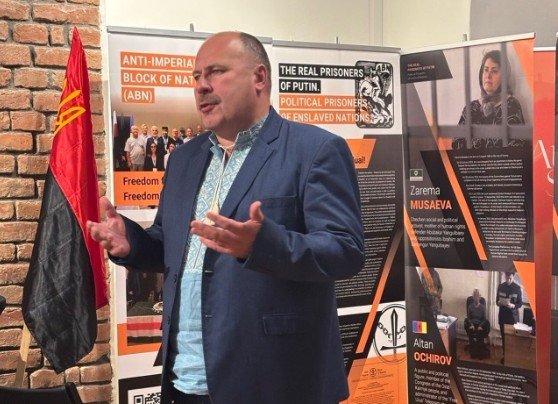

On the second day of work within the framework of the Crimean Week in Brussels, the First Deputy Chairman of the Mejlis of the Crimean Tatar People, Nariman Dzhelal, addressed the deputies of the European Parliament.
Celal began his speech by mentioning Hatice Buyukcan, a girl who disappeared in Crimea on 6 May of this year and was later reported to have been detained by the occupation authorities, but her family still cannot determine her exact whereabouts. He noted that this is just the latest example of illegal detention aimed at intimidating Crimean residents, of whom there have been hundreds during the years of occupation.
“Crimea has been occupied by Russia for eleven years. For eleven years, no citizen of Ukraine in Crimea has been able to feel safe and be confident that, if necessary, they will be able to protect their rights, freedoms, and lives. The residents of Crimea are forced to live in an atmosphere of fear and suspicion, a crisis of trust in each other, and are forced to act against their will under pressure from the occupying authorities,” he said.
The Deputy Chairman of the Mejlis said that due to Russia’s actions, thousands of people were forced to leave Crimea, and those who remained on the peninsula are under constant pressure, and called, when talking about the status of the territories, to also think about the fate of the people:
“While thinking about people, we must also think about the territory, but as long as the Crimean land is under Russian occupation, the danger to the rights of Ukrainian citizens, their freedom and lives will remain. Political persecution will continue: forced disappearances, illegal detentions, searches and arrests. ”
The politician recalled that any recognition of Russian sovereignty over the temporarily occupied territory of Crimea is unacceptable, because such recognition would mean:
- First, a gross violation of fundamental norms of international law;
- Secondly, an attack on the sovereignty and territorial integrity of Ukraine;
- Thirdly, contempt for the inalienable rights of the indigenous Crimean Tatar people;
- Fourth, justification of all crimes committed by Russia in the temporarily occupied Ukrainian territories;
- Fifth, encouraging the policy of ethnocide of the indigenous Crimean Tatar people;
- Sixth, creating a precedent of impunity for the aggressor.
“Do not let yourself be fooled. Russia will not be satisfied with just Crimea. Since 2014, it has controlled the territory of the peninsula, but in 2022, it launched a full-scale war against Ukraine. Because its goal is all of Ukraine. Therefore, the only way to end the Russian-Ukrainian war, establish a guaranteed and just peace is the de-occupation of Crimea and other occupied territories and the restoration of the territorial integrity of Ukraine within its internationally recognized borders. Any other options are a threat of new suffering for millions of people, in particular, for the Crimean Tatar people, whose fundamental rights have been grossly violated for many years. At the same time, any agreements on the status of Crimea should be adopted only with the participation and consent of the Ukrainian state and the indigenous Crimean Tatar people,” Nariman Dzhelal addressed the members of the European Parliament.
At the end of his speech, he recalled the total deportation of the Crimean Tatar people in May 1944 and that as a result of this crime by the Soviet authorities, 46% of Crimean Tatars died – mostly elderly people, women and children, and called on other European countries to join in establishing justice – and to adopt an appropriate decision to recognize the deportation as genocide of the Crimean Tatar people.
The event was attended by MEPs Thijs Reuten, Tobias Cremer, Villy Søvndal and Boguslav Gertruda from the European External Action Service, Head of the Ukraine Relations Group. The Ukrainian delegation was also represented by Olga Kuryshko, Permanent Representative of the Presidential Delegation of Ukraine to the Autonomous Republic of Crimea, and Olga Skrypnyk, Chair of the Board of the Crimean Human Rights Group.