

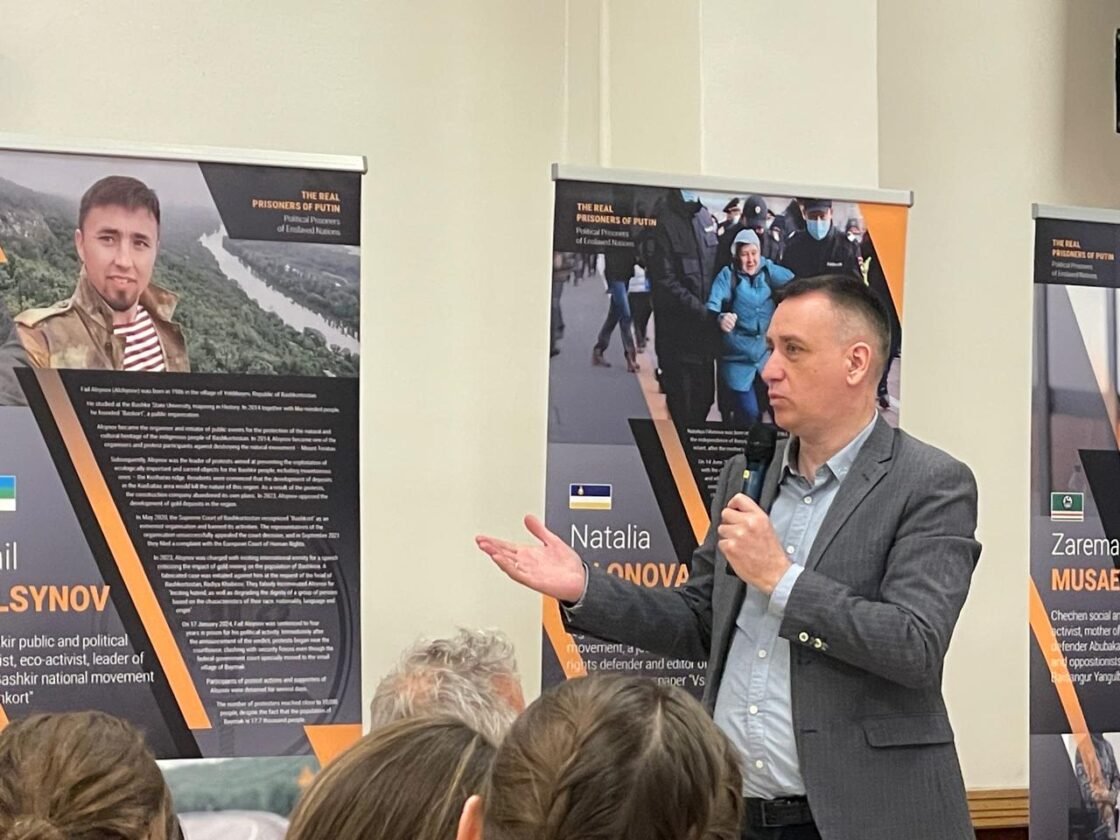
Dear ladies and gentlemen! Dear friends!
More than a year ago, together with partners of the Anti-Imperial Block of Nations, we prepared and presented the human rights project “Putin’s Real Prisoners: Political Prisoners of the Enslaved Nations”. As part of the project, we produced a thematic banner exhibition, which we have the honour to present to your attention today.
What was our goal? Firstly, to declare to the whole world a problem that almost no one knows or talks about – to reveal the names of political prisoners who represent the national liberation movements of the enslaved nations of the so-called “Russian Federation”, whom we consider to be real opponents of the Putin regime.
Secondly, we wanted to convey to the civilized world information about the scale of political repressions in Russia.
Thirdly, we received a mandate of trust from our partners in the ABN to become the voice of political prisoners who represent the national movements of colonised nations and who are unjustly convicted, in order to achieve their release.
Fourthly, we considered it appropriate to emphasize that Russia continues to remain a “prison of nations”, pursuing a cruel colonial policy against Chechens, Tatars, Kalmyks, Buryats, Bashkorts and other enslaved peoples.
And fifthly, it was important for us to explain to everyone that Russia is not a homogeneous, monolithic state. Hundreds of colonised nationalities live on its territory, who in the 21st century continue to suffer oppression on a national basis. Since we launched this human rights project, our exhibition has been seen by virtually the whole world. The USA, Canada, Germany, France, Italy, Spain and now, finally, Great Britain. Thanks to our project, citizens of these democratic countries saw a Russia they did not know and understood who Putin’s regime fears most. In addition to the Ukrainian army, in addition to the unity of our Western partners, he fears most of all the development of national liberation movements within the so-called “federation”.
This thesis is emphasised by the fact that during the existence of the ABN human rights project, only two of the political prisoners presented at the exhibition were released. All the others remain in prison. Moreover, new criminal cases are being fabricated against them. Moreover, new prisoners are being sent to prison.
For example, before representatives of the Altai people had time to speak out against the collapse of local self-government, their leader, Aruna Aruna, was thrown into prison. Protests in Siberia against the illegal seizure of livestock from the local population had barely begun when mass arrests of protesters began. And there are dozens, if not hundreds, of such examples. But, unfortunately, almost no one knows about them. Moscow propaganda skillfully hides information about political repressions. National liberation movements do not have the mass media through which they can convey truthful information about the violation of national and personal rights and freedoms.
That is why the Anti-Imperial Block of Nations, like our predecessors during the “Cold War”, has taken on a noble mission – to support the struggle of enslaved nations, train activists about their liberation movements, and protect their political prisoners. The exhibition presented to you presents the stories of the lives and hardships of ten of these freedom fighters. It also presents the stories of two Crimean Tatar activists and five Ukrainians, citizens of the so-called “Russian Federation”, who are subjected to repressions because of their ethnic origin. It is important for us not only that the entire civilized world learns their names, but that, thanks to international pressure from politicians, human rights activists, and the public, they get a chance to be released and, if successful, be exchanged for the West. Great Britain has good experience in protecting real political prisoners of the Putin regime. For example, recently, a well-known Tatar public figure, human rights activist, and head of the Government of Independent Tatarstan in exile, Rafis Kashapov, received British citizenship. This is a very indicative and successful case that must be used in the future to support freedom fighters.
Other democratic countries of the world should support Great Britain’s example, as they did during the “Cold War”, providing shelter to dissidents and fugitives from the Bolshevik “prison of nations”. The Anti-Imperial Block of Nations is ready to become a partner and mediator in this noble mission! Thank you!






