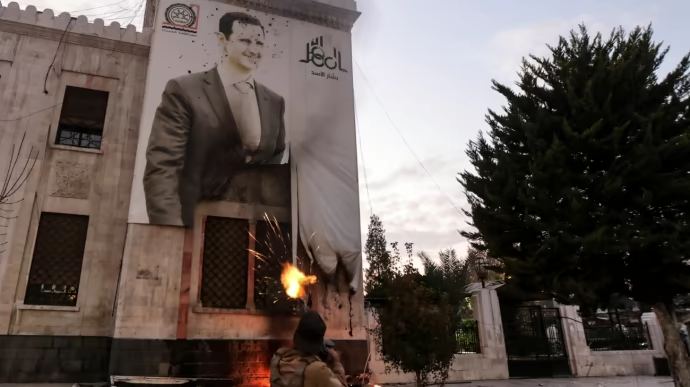
The Syrian rebels announced on the morning of 8 December that they had captured the Syrian capital, Damascus. The country’s President Bashar al-Assad is reported to have fled.
Source: CNN; Syrian Rebel Military Operations Command; Reuters; Associated Press
Quote from the rebels: “We declare the city of Damascus free from the tyrant Bashar al-Assad.”
The Damascus International Airport reportedly stopped receiving and sending flights.
Videos shared on social media depict dozens of people hastily moving through checkpoints and rushing toward exits in an attempt to flee the country.
Earlier, the rebels claimed to have entered the Syrian capital and taken control of the notorious Saydnaya military prison north of Damascus. In 2017, Amnesty International published a report stating that about 13,000 people had been hanged in Saydnaya.
“We broke the news to the Syrian people of liberating our prisoners and unchaining them, and announcing the end of the era of injustice in Saydnaya Prison,” the rebels said.
According to Flightradar, a Syrian Air plane took off from Damascus airport around the time the capital was seized by the rebels.
The plane was initially heading towards Syria’s coastal region, a stronghold of Assad’s Alawite sect, but abruptly made a sharp turn and flew in the opposite direction. A few minutes later, it vanished from the radar.
Updated: Syrian Prime Minister Mohammad Ghazi al-Jalali said that the government is ready to “extend a hand” to the opposition and hand over its functions to the transitional government.
For reference: The Syrian conflict involves the government forces of President Bashar al-Assad, backed by Russia and Iran, Syrian-Kurdish formations supported by the United States, and various rebel groups backed by Türkiye.
The front line in the Syrian conflict has remained unchanged since 2020, when government forces, backed by Russian aircraft and Iranian militias, regained control of most of Syria.
Background:
- The rebel offensive commenced on 27 November. On 30 November, the Syrian military confirmed that the rebels had entered the city of Aleppo. In response, Russia promised Assad additional military assistance to stop the rebels.
- On 3 December, anti-government armed groups in Syria approached the city of Hama.
- According to CNN sources, Assad likely fled the Syrian capital, Damascus. At the same time, Iranian officials and the Syrian government deny these reports, stressing that Assad remains in the country.
- On the night of 7-8 December, Syria’s main rebel group declared the capture of Homs, located north of Damascus. This followed two days after the capture of Hama, situated to the north of Homs.