

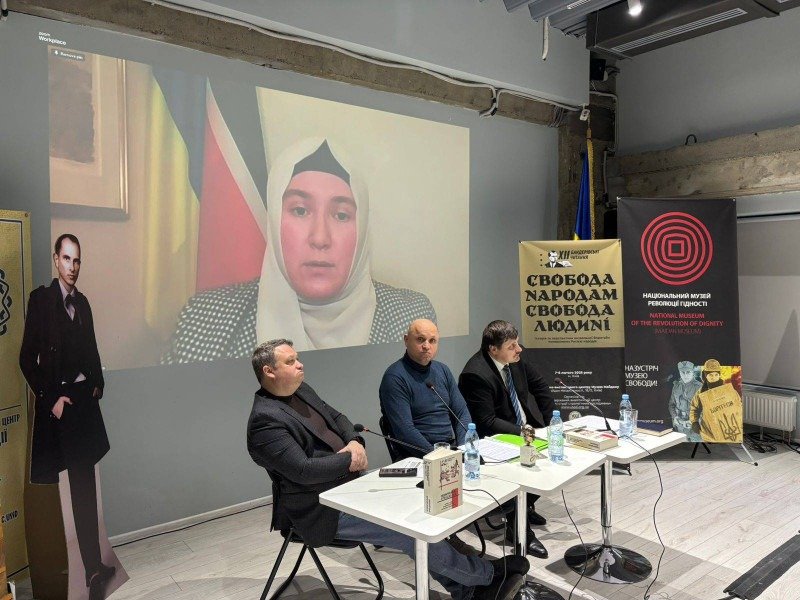
Topic: The role of education as a tool for the upbringing of a political nation and a means of training loyal cadres is one of the key characteristics of the liberation struggle to win freedom for future states.
Theses :
1. Socio-political characteristics associated with political activism and the formation of a demand for change among different educational groups in Russia.
2. The importance of obtaining a quality education for representatives of national liberation movements.
3. The politically educated generation lays the foundations for the subsequent stages of its evolution.
“I greet the organizers and participants of the XII Bandera Readings, where I have been given the opportunity to speak. Since many of us are graduates of the University of Free Nations.
Topic: The role of education as a tool for the upbringing of a political nation and a means of training loyal cadres is one of the key characteristics of the liberation struggle to win freedom for future states.
Theses :
1. Socio-political characteristics associated with political activism and the formation of a demand for change among different educational groups in Russia.
2. The importance of obtaining a quality education for representatives of national liberation movements.
3. The politically educated generation lays the foundations for the subsequent stages of its evolution.
“I greet the organizers and participants of the XII Bandera Readings, where I have been given the opportunity to speak. Since many of us are graduates of the University of Free Nations, created by the Anti-Imperial Bloc of Nations, I would like to touch upon and partially reveal the topic of education in our discussion panel. Namely: how education can become an instrument for educating a political nation and a means of training loyal personnel as key characteristics of the liberation struggle for winning the freedom of future states.
To begin with, I would like to briefly talk about the socio-political characteristics associated with political activism and the formation of a demand for change among different educational groups in Russia.
A similar study was conducted in 2021 based on the materials of an all-Russian survey organized by the Institute of Sociology of the Federal Research Sociological Centre of the Russian Academy of Sciences. The sample was as follows:
1. people with higher education and above,
2. people with secondary specialized or incomplete higher education,
3. people with a general secondary education, that is, they only attended school.
The hypothesis about the connection between education and interest in politics was confirmed. It turned out that people with higher education closely follow information about political events almost twice as often as representatives of the other two groups, and there are fewer of them who are not interested in politics.
Among people with higher education, the share of those participating in public and political life was also higher than in other groups of respondents. Here, the answers to such questions as whether respondents believe that they can influence the state policy as a whole, whether they take part in elections and human rights organizations; whether they are members of various public organizations, whether they discuss political events with friends, at work, on social networks; whether they participate in protest events (actions, rallies, public hearings, petitions) were taken into account.
However, the assumption that people with higher education are more oriented towards political changes and committed to the values of modernization was not confirmed. Therefore, the participation of highly educated residents in the political life of the country is rather formal. This result was predicted by an annual survey, which was conducted in 2003, which found out the proportion of Russians who believe that the country needs significant changes and new economic and political reforms. Here, the answers did not reveal a significant dependence on the level of education of respondents.
Secondly, the survey data were assessed, where respondents were asked to share their ideas about the desired future of the country. It turned out that, on the one hand, people with higher education were more likely to support human rights, democracy, and freedom of expression (although the percentage difference with the responses of representatives of other groups was insignificant). On the other hand, they were more likely to support a strong government, the preservation of national traditions, and moral and religious values that have stood the test of time.
Based on the results of a sociological survey on the formation and articulation of political sympathies and antipathies, a general conclusion was made: Russian professionals, highly educated Russians, are almost no different from less educated ones.
In general, this sample has the right to exist, but the Russian Academy of Sciences will never talk about the real cause-and-effect relationships of such results. First, I want to highlight the fact that in Putin’s Russia, the institution of education has lost its true purpose and value. Many commercial institutions have appeared, filled with countless psychologists, economists, and lawyers, who have not even mastered their profession to the proper degree, not to mention the creation of a socio-political environment in such higher educational institutions, where models for involving the new generation in social processes could be formed and they could demonstrate their subjective position in politics. And even on the contrary, universities were lobbying for pro-government narratives among the new generation. The deficit of subjectivity is what primarily affects the belief in the possibility of qualitative change in various situations in life.
Also, the demonstrative suppression of opposition unrest did not make the direct involvement of “professionals” in the practices of political and social participation attractive and was pulsating, representing their reaction to certain political events that seemed important to them.
Secondly, in the Putin era, as reasons for the lack of interest in participation in the political agenda of representatives with different education, it is worth noting apoliticism and general mistrust associated with the repeated bankruptcy of the authority of state structures before the population. The lack of conviction “due to influence on politics”, the change of power and the unjustifiably confident dominance of the “party in power”, and weak, semi-marginal flanks, etc. oriented people towards individual self-realization, who avoided participation in the socio-political life of the country. This concerns not only their participation but also their interest in political processes.
Residents with secondary education, the majority of whom are in the working class and the service sector, are increasingly alienated from politics and public life in general. Politics and political participation are not mechanisms for solving their life problems. This segment of residents with their low level of communicative resources, despite their difficult situation, do not consider politics from the point of view of realizing personal interests – it is important for them that someone in power improves their situation and determines social equality, while the share of supporters of political freedoms and democracy is high among young people (43%) and the educated part of society is higher (46%).
A certain difference between national republics and Russia is the presence of national identity in politics. What does this mean? It means that the identity of the people and the desire to preserve their native language, culture, tradition, and faith introduces the masses of people into politics and is a strong demand for change, regardless of education. Unfortunately, while the Republic of Tatarstan is formally a part of Russia, these demands for change are possible mainly not so much in everyday-regulated, but in extreme-protest forms.
2. The importance of obtaining a quality education for representatives of national liberation movements.
At this stage of the national liberation struggle, our main resource is proven, reliable people and their qualifications. Many do not have political, diplomatic, or even legal education, which in state building and institutionalization of state power is an important basis for continuing high-quality and responsible work, including at the international level. It is possible to improve the qualifications of members of national liberation movements by increasing investments in educational projects.
The implementation of the idea of independence of national republics is a large political project, which must necessarily include the training of personnel, their constant retraining, and even training.
For many years, Muscovy has pursued a policy of assimilating non-Russian nations into the Russian world, and at the same time, through propagandists, it has marginalized representatives of the national movement fighting for the rights of the Tatar people and the real sovereignty of the Republic of Tatarstan. Therefore, the protest forces in the Republic and concentrated abroad should not frighten Tatars who are not ready for fundamental changes with prejudices inspired by the metropolis but should strive to become an educated and intellectual force that can attract and bring new meaning to justice for the population.
As an indicator for analyzing the probable modeling of people’s behavior in the future, we can use the socio-political environment of modern Russia – when, when choosing between the government and the opposition, more than 50% of surveyed Russians prefer the government, even though support for the government is conditional. Only 13-15% of respondents during the final stages of the VTsIOM study declared their unconditional support for the government. The largest number of such people is among the elderly (16-21%), socially passive, and poorly educated people (18-27%). Support for the government by the rest is associated with inertia, a negative image of the opposition, fear of change, and not with a positive perception of the government itself as such. This means that political stability in the country can at any moment be replaced by instability – if a real vision of an alternative arises.
When the time comes and the centre weakens, the population of the republics will show themselves more and more actively – both in protest actions, in the strategic arena, and in various initiatives, which will lead to a steady heating up of political life in the republic, forcing one to recall the 1980s, or more precisely, their middle. Then, educated personnel brought up in the spirit of striving for the independence of the republic will be able to play a decisive role in the formation of the state. They will qualitatively determine the national domestic and foreign policy of the country, balance the economy, and stabilize the socio-political perception of citizens, an independent Tatarstan as a subject of international law.
3. The politically educated generation lays the foundations for the subsequent stages of its evolution.
Qualified members of national liberation movements in the context of new realities of aggressive geopolitics of Russia and as a result of its exclusion from international institutions, or personal withdrawal from international organizations, opens up the opportunity for leaders of national liberation movements to personally present their peoples in various international consultative organizations. In this context, for the competent construction and strengthening of international communications, the competitiveness of national organizations needs to be presentable through the prism of political education.
Having trained qualified personnel for state building conditionally “today”, we will be able to forget about the extreme shortage in independent Tatarstan of politicians in the future, whom society is ready to perceive as potential leaders.
In the conditions of political heating of the population in post-Russia, the main task of transitional governments will be to ensure the stability of the living political structure of the republic, effectively working state institutions capable of beginning to represent the interests of the people. Involvement of citizens in the processes of strategic planning of civic position, strengthening the interrelations of social communications, national and cultural identity, urban Internet platforms and a comfortable urban environment, as a space of communication between residents of different generations, political and ideological views, in the context of the implementation of social innovations in the development of a republic independent from Moscow, etc.
At the same time, politicians, including those educated abroad and having adopted the socio-political experience of democratic countries, will need to not only generate the acquired modern knowledge in the society of independent Tatarstan but also ensure its transfer to the national system of social development, forming a special nationally oriented legal, economic, technological, educational, social, cultural and intellectual environment of the future independent state.
Glory to Ukraine! Glory to independent Tatarstan! ”






