


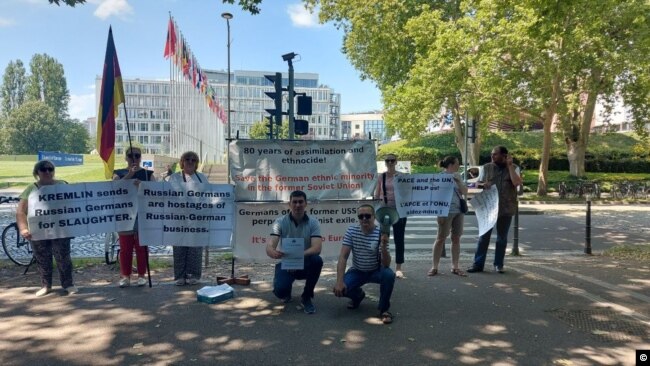
On Thursday, 27 June a group of nine Ukrainian Germans held a picket in front of the Parliamentary Assembly of the Council of Europe in Strasbourg.
The picketers unfurled posters with mostly English slogans. “The Kremlin is sending Russian Germans to slaughter,” “80 years of assimilation and ethnocide,” “Save the German ethnic minority in the former Soviet Union,” “Russian Germans are hostages of Russian-German business,” the posters read.
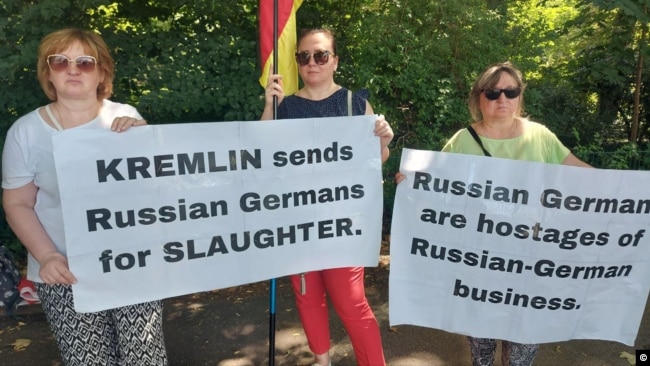
The participants of the action arrived in France from Germany, where they currently live. The picket was held across the street from the PACE building. The police prohibited the participants from holding a rally and unfurling posters directly at the organization’s headquarters or on the steps leading to it.
One of the organizers of the picket, the chairman of the Association of Germans of Ukraine Vyacheslav Bodrov (Redekop) told “Idel.Realii” that he and his comrades were forced to organize the action by the situation that is developing with the German minority in Russia. According to him, since the beginning of the full-scale invasion of the Russian Federation into Ukraine, several German organizations inside the country have been actively conducting anti-Ukrainian and anti-Western propaganda, and the Putin regime is recruiting Germans for the war. All this is happening against the backdrop of the gradual assimilation of the German minority.
— At this event, we once again showed the problem of Germans in the entire post-Soviet space. Russia has been fenced off from the Germans, and the Putin regime is leading them to slaughter. We appealed to PACE because this body has been monitoring the situation of Germans since the 1980s, first in the USSR, and then in the post-Soviet space. In 1994, they declared that Russia had embarked on a democratic path and promised to carry out rehabilitation. But for 30 years, nothing has been done, and the Germans continue to disappear — to assimilate, to die in the war for the “Russian world”. After the war, there will be no Germans left in Russia, — predicts Vyacheslav Bodrov.
A few days before the picket, Bodrov and his associates sent letters on behalf of their organization to PACE and several other German and EU structures — the Bundestag, the European Parliament, and the OSCE. The appeal (a copy is at the editorial office’s disposal) contains a call to “give Germans of the post-Soviet space and their family members the opportunity to receive refugee status with the possibility of integration in Western democratic countries.”
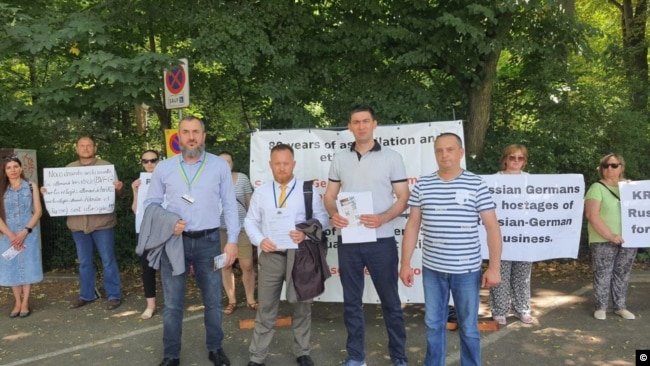
Interest in the picket was shown by the leader of the Chechen national liberation movement “United Force” Dzhambulat Suleimanov, who, according to Bodrov, organized a meeting of the picketers with the deputy of the Verkhovna Rada of Ukraine Yuriy Kamelchuk. The latter took a copy of the letter from the participants of the action, promising to hand it to the chairman of PACE.
According to Suleimanov, the problems faced by Russian Germans are also typical for other nations of Russia.
In a conversation with a correspondent of Idel.Realii, Vyacheslav Bodrov added that Russian Germans support the action of the Association of Germans of Ukraine, but some of them were unable to join the picket “for technical reasons”, and some, for one reason or another, “are afraid to speak openly about the existing problem.”
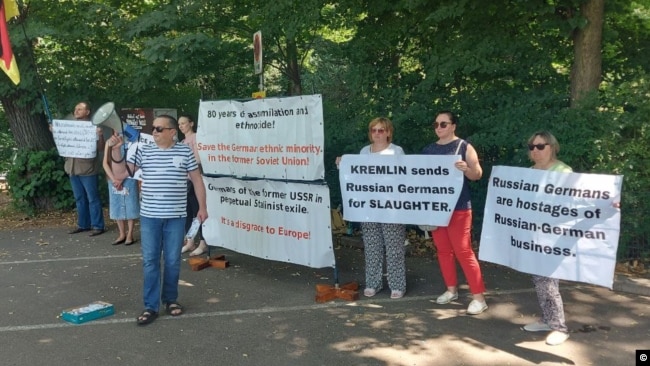
Bodrov intends to seek attention to the issue from Western democracies. In his opinion, officials in Germany are not making enough efforts to resolve the issue.
— For 30 years, Germany and Russia have not been able to solve the problem of Soviet Germans. This means that this is a problem for the entire world community, — the activist believes.
- At the start of Russia’s full-scale invasion of Ukraine, the media reported on the disproportionately high proportion of ethnic minorities that Russia was using in its war against Ukraine. This was pointed out, for example, by the FT. There are widespread media reports that the per capita casualty rate among ethnic minorities is much higher than among soldiers of Slavic origin, the publication wrote in mid-summer 2022.
Andrey Grigoriev






