

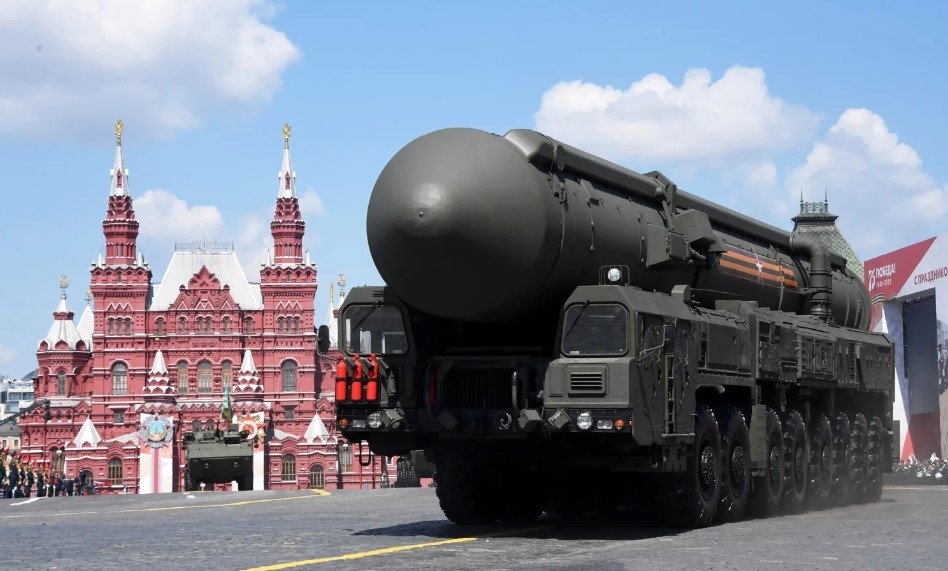
All people of good will must commend the Eighth Free Nations of Russia Forum for adopting the Zero Nuclear Weapons Post-Russia Pact which commits the countries that will emerge from the disintegration of the Russian Federation to not using or even possessing nuclear weapons. Such a declaration goes a long way to still the fears of those that the disintegration of the Moscow-centric state could, as some feared 30 years ago, lead to “a Yugoslavia with nukes” and thus opens the way for these emergent countries to receive the support they must receive from other states around the world. But unfortunately, the pact does not go far enough because it does not address a fundamental problem: given the attitudes of the current Russian government and its likely successor in the form of a state based at the center of the current Russian Federation, the Free Nations of Russia must recognize that the de-colonization of Russia requires the de-nuclearization of Moscow even before they achieve their primary goals. If that does not happen, it is not just likely but almost certain that those who currently possess these and other weapons of mass destruction will use them against any nations and regions who seek independence from the center – and that such use will trigger a broader war that will threaten the survival not just of them but of the world as a whole.
There are three compelling reasons for that conclusion:
First, while many who talk about the independence of regions and republics within Russia act as if there won’t be anything left of a Russian state, the likelihood is that even though most of the past conquests of that state will leave, a Russian state, albeit one much reduced in size, will remain and will seek to use the resources at its command, including nuclear weapons and other weapons of mass destruction, to recover some or all of what it had ruled. As I have argued elsewhere, that means that the approaching disintegration of the Russian Federation is likely to resemble what happened in 1918 rather than what happened in 1991 and this round of disintegration will end with some of those who are now confident that they will escape the embrace of the center not being able to.
Second, from the beginning of the Soviet state to the Putin era, officials have been willing to use weapons of mass destruction against their own population as against the Tambov uprising of workers and peasants at the end of the Russian Civil War or to talk about the use of nuclear weapons on their territory against any challenges. The recent suggestion of Russia Today’s Margarita Simonyan that Moscow should consider exploding a nuclear weapon over Siberia is only the most outrageous of these ideas. She said doing so would intimidate the West, but she clearly came up with the idea not on her own but because such things are being discussed behind the scenes in Moscow and because she and other Putin officials want to intimidate the West not just against supporting Ukraine but also against supporting any region or republic seeking to leave.
And third, such behavior would be absolutely consistent with the thinking of Vladimir Putin personally, a man who has often referred to his experience growing up of seeing how a cornered rat has to behave if he is to have any chance to survive. Putin and his supporters have invoked that image to justify aggressive behavior out of the belief that only by attacking first do they have the chance to survive – even though that analogy says more about them than about the realities of the situation they find themselves in.
There is no doubt that many in the West will see any discussion of these risks as one more reason not to rock the boat and seek the dismemberment of the Russian Federation. But many others, including officials in multiple countries, who now recognize that if a nuclear-armed country centered on Moscow remains, it will constitute a continuing and potentially mortal threat to the world, will see a recognition by those who seek independence from that imperial state as a compelling reason for supporting them. And moreover, by taking a stance in favor of the de-nuclearization of that state now, the free nations of Russia will not only make the prospects for their own success greater but will win them support among those in the West who also oppose such weapons, thus expanding the basis of support for those seeking self-determination from Moscow.
But there is an even more important reason for the nations and regions of what is now the Russian Federation to demand that Moscow de-nuclearize and it is this: Many advocates of independence for regions and republics within that country assume that the path forward is going to be easy. They often think that the end of the Russian Federation will be like the end of the USSR in 1991, a remarkable event in which no one came to the defense of that empire but rather allowed it to fall apart in a remarkably peaceful way. Such advocates of disintegration today are encouraged in such thinking by the far more numerous groups and political figures in the West who are supporting their rights than supported the non-Russian union republics in their quest for independence thirty years ago. There is no chance that there is going to be another “Chicken Kiev” speech in which an American leader will tell non-Russians, in the words of US President George H.W. Bush that “the pursuit of independence is a form of suicidal nationalism.” However, that does not mean that there will be the kind of support they need to succeed. Indeed, there is an all too real risk that Western support of such groups will be sufficient to allow the surviving state in Moscow to label them pawns of the West but not sufficient to allow these peoples to achieve their goals, precisely what happened during the Russian Civil War and that allowed the Bolsheviks to restore much of the empire.
Realism requires that advocates of independence for the regions and republics now within the borders of the Russian Federation recognize these realities. The time for drawing maps of “a beautiful future” is over; the time for coming up with strategies to achieve them is at hand. And among the most important of these strategies is a common commitment to the de-nuclearization not only of themselves but in the first instance of Muscovy because the de-nuclearization of any Moscow state is necessary for the de-colonization of Russia. Achieving that won’t be easy; but not seeking it will keep the long captive nations of Russia from achieving their entirely justified goals.
Paul Goble
Note: for a quick information search please subscribe to our Telegram channel “Freedom for Nations!” https://t.me/ABN_Freedom_for_Nations
Also, read the Facebook materials of the ABN page and the group
Our site: https://abn.org.uaen/






