FSB officers detained five Russians on suspicion of setting fire to a Ka-32 firefighting helicopter at the Moscow airfield in Ostafyevo. Among the detainees are residents of the Novosibirsk region, 22-year-old N. Bulgakov, 21-year-old S. Khamidullin, 22-year-old D. Yamskov and 19-year-old A. Mochalina from Norilsk, as well as 22-year-old R. Yakovets from the Rostov region.
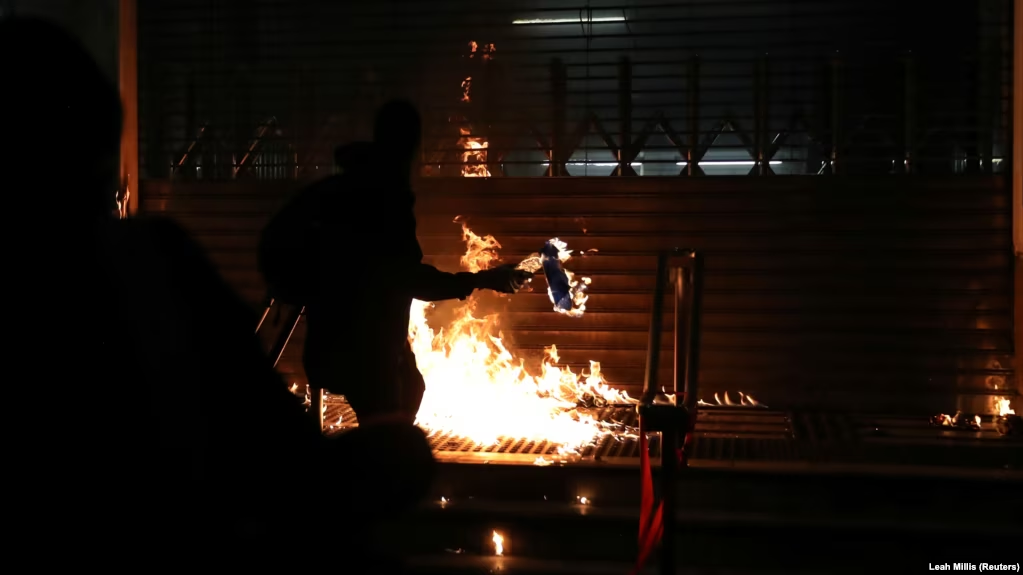
The fire at the Ostafyevo airfield occurred on the night of 26 April. The first footage of a helicopter belonging to the Moscow Aviation Centre burning in the parking lot was published by the Ukrainian media, citing data from the Main Intelligence Directorate of the Ministry of Defence of Ukraine. Then the information about the arson was confirmed by Russian publications, including the Zvezda TV channel, which is subordinate to the Russian Ministry of Defence.
According to the telegram channel Baza, which is close to the law enforcement agencies, and was the first to publish the list of names of suspects, at the scene of the incident, forensic scientists found a bag for replacement shoes, a litre bottle with the smell of flammable liquid, mounting equipment, barbed wire, a scarf and gloves. The Investigative Committee for Water and Air Transport opened a criminal case under the article “Terrorist Attack” (Article 205 of the Criminal Code of the Russian Federation).
Baza also claims that Bulgakov, Yamskov, Khamidulin and Yakovets allegedly admitted during interrogation, that before the Ka-32 was set on fire, they set fire to the relay cabinet at the Belorusskaya station in Moscow.
- After the start of the full-scale invasion of Ukraine by Russian troops, military registration and enlistment offices, police departments, state administration buildings and United Russia reception offices began to be set on fire throughout Russia, as well as sabotage on the railways. After the mobilization was announced, the number of such attacks increased many times over.
- No one was killed or injured as a result of the arson. Those detained on charges of attempted arson are most often charged with terrorism. More than 30 cases have already resulted in convictions, the most severe of which – 19 years in prison – was given to two anti-war activists for setting fire to the city administration building in the Chelyabinsk region.
- In 2023, almost one and a half hundred Russians became involved in 115 criminal cases of sabotage. Most of them are under 25 years old, a third have not reached adulthood. Three-quarters of the cases under investigation involve the arson of a railway relay cabinet containing train control equipment.
- On 24 April, State Duma deputy Vasily Piskarev announced the introduction of a bill providing for an increase in the sentence for sabotage crimes (Article 281-281.3 of the Criminal Code of the Russian Federation) to 35 years in prison. In addition, he promised to increase liability for the intentional destruction or damage of property committed “for reasons of political, ideological, racial, national or religious hatred or enmity” to 5 years in prison.