

After three years of a large-scale Russian-Ukrainian war, Moscow is demonstrating its economic stability to the world. They say that sanctions have not harmed us, the state is successfully ensuring both the war and the well-being of the population, and in general, we can fight as long as necessary.
Indeed, official statistics paint a surprisingly pleasing picture for a country that, as an aggressor under unprecedented sanctions, is waging the largest war in Europe since World War II. Defense spending is planned to amount to 7.2% of GDP by 2025, the budget deficit is set at a meagre 0.5% of GDP, and the state debt is 16.4% of GDP, which is even lower than in 2021 (17.6%). These figures are one of the pillars of the Kremlin’s negotiating position: either you agree to our terms today, or we will get our way later anyway, because time is on our side.
Machinations with Gazprom
In February 2025, American economist Craig Kennedy published a study that solves the mystery of the apparent stability of the Russian economy. He has long been among those who have questioned the veracity of the occupier’s official statistics. Kennedy admits that he got on the path to the answer by accident, while investigating the Kremlin’s efforts to save the national giant, Gazprom.
It is known that during 2022, Russia lost most of its revenues from gas exports to Europe. As one of the largest corporate borrowers in the world, Gazprom had a huge debt burden of $80 billion at the end of 2023. With revenues falling sharply, the company was at risk of default. However, Gazprom is too important to the Russian government to allow it to go bankrupt.
Instead of solving the problem using market methods (liberalization of domestic prices, reduction of the tax burden, etc.), the Kremlin decided to act unconventionally. Officials allowed Gazprom — essentially an insolvent company — to borrow even more money. Since the end of 2022, the gas giant has placed bonds worth ₽1.4 trillion ($15.8 billion) on the domestic market. Without a doubt, such transactions could not have taken place without state intervention, because no borrower would take the risk of lending to a corporation in a pre-default state.
The funds received by Gazprom are essentially hidden government spending that is not reflected in the budget. Instead, these funds end up on the company’s balance sheet, regardless of whether the transaction is in the government’s interests.
Hidden off-budget costs
The revelations about Gazprom prompted Kennedy to investigate the behavior of the Russian corporate lending market. Data from the Central Bank of Russia (CBR) confirmed the correctness of the guesses: starting from 2022, the debt of Russian corporations has shown astronomical growth. From July 2022 to November 2024, they borrowed ₽36.6 trillion ($446 billion) from banks.

Chart 1. Total debt of the non-financial sector of Russia (adjusted for inflation, converted to a base level of 100). Source
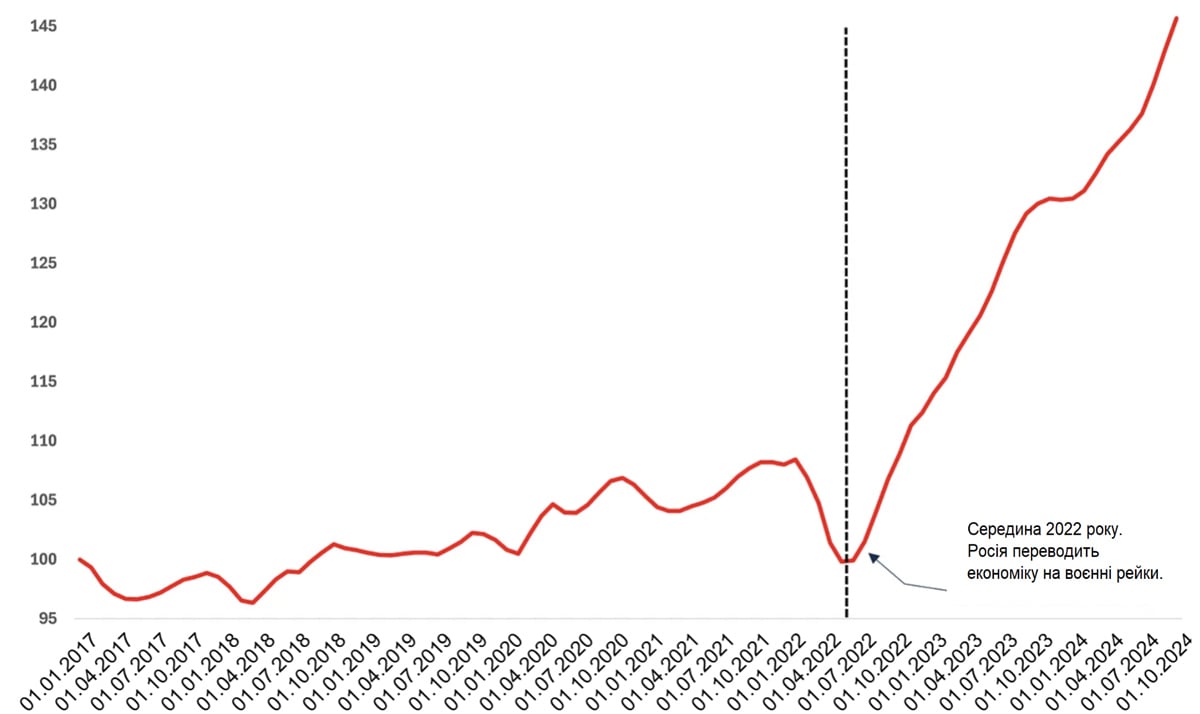
This amount is more than double the defense budget, seven times the state borrowing over the same period. Moreover, the trend coincides in time with the moment when Moscow realized the impossibility of a quick victory and the need to put the economy on a war footing (shown in the graph by the dashed vertical line).
The question arises: how to prove that the explosive growth of companies’ loan portfolios is actually related to the state’s attempts to finance the war in an extra-budgetary way?
This thesis is supported by data from industry analysis. The Central Bank classifies the economy into 78 sectors according to the OKVED2 system . These can be divided into 4, which are the basis of the military-industrial complex (MIC); 11, related to the MIC; and the remaining 63, which have little or no relation to the MIC. The Central Bank data show that lending to 15 defense industries exceeded lending to other sectors by 2.7 times.
The most interesting thing is that the growth rate of corporate debt of the defense industries did not respond in any way to the increase in the CBR discount rate. Trying to curb inflation, the central bank raised the rate from 7.5 to 21%, which should have made loans too expensive. And so it happened, but only for peaceful industries. And the defense sector continued to receive preferential loans to ensure uninterrupted service to the army.
Origin of the credit scheme
The credit scheme mechanism is not new. Moscow has been using it since 2010.
Back in 2007, Vladimir Putin announced a program to rearm the Russian military, which was supposed to return Moscow to the “power of the Soviet era,” but with a smart and effective approach to investing budget funds.
However, after three years, the Kremlin realized that the program was failing: the goals set were too unrealistic, and there was a constant lack of funds due to corruption and poor management.
The government was faced with a dilemma: to continue implementing the program, it was either necessary to find more funds or admit failure and cancel it altogether. Of course, a sharp increase in budget expenditures would also be perceived as evidence of failure.
In the end, they decided to solve the problem by appealing to commercial banks. They were to provide loans to defense sector companies under state guarantees. In the offices, the strategy was called a credit scheme (Russian: «кредитная шхема»). However, the state guaranteed only the principal amount (body) of the debt, without assuming any interest obligations.
In the short term, the scheme proved effective. However, some borrowers soon became unable to pay their debts. Starting in 2016, the government had to honor its guarantee obligations to prevent the default of important military-industrial companies. It is clear that the state budget never included these expenses in the defense budget. However, the dissatisfaction of banks, which received a portfolio of bad loans at the request of officials, was growing: borrowers were in no hurry to pay off guaranteed debts, and receiving compensation from the state took a long time.
Despite the obvious problems, the Kremlin assessed the credit scheme as a fairly effective mechanism. This is evidenced by its simplification for the state during the stage of preparation for a large-scale war.
Since banks did not like to suffer losses due to bad loans, there was a need to develop a legal mechanism to force them to participate in the scheme. So, in December 2021, an absolutely authoritarian law was developed that gave the government the power to dictate the terms of lending to the defense sector, including loan amounts, interest rates, repayment terms, etc. Putin signed this law on the second day of the invasion — February 25, 2022.
The scale of hidden costs
The next question, after clarifying the military nature of the credit scheme, is its scope. Craig Kennedy has estimated the possible range; he has assumed that loans for the four main branches of the military-industrial complex are 100% off-budgetary; and that loans for the eleven auxiliary branches may be 50% to 100% defense-related. Accordingly, the range has two limits:
- minimum: 100% of loans for main industries + 50% of loans for auxiliary industries;
- maximum: 100% of loans for main industries + 100% of loans for auxiliary industries.
The result of the analysis is the following conclusion: the amount of loans for defense companies ranges from 72 (minimum limit) to 118% (maximum limit) of the defense budget for the period from July 2022 to November 2024. This means that Russia’s real war spending may be more than twice (!) higher than those indicated in official documents.
Adding these amounts to the government’s declared expenditures, we get a 6–7% of GDP deficit in the Russian state budget in 2023–2024 (while officially the deficit in 2024 was 1.7% of GDP). And if Moscow were to finance this deficit through state borrowing, the amount of state debt would increase by 2–2.5 times, compared to the summer of 2022.
Reflecting such indicators in official statistics would not allow Russia to pretend to be the standard of economic stability that is so important at the negotiating table today. However, abuses have already begun to lead to serious problems, which we will discuss below.
Systemic risks
In October 2024, the Central Bank raised the key rate to a record 21%, and its head, Elvira Nabiullina, called on the government to abandon aggressive preferential lending. Her arguments were based on two systemic threats: inflation and credit risk.
According to official statistics, inflation in Russia has been growing every month since the beginning of 2023. In March 2025, consumer inflation reached 10.3%. Previously, the central bank fought against price increases by raising the discount rate, but this tool is no longer effective for defense companies. Thus, the CBR literally blocks access to credit funds for peaceful enterprises, and preferential lending to the military-industrial complex continues to accelerate inflation.
However, the second risk is much more serious – credit. First, the defense sector, receiving huge loans, is able to repay them only if there is continuous income from state contracts. However, we already know that in Russia, corruption and general inefficiency of the bureaucracy often lead to insufficient funding. In addition, it is not known what will happen to these companies if the fighting ends, when the need for daily support of the front disappears and state funding ceases.
Second, the rest of the economy has found itself facing an unprecedented rise in the cost of credit. Either companies stop borrowing (investing) altogether, or they have to borrow at a higher cost, which significantly increases the risk of insolvency.
Third, banks find themselves in a situation where a significant portion of their clients fall into the category of potentially insolvent. Accordingly, literally all economic actors find themselves hostage to a situation where Russia seeks to realize its imperial ambitions, while at the same time inventing bizarre and dangerous schemes to hide the real state of affairs.
The danger of credit risk lies in its insidiousness. It is almost impossible to predict when an event will occur that will lead to the collapse of the entire system. This is much more dangerous than a gradual increase in inflation or a decline in GDP.
Time is not on Russia’s side.
Vladimir Putin seems to have finally begun to realize the scale of the problem. And he understands that the only way to fix everything is to significantly reduce defense spending. If in 2022 he said that “the state, the government will provide the army with everything it asks for,” then at the end of 2024 the rhetoric changed: “We cannot increase spending indefinitely,” he said in December at his annual speech at the Ministry of Defense.
Even if Russia drastically reduces defense spending, companies will still have huge debts on their balance sheets. The cessation of hostilities will only increase the risk of their insolvency. The state will have to attract enormous resources to save both the defense industry and commercial banks at the same time.
In addition, there are many other factors that could accelerate the decline of the Russian economy. First and foremost, we are talking about energy prices, the revenues from which provide about a third of Russia’s official budget.
In any case, against the background of the situation described in this article, Russia’s position at the negotiating table does not seem very confident. Putin should understand that time is not on his side. The worst thing that can be done in such a situation is to ease sanctions, restoring the Kremlin’s access to lost cash flows. What Putin especially wants is to unfreeze foreign assets: about $300 billion would partially help solve his credit problem.
Ukrainians should understand that the Russian economy is not as stable as Moscow is trying to show. Therefore, we must do everything to wait out its collapse with the least possible losses for ourselves.
Oleksandr Chupak, Head of Economic Programs at the Ukrainian Strategic Research Studies (USRS)
Тиждень





