

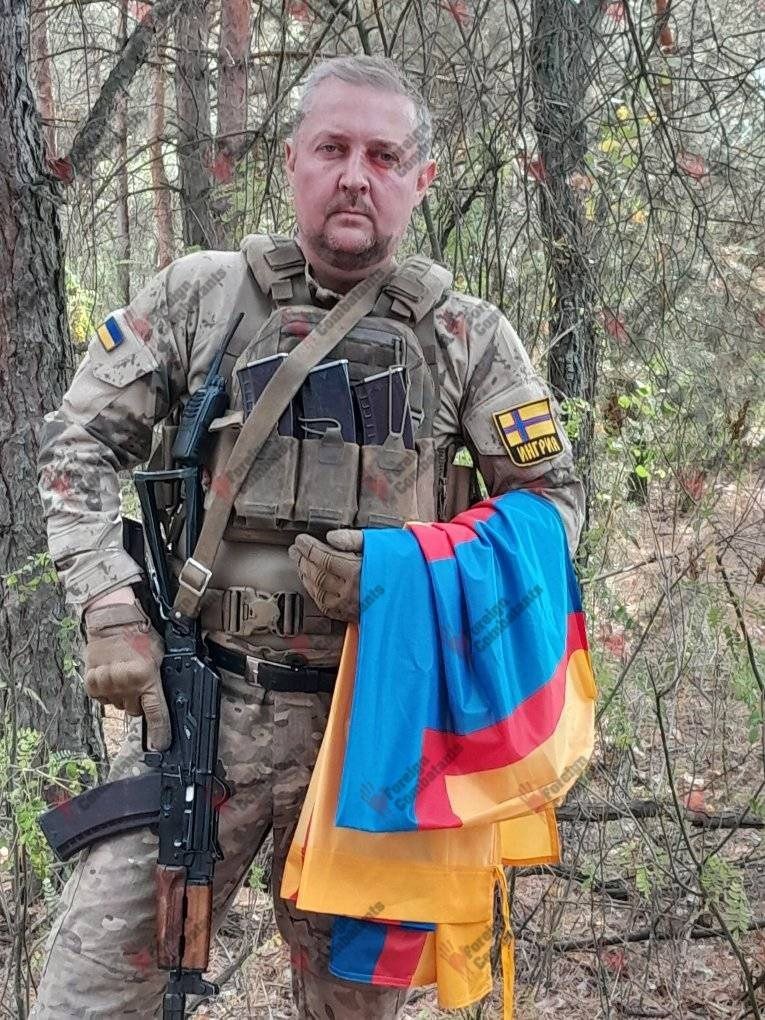
— Pavlo, first of all, I want to congratulate you on the birth of your son. I wish him to please his parents and that everything goes well for him.
— Thank you very much. I am sincerely grateful for the kind words.
— In what events have activists of the Free Ingria movement participated recently and what are your plans for the near future?
— After the start of the Russian-Ukrainian war, our main platform for communicating with foreign colleagues and experts is the Forum of Free Peoples and Regions of Post-Russia. We have been representing the Free Ingria movement there for the past three years. Additionally, we regularly participate in the Vilnius Forum, hosted by Garry Kasparov. Despite disagreements with some speakers, we highly appreciate his anti-imperial position and maintain working contacts. In the fall, we will again participate in the Forum of Free Peoples of Post-Russia. Traditionally, the Free Ingria movement delegation is the largest at the Forum, between five to ten people. The forum will most likely be held in one of the countries of Northern Europe. Also, a group of our movement coordinators has begun preparations for convening a founding conference of the socio-political movement “Free Ingria” to grant it official status. Until now, it has been a horizontal network movement, but now we see the need to create a legal entity for interaction with European and American politicians. This is impossible in Russia. We will do this in one of the European countries.
— Which regionalist movements in Russia, in your opinion, have the greatest potential for support today?
— It is currently extremely difficult to assess the real support in Russia for the ideas of regionalism (as well as all others). A totalitarian machine operates in the country, which “rolls any dissent into the asphalt”. If we talk about the prospects, then serious regional political forces, in addition to Ingria, may appear in Karelia, Kaliningrad, Tatarstan, Bashkortostan and Siberia. The independence movements in these regions have a history and political experience. When the central government weakens, the demand for regionalist ideas will be maximum.
— Let’s move on to the topic of infrastructure. How do you assess the importance of the port of Ust-Luga and other terminals in the Leningrad region for the Putin regime? Could blocking them cause a crisis?
— Absolutely. The port of Ust-Luga is the largest oil terminal, and Primorsk is the main gas port. Despite the reorientation of exports to China and India, it is Ingria (Leningrad region) that remains the key route for supplying oil and gas to Europe. These are critically important nodes, and the destruction of these facilities would be a serious blow to the Russian economy.
— St. Petersburg is a major centre of the Russian military-industrial complex. How vulnerable are the city’s defence enterprises to sanctions?
— Absolutely all enterprises in St. Petersburg and Ingria are vulnerable to international sanctions. But today, sanctions alone are not enough. Moreover, I do not hide it: the independence of Ingria will become real only in the event of a serious military defeat of Russia. The war must directly affect St. Petersburg, otherwise, its residents will not realise what is happening. Today, the majority of St. Petersburgers live a normal, peaceful life — war remains somewhere far away for them. This must change. It is the enterprises that work for the war, as well as the ports of Ust-Luga and Primorsk, that should first become the targets of military attacks.
— You are also known as a football fan. What does Zenit mean to you today?
— I have been a Zenit fan all my life, like my father and grandfather. In the 90s and early 2000s, Zenit was a symbol of the “uniqueness” of St. Petersburg, one might say, almost the “national idea of Ingria.” But since the club was owned by the state corporation Gazprom, the team has turned into a tool of Russian imperial propaganda, and the Zenit fan movement, fuelled by Gazprom’s leadership, has degraded terribly. Today’s Zenit is, unfortunately, a “zombie Zenit,” and its fans have turned into a branch of the Young Guard of United Russia. It is painful and disgusting to watch. I don’t follow the Russian championship now.
— How do you assess the fan movement today and the participation of its representatives in the war?
— The football ultras movement is, by definition, very passionate. And the authoritarian Russian government is trying to use this passion for its own purposes. There is the so-called “Espanyol combat unit” — an initiative of the Moscow ultras, where the backbone is made up of fans of CSKA, Spartak, and Dynamo. Not very intelligent Zenit fans also end up there, mostly as ordinary fighters. I regularly see news about ultras killed on the front, but it no longer evokes emotions in me. The fan environment in Russia today is completely controlled by the state. Recruitment is active, especially among young and passionate guys — my generation has long since left the fan movement, and the current one is completely under the control of the Kremlin authorities. It is very unfortunate, but such is the reality.
— Thank you for the frank conversation.
— And thank you, goodbye.






