

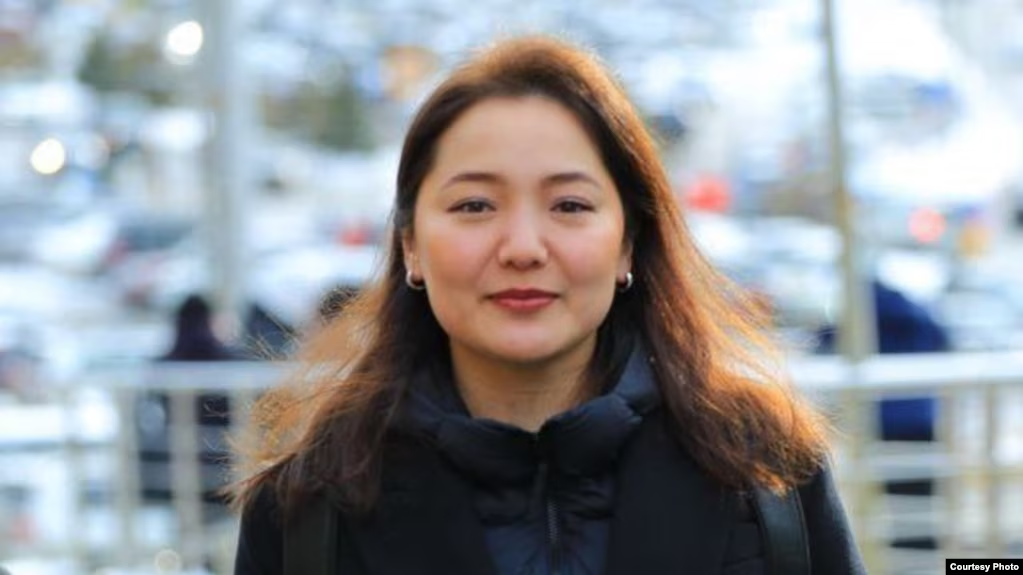
In an interview with Idel.Realii, Sakha activist Vilyuya Choynova discussed why she considers the independence of the Sakha Republic (Yakutia) an inevitable step, how Moscow’s policies threaten the languages and cultures of indigenous peoples, and how Siberian movements differ from those in the Caucasus. She explained that for the Sakha, resource wealth has become both a “curse and a blessing,” and that national activists, unlike “good Russians,” do not seek to rule other peoples but merely care for the future of their republics.
— Vilyuya, how long have you been involved in activism related to the protection of the Sakha people?
I’m an environmental engineer by profession, so I wasn’t really involved in eco-activism, but rather in environmental issues in the republic on a professional level. I only became involved in anti-war decolonial activism in 2022, after Russia’s full-scale invasion of Ukraine.
— Ethnic activists often have some kind of environmental agenda. Is this a case?
— Yes, definitely. All indigenous activists, national activists, as far as I know, everyone who came to anti-war activism, had already done something like this before. This usually involves eco-, linguistic, and cultural activism.

Confrontations on Mount Kushtau in the context of a new decolonial agenda
There are various activists, even organisations, who claim to defend the interests of the Sakha people. Is there a generational conflict within the Yakut national movement?
We don’t have fundamental differences like, for example, religion. And so, compared to others, I don’t think we have many differences. There are, of course, older people with more conservative views, but these aren’t such fundamental differences. [On this—everyday—level], perhaps they exist. Even in Finland, for example, there are such differences between generations. But I think that’s normal. We just need to talk to each other more.
You said the older generation is more conservative. However, among the nationalities living in Russia, in their national movements, it’s very common for the youth to be more conservative than the older generation. For example, this is often observed in the Caucasus. The younger generation there is more religious than those who lived a significant part of their lives during the Soviet period. So, if we’re talking about activists who lived a significant part of their lives during the Soviet period, and then there are those like you, I understand you’re more involved in activism in the post-Soviet period. Are there any differences in this regard among Sakha activists?
— Absolutely. However, I see now, for example, young bloggers who live in the republic, but they are pro-war, pro-government. They promote this narrative of “traditional values,” which is very patriarchal and conservative.

Gender researcher Ella Rossman: “For Russia to have traditionalism, there was no need to start a war.”
But among anti-war activists, for example, I don’t notice much of this. They advocate for the rights of indigenous peoples, but also for women’s rights, the rights of LGBT people, and all other vulnerable groups in society. So, yes, we do have differences. However, I would say it isn’t within the anti-war movement. [There are] those who promote the official propaganda of traditional values, and those who oppose the government, the regime, and what it [the government] is promoting now.

Active organisations of the peoples of the Volga region and Russia. What are they?
There’s a foundation called “Free Yakutia.” It positions itself as an anti-war, decolonial movement that envisages Yakutia as an independent, democratic state. The foundation’s co-founders are Syrgylana Kondakova and Raisa Zubareva. I looked at the foundation’s social media page and was surprised to discover that it covers a wide range of topics, including women’s rights. As someone from the Caucasus, this is quite unusual for me, because the national movement there is typically very conservative, and, accordingly, their rhetoric is similar. And in this sense, this foundation—I mean “Free Yakutia”—is quite different from those Caucasian movements. Do you feel that?
— Yes, absolutely. Well, first of all, [I’ll add], Sargalana Kondakova is a co-founder of “Free Yakutia,” and Raisa Zubareva was with them at the beginning, and now she’s organised her own movement. So, these are two different movements.
Yes, I certainly notice. I think these are differences between the Caucasian and Siberian republics. Very often, when I talk to foreign politicians, they constantly accuse us of being disunited, of being fragmented.
These differences exist among us; they have always existed, and probably always will. Therefore, trying to unite such different republics into a single movement is hardly possible. We are all fighting against the empire, against Moscow’s imperial policies, but at the same time, the Chechen Republic and the Sakha Republic have very little in common. I can’t speak for the Caucasian republics, of course, but here we promote themes that are inclusive for all of society. [We talk about] what kind of independent state we want to build: it should have a place for everyone. In the Sakha Republic, by the way, there is also a large Muslim population from Central Asia and the Caucasus. And there should be a place for all of them in our republic, in a free country. That’s what we are fighting for. So yes, of course, we must talk about the problems of all segments of the population.
Another point that really sets these movements apart: Yakut activists often view international activism as a key focus. You also participate in UN events. Do you think this is an effective form of struggle?
— I can’t say whether it’s effective or ineffective. For example, if we look at the war in Chechnya and the war in Ukraine, it seems to me that international solidarity plays a very important role in these issues. Chechnya, for example, didn’t have the same [solidarity] as Ukraine. Ukraine has the support of practically the entire world. And perhaps because of this, they continue to fight against such a huge country, which is many times greater than their forces. And for our republics, the lack of recognition is a problem. For example, even when we simply travel somewhere outside of Russia, everyone we meet (at least I do) says they’ve never heard of us. I’m the first person they’ve ever met from the Sakha Republic. And I think this needs to change.
We lived in secrecy and isolation for a very long time—practically all of Siberia, and probably the Caucasus too. Our advocacy goal is to change that and show that we, too, are democratic, that we can shape our own destiny, that we can determine our own country’s policies, and to do that, of course, we need to build connections. Now, we need to attend conferences, forums, and talk about ourselves, that we exist, and that we want to exist independently [from Russia].
Various Yakut activists, or Sakha activists, advocate for an independent Yakutia. If Yakutia were to secede, it would mean that Russia, the country, would be divided into two parts: Yakutia stretches across Siberia, covering the entire breadth of the country’s map. Clearly, Moscow will do everything it can to keep this republic. As Sakha activists, do you realise how crucial this will be for the Kremlin? I mean, keeping Yakutia.
“Yes, we are aware of this. Because, of course, the Sakha Republic is very rich in natural resources. It’s our, so to speak, ‘curse and blessing’ ( Idel.Realii ). They will definitely fight for us to the bitter end. But, for example, one of the recent PACE resolutions stated that decolonisation and the rejection of Moscow’s imperial policies are prerequisites for Russia’s democratisation.”
The first paragraph of PACE Resolution 2621 (2025) states, among other things: “The Assembly noted the ongoing forced Russification, repression, and discrimination against indigenous peoples and minorities in the Russian Federation, which constitutes a violation of the International Convention on the Elimination of All Forms of Racial Discrimination. The document concludes that genuine democracy in Russia is impossible without decolonization; it emphasizes that sustainable peace requires the Russian Federation to renounce its imperial ambitions; and it calls for the implementation of UN General Assembly Resolution 1514 (XV) (1960).”
And this, I believe, is one of the fundamental differences between the so-called “good Russians” and national activists. I’ll speak for myself. For example, I don’t see myself as the president of Russia, and I don’t want to rule all these nationalities. In my opinion, all national activists simply care about their republics and their well-being. And this already suggests that we, national activists, for example, have no imperial ambitions.
When “good Russians” say they don’t want their country to fall apart, they want a parliamentary republic, a confederation—whatever it’s called—for indigenous peoples, for example, nothing will change in the global sense. We will also be used as a resource. And we don’t want that, which is why we want independence.
“I looked at the statistics related to the Sakha people. The Yakut population has remained virtually unchanged between the last two censuses. Many nations are showing negative trends. How do you explain this?”
— I don’t know what years’ statistics we’re talking about.
— 2010 and 2020 censuses.
— Recently, I think it was a year or two ago, Aisen Nikolaev, the head of the republic, solemnly announced that the republic had reached its millionth resident. But I don’t really believe it, because we had a pandemic, then the historic emigration of indigenous peoples from the republic, and then the full-scale war in Ukraine. So I don’t think we have any definitive statistics that can be trusted. But I know that the number of migrants has increased significantly over the past 10 years. So, unfortunately, I can’t say why the Sakha population, as you say, hasn’t changed. Perhaps they [the authorities] are trying to keep the numbers more or less the same, to avoid anti-migrant sentiment. I often hear that all the indigenous people are leaving and migrants are coming in their place. Honestly, I don’t know.
— When discussing the problems of indigenous peoples, the issue of “exploitation of natural resources” is often mentioned. That’s precisely how activists phrase it. In the case of Yakutia, it usually refers to large-scale mineral extraction. You mentioned several of them today: diamonds, gold, gas and coal. Do the Yakuts themselves benefit from this?
— No, there are no dividends. ALROSA ( a Russian group of diamond mining companies, the world’s leading diamond producer. The corporation is engaged in exploration, mining, processing, and sales of rough diamonds. Its main operations are concentrated in Yakutia, as well as in the Arkhangelsk region and Africa — Idel.Realii) reports, for example, that they invest in the local population. They built Orto Doydu—a nature park. But this is simply smoke and mirrors, because the local population receives nothing. Until the 2010s, the indigenous population wasn’t even allowed to work shifts; they always hired Russians from the central regions.
Aisen Nikolaev even fought to prioritize the indigenous peoples already living in the republic. Only after that did they begin hiring local workers. We don’t see any benefits from the fact that all these resources are being extracted here. In the areas where natural resources are being extracted, they build infrastructure—roads—but as soon as the mines are exhausted, they close them and leave. And that’s it, no more investment, no more investments in these regions.
Researcher Anatoly Breslavsky points to migration from small towns. This impacts the traditional way of life and the preservation of the indigenous population’s culture. As someone from this republic, do you feel this is a problematic issue?
— Yes, it’s a problem. I’m from a village, and in my village this year there wasn’t a single first-grader because villages are literally dying, and everyone’s moving to the cities because there’s no work, no prospects. In Russia, they just call it “economically unviable” to support villages with, say, 100 people. I live in Scandinavia, and the mentality here is so different: here, everything is done for the people, while in Russia, it’s against them. How can anyone think that a village with a population of 100 is economically unviable, and therefore the entire budget should be cut and its residents should move to the cities!? Agriculture is widespread in our republics. That’s how villages have survived all these years. And it’s impossible to resettle all the villages to the cities; I simply don’t understand this policy. What will happen if they all move to the cities? And in the cities, there’s no housing or work for everyone.
“But there’s another problem. Villages usually preserve their language and culture, and when people move from the village to the city, they tend to lose them. And given that we’re talking about a relatively small culture—I’m talking about the Sakha people, a people of half a million—this is probably felt more strongly.”
— Yes, absolutely. Villages are what sustain culture and language. Plus, Russia only recognises as indigenous peoples those with a population of less than 50,000 and who lead a traditional way of life.
According to Russian law, indigenous peoples of the North, Siberia, and the Far East are defined as ethnic groups in the region whose numbers do not exceed 50,000. This numerical threshold is a mandatory requirement for official recognition. However, activists dispute this criterion, pointing out that it is absent from international documents.
That is, if they can’t maintain their traditional way of life and have to move to the city to survive, they lose their status as indigenous people. This is probably precisely why they’re doing this, to prevent indigenous peoples from defending their lands through legal mechanisms. And they [the authorities] are doing everything they can to ensure we lose our status as indigenous people. Because if we move to the city or even leave the republic and don’t fish or hunt, then we’re not indigenous and have no rights to our land. But we’re fighting against this, because an indigenous person will always remain an indigenous person, no matter where they live or what they do. We, too, deserve all the benefits of civilization. We don’t have to fish to feed ourselves. We, too, can go to the supermarket and buy food there.
What do you think is happening to ethnic groups in Russia? Many of them are losing their languages at an incredible rate: between each census, a very high proportion of the population is losing their language. It’s high even in the Caucasus republics, not just among the peoples who inhabit Siberia and other regions. Do you think this is just a coincidence, or is it a deliberate Kremlin policy?
“I’m sure this is a deliberate Kremlin policy, because first they made national languages optional. And now they’ve cut the number [of hours of study]. But it’s definitely a deliberate policy. They don’t want national republics. This is probably connected to the fight against separatism, firstly, and secondly, to make it easier to extract natural resources, eliminating the status of indigenous peoples here. And I think this will only get worse unless the regime or policies change.”
In January 2019, the Advisory Committee of the Council of Europe’s Framework Convention for the Protection of National Minorities criticised Russia for its nationality policies. The experts expressed concern about the “growing dominance of the Russian language” and the simultaneous “lack of effective support for minority languages.”
That same year, OSCE High Commissioner on National Minorities, Lamberto Zannier, stated in an interview with Idel.Realii that, according to his information, Tatars’ access to learning their linguistic culture remains quite limited even in Tatarstan itself, despite Tatar being the official language of the republic. The international official was surprised that the Unified State Exam (USE) is only taken in Russian in the republic, and is prohibited from being taken in Tatar, even if the student was educated in Tatar.
Previously, the Russian independent media outlet Takie Dela, citing experts, reported that the proportion of Russian schoolchildren studying in their native languages other than Russian had halved between 2016 and 2023. Instruction in 38 languages had ceased entirely. As the article noted, this situation was caused by a complex set of problems, including declining interest in native languages, a reduction in the number of lessons, a teacher shortage, and a rift with foreign partners due to sanctions.
According to the new curriculum of the Russian Ministry of Education, starting 1 September 2025, the subjects “native language” and “literary reading in the native language” will be taught in first grade for one hour per week instead of two; and in schools with a language other than Russian, the subjects will be taught for two hours instead of three.
— I have a traditional question for all our guests: what comes after Putin?
“I think that after Putin, Russia will disintegrate, and all the national republics will gain independence and build their own states in accordance with their own values. We shouldn’t all have the same future. If some republics want to unite into their own confederations, that’s possible. But this shouldn’t happen by force, but because we ourselves see benefits for our republics.”
Idel.Реалии





