

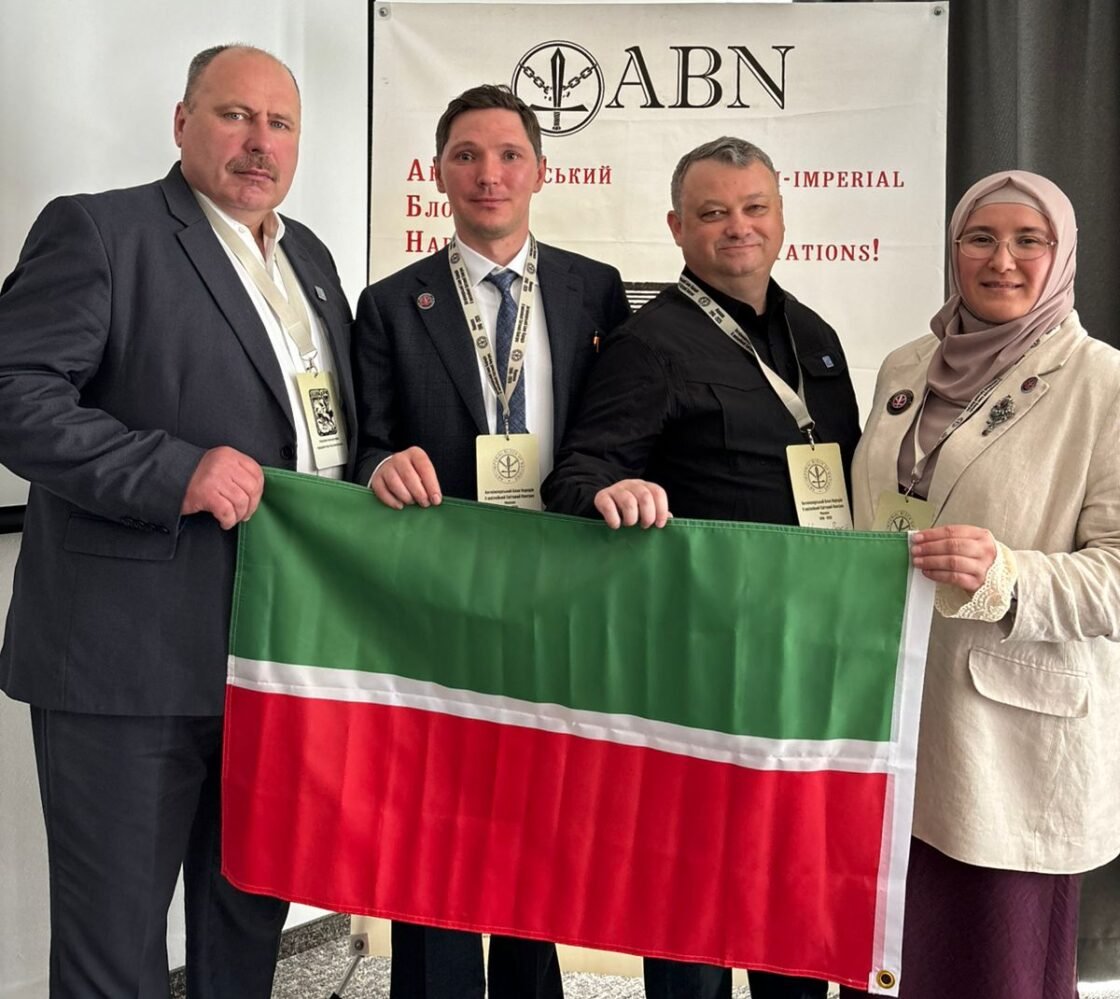

On 25 April, Munich hosted the Second International Congress of the Anti-Imperial Block of Nations (ABN), dedicated to the 80th anniversary of the founding of the Anti-Bolshevik Bloc of Nations.
Representatives of ABN committees from the United States, Canada, Sweden, Ukraine, and Germany took part in the Congress. The Tatar national movement was officially represented by Aida Abdrakhmanova, Head of the Tatarstan Independence Committee and Vice President of ABN, and Nikolai Bashmakov, a member of the Committee.

On behalf of all members of the Committee, the delegates welcomed participants, speakers, and guests of the Congress, and presented commemorative gifts — a letter of appreciation and one of the first branded T-shirts with the organisation’s logo, which will be added to the ABN archives.


In turn, ABN Vice President Aida Abdrakhmanova was awarded a commemorative ABN medal for her contributions to the organisation, as well as an original ABN postcard from 1951.


In her speech, Aida Abdrakhmanova emphasised the importance and symbolic significance of events dedicated to historically important organisations that opposed Russian imperialism and advocated for the freedom of nations. She outlined the Committee’s future course of work and its key principles aimed at achieving tangible results, including in the context of future changes in Tatarstan.

Nikolai Bashmakov presented proposals in the field of human rights activities, highlighted existing challenges, and called for more targeted assistance to those in need among their associates. He also proposed strengthening security measures and adherence to protocols in light of recent assassination attempts targeting representatives and leaders of national liberation movements.

Following the official ceremonial and discussion part of the Congress, delegates visited the graves of Stepan Bandera, Yaroslav Stetsko, and the prominent Chechen figure Abdurakhman Avtorkhanov.

Thus, during the Second International Congress, important and sensitive issues were addressed, initiatives and methods for their implementation were proposed and discussed, and a constructive and friendly working atmosphere was formed — one in which participants became not only colleagues but also brothers-in-arms against the “prison of nations — the empire of evil Russia.”


In the 1950s, Munich was already one of the key centres of Tatar political life: it was home to and a place of work for Gayaz Iskhaki, the ideological leader and chairman of the Idel-Ural State, and it was also where Radio Liberty was established, later employing his associates.
As a result of the Second International Jubilee Congress of ABN in Munich, the Munich Declaration was signed. It was also signed by representatives of the Tatarstan Independence Committee — Aida Abdrakhmanova and Nikolai Bashmakov. The text of the Munich Declaration was read by ABN Vice President Leontiy Shypilov.
Participation of the Committee for the Independence of Tatarstan in the ABN Congress and its future projects is viewed as a continuation of the involvement of Tatar national movement activists in the work of the Anti-Bolshevik Bloc of Nations of the 1940s and as a decisive step toward restoring Tatar statehood within international activity.


Information Department of the Tatarstan Independence Committee






